
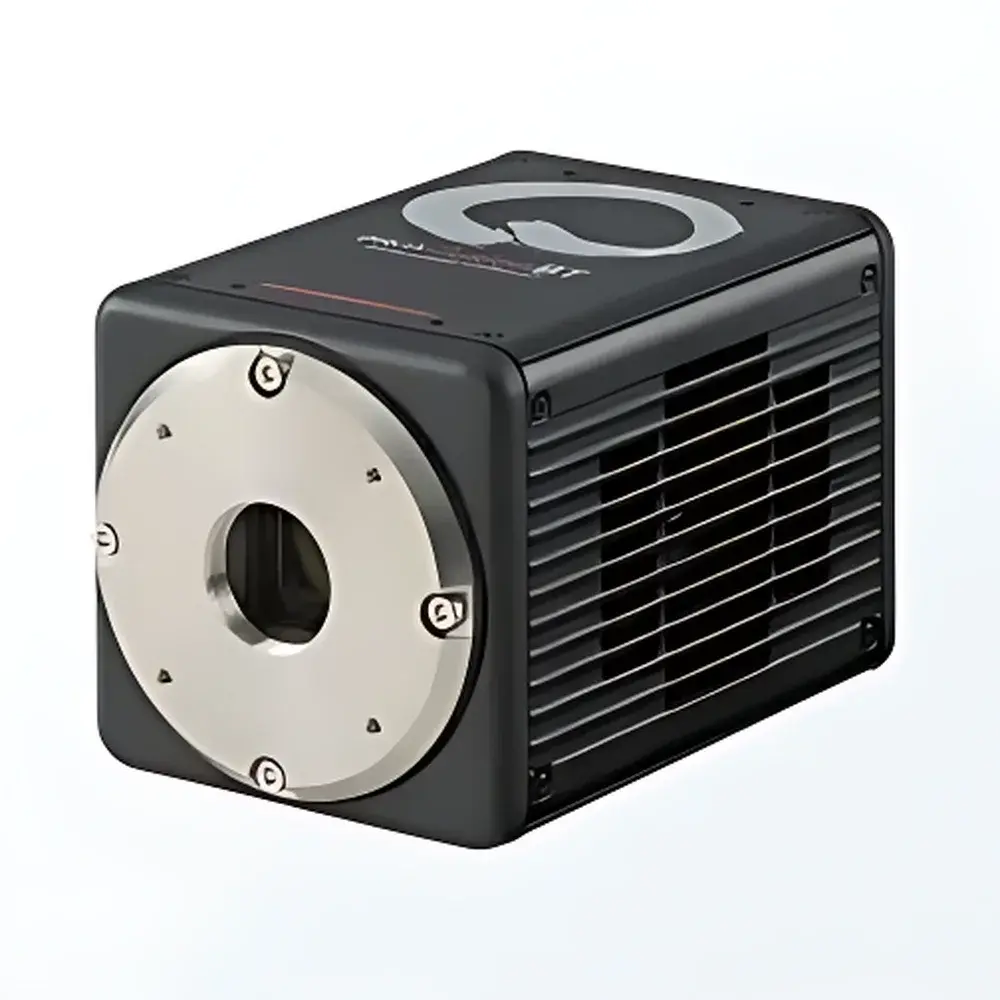
Hamamatsu ORCA-Fusion BT Back-Illuminated sCMOS Camera
| Brand | Hamamatsu |
|---|---|
| Origin | Japan |
| Manufacturer | Hamamatsu Photonics K.K. |
| Type | Imported Scientific sCMOS Camera |
| Model | C15440-20UP |
| Resolution | 2304 (H) × 2304 (V), 5.3 MP |
| Pixel Size | 6.5 µm × 6.5 µm |
| Sensor Format | 15 mm × 15 mm |
| Readout Speed | 89.1 fps @ full resolution (16-bit, Fast Scan mode) |
| Read Noise | 0.7 e⁻ rms (Ultra-Quiet Scan mode, typical) |
| Dynamic Range | 21,400:1 (typical) |
| Quantum Efficiency | 95% @ 550 nm |
| Bit Depth | 16/12/8-bit selectable |
| Interface | USB 3.2 Gen 1 & CoaXPress 2.0 (CXP-6) |
| Cooling | Thermoelectric (−15 °C stabilized, ΔT ≈ 35 °C below ambient) |
| Shutter Modes | Global and Rolling |
Overview
The Hamamatsu ORCA-Fusion BT (Model C15440-20UP) is a back-illuminated scientific CMOS (sCMOS) camera engineered for demanding low-light quantitative imaging applications in life sciences and physical research. Its monolithic, thinned, back-illuminated sensor architecture enables exceptional photon collection efficiency across the visible to near-UV spectrum (300–1100 nm), with peak quantum efficiency (QE) of 95% at 550 nm—surpassing conventional front-illuminated sCMOS and matching or exceeding CCD performance in uniformity and sensitivity. Unlike EM-CCD systems, the ORCA-Fusion BT delivers true photon-counting capability without multiplication noise, enabling linear, calibration-traceable intensity measurements essential for quantitative fluorescence, FRET, Ca²⁺ dynamics, and single-molecule localization microscopy (SMLM). The 15 mm × 15 mm active area supports wide-field optical configurations while maintaining diffraction-limited sampling at common microscope magnifications (e.g., 40×–100× oil immersion).
Key Features
- Back-illuminated sCMOS sensor: Optimized for high QE (>90% from 400–700 nm), minimal etaloning, and exceptional pixel-to-pixel response uniformity (≤0.5% RMS non-uniformity, typical).
- Ultra-low read noise: As low as 0.7 electrons rms in Ultra-Quiet Scan mode—enabling reliable detection of sub-photon-level signals without electron multiplication artifacts.
- High-speed acquisition: 89.1 frames per second at full 5.3 MP resolution (16-bit, Fast Scan), scalable to 12-bit or 8-bit for increased throughput in time-lapse or light-sheet applications.
- Three scan modes: Fast Scan (high speed), Ultra-Quiet Scan (ultra-low noise), and Lightsheet Scan (optimized line-synchronized exposure for orthogonal illumination geometries).
- Dual interface architecture: Simultaneous USB 3.2 Gen 1 (for ease of setup and compatibility) and CoaXPress 2.0 (CXP-6) (for sustained full-frame streaming at >1.5 Gbps bandwidth).
- Active thermoelectric cooling: Stabilized sensor temperature at −15 °C (ΔT ≈ 35 °C below ambient), reducing dark current to <0.5 e⁻/pixel/s (typ.) and ensuring long-exposure stability.
- No binning-induced nonlinearity: Native 6.5 µm pixels support hardware binning (2×2, 4×4) without compromising dynamic range or introducing fixed-pattern noise amplification.
Sample Compatibility & Compliance
The ORCA-Fusion BT is designed for integration into regulated and non-regulated laboratory environments. Its firmware and driver architecture support audit-ready operation under GLP and GMP frameworks when deployed with compliant data management systems. While the camera itself does not carry FDA 21 CFR Part 11 certification, its deterministic frame timing, hardware-triggered acquisition, and metadata-rich TIFF/ND2 output formats enable traceable image provenance required for ISO/IEC 17025-accredited testing labs. The device complies with IEC 61000-6-3 (EMC emission) and IEC 61000-6-2 (immunity) standards, and meets RoHS 3 and REACH material restrictions. Its sealed, dust-resistant housing (IP20) ensures reliability in controlled cleanroom-adjacent imaging suites.
Software & Data Management
Hamamatsu provides the unified HCImage Live software suite (Windows 10/11, 64-bit), offering real-time visualization, multi-channel time-series recording, region-of-interest (ROI) statistics, and hardware-synchronized multi-camera triggering. APIs are available for MATLAB, Python (via PyHamamatsu), LabVIEW, and Micro-Manager 2.0, supporting custom pipeline development for AI-assisted segmentation or real-time deconvolution. All acquired images embed EXIF-compliant metadata—including exposure time, gain, sensor temperature, timestamp (UTC-sync capable), and hardware configuration—ensuring FAIR (Findable, Accessible, Interoperable, Reusable) data principles. Raw 16-bit data is stored losslessly; no on-camera compression or LUT-based processing is applied by default.
Applications
- Widefield fluorescence microscopy with quantitative intensity calibration
- Live-cell calcium and voltage imaging requiring high temporal fidelity and SNR
- Spinning-disk confocal and lattice light-sheet microscopy (LLSM) with synchronized scan control
- Single-molecule tracking (SMT) and super-resolution modalities including PALM/STORM
- Optogenetic stimulation monitoring with millisecond-scale temporal registration
- Computational imaging workflows involving structured illumination or Fourier ptychography
- Quantum optics experiments requiring photon arrival time stamping and spatial correlation analysis
FAQ
What is the effective full-well capacity per pixel?
Typical full-well capacity is 30,000 electrons (at 16-bit gain setting); this value scales linearly with bit-depth selection.
Does the camera support hardware triggering with sub-microsecond jitter?
Yes—external TTL trigger input supports both rising- and falling-edge synchronization with ≤100 ns timing jitter relative to exposure start.
Can the ORCA-Fusion BT be used in vacuum or high-humidity environments?
No—it is rated for indoor laboratory use only (IEC 60529 IP20); operation outside 15–30 °C ambient and 20–80% RH non-condensing is not validated.
Is there a difference in quantum efficiency between USB and CoaXPress interfaces?
No—QE is a property of the sensor and optical stack; interface choice affects only data transfer latency and sustained frame rate, not photon conversion efficiency.
How is calibration performed for quantitative intensity measurements?
Hamamatsu provides factory-measured flat-field and dark-frame reference datasets; users may perform in-situ photometric calibration using NIST-traceable neutral density filters and stable LED sources.





