
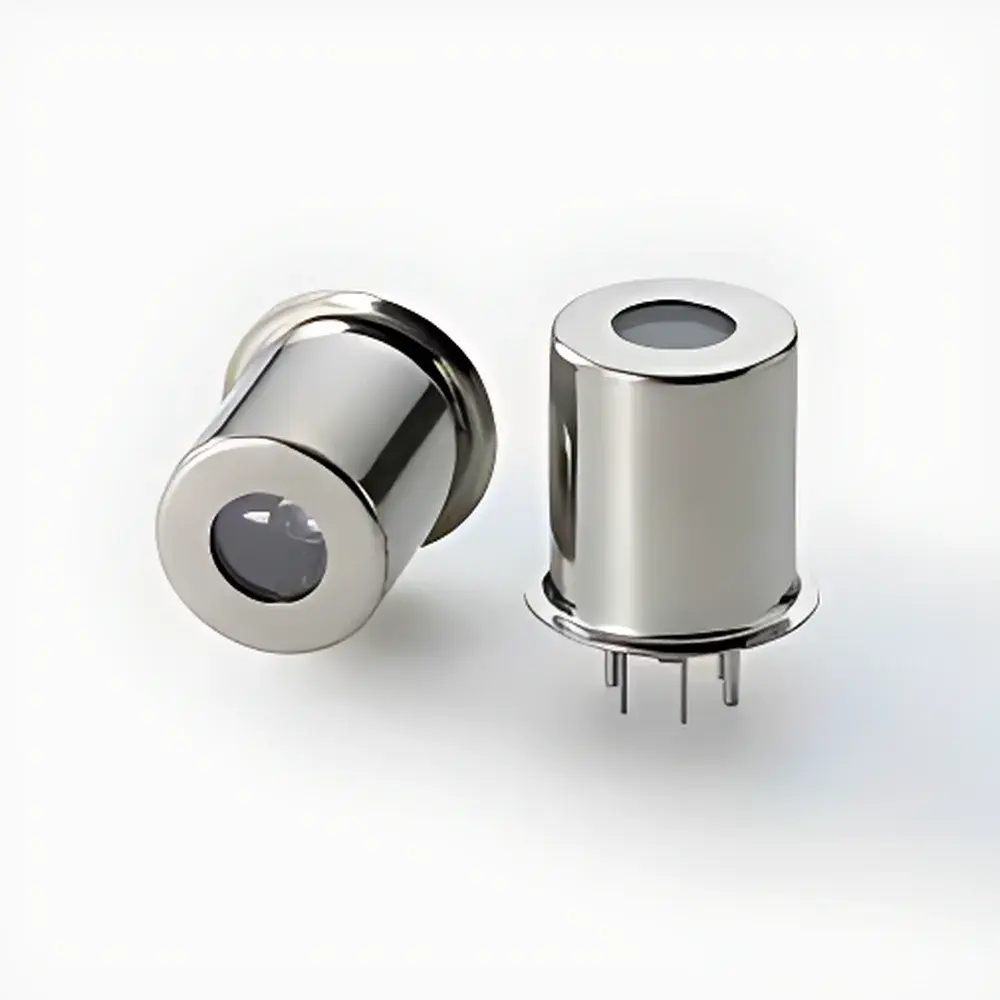
Hamamatsu L6604/L6605/L7684/L7685 60 W Pulsed Xenon Flash Lamp
| Brand | Hamamatsu |
|---|---|
| Origin | Japan |
| Manufacturer Type | Original Equipment Manufacturer (OEM) |
| Import Status | Imported |
| Models | L6604, L6605, L7684, L7685 |
| Light Source Type | Pulsed Xenon Lamp |
| Illumination Mode | External Irradiation |
| Stability (≥10 Hz) | ≤1.5% CV, ≤3.0% p-p |
| Lifetime | ≥1×10⁹ flashes (to 50% radiant output @ 190–1100 nm, under 975 V / 2.1 µF / 60 Hz) |
| Max Avg. Input Power (Continuous) | 15 W (active cooling required above this level) |
| Cooling Option | E6611 Water-Cooled Jacket |
| Trigger Compatibility | External TTL/CMOS |
| Operating Voltage Range | 300–1000 V (main discharge) |
| Capacitance Options | Standard 2.1 µF |
| Energy per Flash (typ.) | 1.0–3.0 J (configurable via V & C) |
Overview
The Hamamatsu L6604, L6605, L7684, and L7685 series are high-intensity, externally triggered pulsed xenon flash lamps engineered for demanding optical instrumentation applications requiring broadband spectral output (190–1100 nm), high peak irradiance, and exceptional pulse-to-pulse stability. Unlike continuous arc or LED sources, these lamps operate on a capacitive discharge principle—storing energy in a high-voltage capacitor bank and releasing it in microsecond-duration pulses across a sealed xenon-filled quartz envelope. This architecture delivers superior UV throughput and temporal consistency compared to DC-driven xenon arcs, making them ideal for time-resolved spectroscopy, absorbance-based quantification, and synchronized detection systems where signal-to-noise ratio and timing fidelity are critical.
Key Features
- Broadband Spectral Coverage: Continuous emission from deep UV (190 nm) through visible to near-IR (1100 nm), enabling compatibility with silicon photodiodes (e.g., Hamamatsu S1336-8BQ), PMTs, and CCD/CMOS spectrometers without spectral gaps.
- High Pulse Stability: Optical output stability ≤1.5% coefficient of variation (CV) and ≤3.0% peak-to-peak (p-p) when operated at ≥10 Hz repetition rate—critical for quantitative multi-cycle measurements in regulated environments.
- Extended Operational Lifetime: Rated for ≥1×10⁹ flashes before radiant output degrades to 50% of initial value under standard operating conditions (975 V, 2.1 µF, 60 Hz), supporting long-term deployment in automated analyzers and production-line QA systems.
- Modular Thermal Management: Designed for integration with the optional E6611 water-cooled jacket; mandatory for sustained operation above 15 W average input power to maintain envelope temperature below 150 °C and prevent quartz devitrification or electrode erosion.
- Flexible Electrical Configuration: Compatible with both internal and external main discharge capacitors—including the optional E7289-02 unit—allowing precise tuning of pulse energy (E = ½CV²) from 1.0 J to 3.0 J across voltage ranges of 300–1000 V.
- OEM-Ready Interface: TTL/CMOS-compatible trigger input with adjustable delay and jitter <100 ns, facilitating synchronization with high-speed cameras, gated detectors, or chromatographic fraction collectors in HPLC and flow cytometry platforms.
Sample Compatibility & Compliance
These lamps are routinely deployed in instruments subject to ISO/IEC 17025-accredited testing protocols and FDA-regulated workflows including in vitro diagnostics (IVD) and pharmaceutical QC. Their stable, reproducible output supports compliance with USP (Photometric Absorbance), ASTM E308 (Computing CIE Colors), and IEC 61000-4-5 (surge immunity for lamp drivers). The quartz envelope meets Class A UV transmission specifications per ISO 10110-7, ensuring minimal absorption artifacts in UV-Vis spectrophotometers. No mercury or hazardous heavy metals are used—fully compliant with RoHS 3 and REACH Annex XIV restrictions.
Software & Data Management
While the lamp itself is hardware-only, its integration into instrument control ecosystems follows industry-standard digital interfaces. When paired with Hamamatsu’s C13642-series lamp drivers or third-party programmable power supplies (e.g., Stanford Research Systems PS300), pulse parameters—including voltage, capacitance, repetition rate, and trigger delay—are controllable via RS-232, USB-VCP, or Ethernet (TCP/IP). Audit trails for operational settings can be logged in accordance with 21 CFR Part 11 requirements when hosted within validated instrument software (e.g., LabVIEW-based GxP-compliant DAQ systems). Firmware-upgradable drivers support GLP/GMP traceability through timestamped configuration snapshots and error-code logging.
Applications
- UV-Vis Spectrophotometry: Reference-grade light source for benchtop and portable absorption analyzers in environmental water quality monitoring (e.g., nitrate, COD, TOC) and atmospheric gas sensing (NO₂, SO₂).
- HPLC & Flow Cell Detection: High-duty-cycle excitation for post-column derivatization and fluorescence detection in pharmaceutical impurity profiling and oligonucleotide QC.
- Multiplex Microplate Readers (MTP): Simultaneous excitation across multiple wavelength bands using interference filters—enabling kinetic ELISA, calcium flux assays, and NAD(P)H autofluorescence imaging.
- Imaging Flow Cytometry: Sub-microsecond flash synchronization with sCMOS sensors for high-throughput morphological and fluorescent phenotyping of blood and urine samples.
- Material Characterization: Reflectance and transmittance mapping of semiconductors, gemstones, and food products (e.g., chlorophyll degradation in leafy greens, carotenoid content in fruits).
FAQ
What is the recommended minimum repetition frequency for optimal stability?
For ≤1.5% CV optical output stability, operation at ≥10 Hz is strongly advised. Below this threshold, thermal drift and capacitor charge relaxation may increase pulse variability.
Is active cooling mandatory for all operating conditions?
Cooling (e.g., E6611 jacket) is required only when average input power exceeds 15 W—equivalent to >50 Hz at 300 mJ/pulse or >20 Hz at 750 mJ/pulse. Intermittent low-duty-cycle use (<5 Hz) typically permits passive convection.
Can these lamps be used in vacuum or inert-gas environments?
Yes—the fused silica envelope and Kovar-sealed electrodes are rated for operation in dry nitrogen or argon atmospheres down to 10⁻³ mbar; however, UV output below 190 nm is attenuated by residual O₂ and requires purged optics paths.
How is lifetime defined, and what failure mode occurs at end-of-life?
Lifetime is defined as the number of flashes until integrated radiant flux (190–1100 nm) drops to 50% of initial value, or pulse-to-pulse fluctuation exceeds ±5% p-p. Failure manifests as increased electrode sputtering, reduced UV output, and eventual open-circuit due to filament erosion—not catastrophic rupture.
Are replacement lamps supplied with calibration certificates?
Hamamatsu provides factory-measured relative spectral irradiance data (NIST-traceable reference detector) with each lamp batch. Full ISO/IEC 17025 calibration reports are available upon request for regulated applications.



