
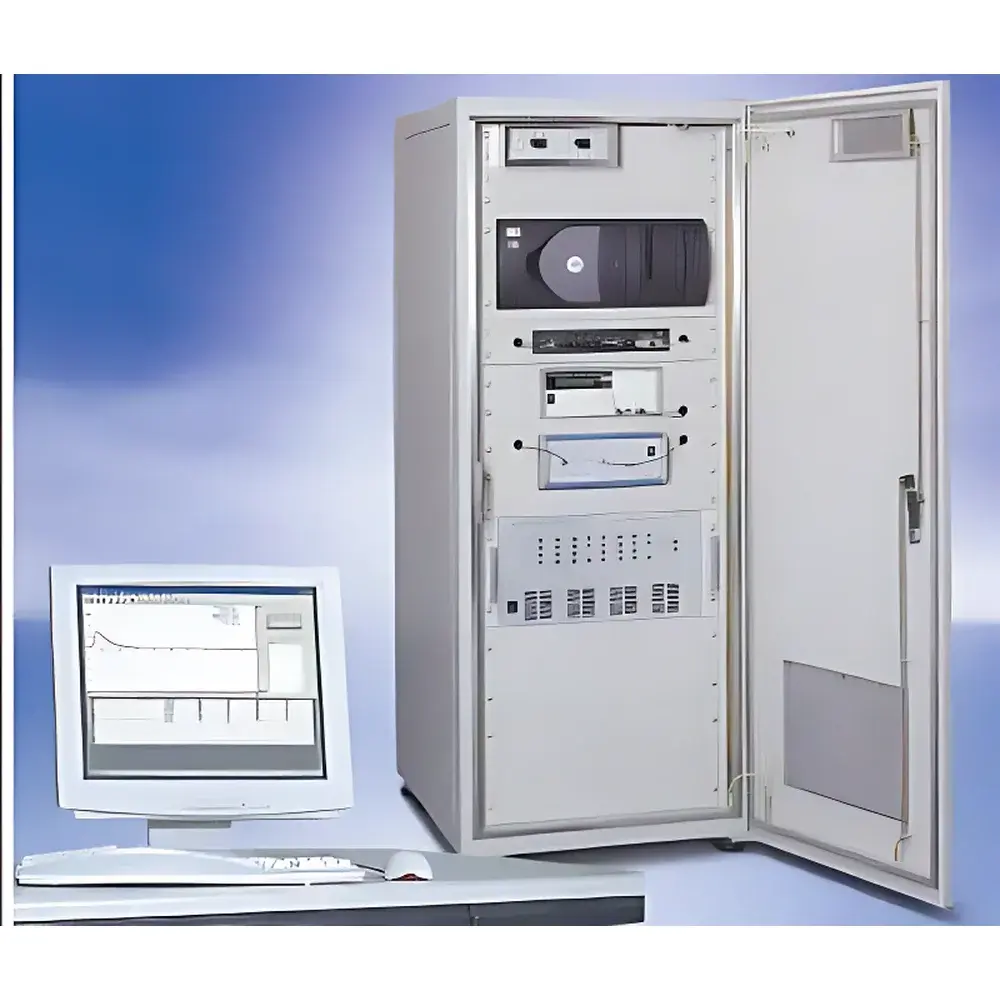
LCM-2 Liquid Crystal Material Characterization System (VHR, Ionic Impurity, and Rotational Viscosity γ₁ Analyzer)
| Origin | Japan |
|---|---|
| Manufacturer Type | Authorized Distributor |
| Origin Category | Imported |
| Model | LCM-2 |
| Pricing | Available Upon Request |
Overview
The LCM-2 Liquid Crystal Material Characterization System is an engineered instrumentation platform developed through collaborative R&D among Toyo Corporation (Japan), Merck KGaA (Germany), Merck Ltd. (Japan), and Osaka Metropolitan University. It is specifically designed for the quantitative determination of rotational viscosity coefficient γ₁ in both positive and negative dielectric liquid crystals—critical parameters governing electro-optic response dynamics in advanced LCD technologies. Unlike conventional magnetic-field-based methods requiring extended measurement durations (often >30 minutes per sample), the LCM-2 employs a pulsed-voltage transient current analysis technique: a precisely controlled voltage step is applied across a standard liquid crystal test cell, and the resulting time-resolved current waveform is acquired and deconvoluted using proprietary physical models that explicitly incorporate hydrodynamic flow contributions and interfacial boundary conditions (e.g., free-slip at alignment layers). This enables high-reproducibility γ₁ extraction within seconds per measurement cycle. The system further integrates simultaneous characterization of Voltage Holding Ratio (VHR), ionic impurity concentration (via low-frequency conductivity analysis), and residual DC voltage—parameters directly linked to image sticking, flicker, and long-term display reliability.
Key Features
- Simultaneous multi-parameter acquisition: γ₁ (rotational viscosity), VHR (at 1 Hz and 60 Hz), ionic concentration (calibrated via conductivity-to-impurity conversion), and residual DC voltage—all measured on a single sample under identical thermal and electrical conditioning.
- Free-slip interface modeling: Built-in analytical framework accounts for velocity slip at polyimide or photo-alignment surfaces, essential for accurate γ₁ quantification in vertically aligned (VA) and fringe-field switching (FFS) nematic formulations.
- High-throughput architecture: Standard configuration supports 16 independent sample channels with automated cell indexing, enabling statistical batch analysis compliant with QC protocols in material development labs.
- Minimal sample consumption: Requires only ~10 µL of liquid crystal material per test cell—critical for evaluating expensive, low-yield research-grade mixtures.
- Regulatory-ready design: CE-marked; hardware and firmware architecture supports audit trails and user access control, facilitating alignment with GLP-compliant workflows and internal quality documentation requirements.
Sample Compatibility & Compliance
The LCM-2 accepts industry-standard ITO-coated glass test cells (e.g., 5 µm, 7 µm, or 9 µm gap thicknesses) with homogeneous, vertical, or hybrid alignment. It is validated for use with nematic LCs exhibiting dielectric anisotropy (Δε) ranging from −5 to +15 and birefringence (Δn) between 0.07 and 0.18. The system operates within a temperature-controlled environment (25 °C ± 0.1 °C) and supports optional Peltier stage integration for isothermal sweeps between 10 °C and 60 °C. All electrical safety and electromagnetic compatibility performance conforms to EN 61326-1:2013 and EN 61000-6-3:2011 standards. Data integrity features—including timestamped raw current traces, parameter derivation logs, and operator ID tagging—support traceability requirements analogous to those referenced in ISO/IEC 17025:2017 Clause 7.7.
Software & Data Management
The LCM-2 is operated via Windows-based LCM-Control Suite v4.x, which provides real-time visualization of transient current waveforms, automatic γ₁ fitting using Levenberg–Marquardt optimization against a 3-parameter hydrodynamic model (including flow coupling term), and export of results in CSV, PDF, and XML formats. Software modules include batch report generation with configurable pass/fail thresholds for VHR (>99.0% typical spec), ionic concentration (<10 p.p.b. equivalent Na⁺), and γ₁ repeatability (RSD < 2.5% across 5 replicates). Audit trail functionality records all parameter changes, calibration events, and user logins—fully compatible with FDA 21 CFR Part 11 readiness when deployed with network authentication and electronic signature modules.
Applications
- Development and qualification of VA-mode and IPS-type LC mixtures for ultra-high-definition (UHD) and fast-refresh-rate (≥240 Hz) displays.
- Root-cause analysis of slow gray-to-gray response times correlated with γ₁ anomalies and interfacial slip behavior.
- Stability assessment of LC formulations under thermal stress or UV exposure via longitudinal VHR and ionic drift monitoring.
- QC release testing of commercial LC batches against internal specifications for γ₁ consistency and ionic purity.
- Academic research into structure–viscosity relationships in fluorinated and polymer-stabilized nematics.
FAQ
Does the LCM-2 require calibration with reference liquid crystals?
Yes—system calibration is performed annually using NIST-traceable reference materials (e.g., Merck MDA-01-1352 for γ₁ and certified ionic standard solutions) following the manufacturer’s documented procedure.
Can the LCM-2 measure rotational viscosity for cholesteric or blue-phase LCs?
No—the current firmware and physical model are optimized for uniaxial nematic phases; chiral or cubic phase systems require specialized modeling not included in baseline software.
Is the 16-channel configuration expandable to 32 channels?
Not as a field upgrade—the hardware architecture is fixed at 16 channels; higher throughput requires parallel deployment of multiple LCM-2 units with centralized data aggregation.
What is the minimum measurable ionic concentration?
Detection limit is 0.5 p.p.b. (as Na⁺ equivalent) under optimal signal-to-noise conditions using low-noise current preamplification and 10-second integration averaging.
Does the system support automated temperature ramping during γ₁ measurement?
No—temperature must be stabilized prior to each measurement; dynamic γ₁ vs. T profiling requires manual setpoint adjustment and sequential acquisition.



