
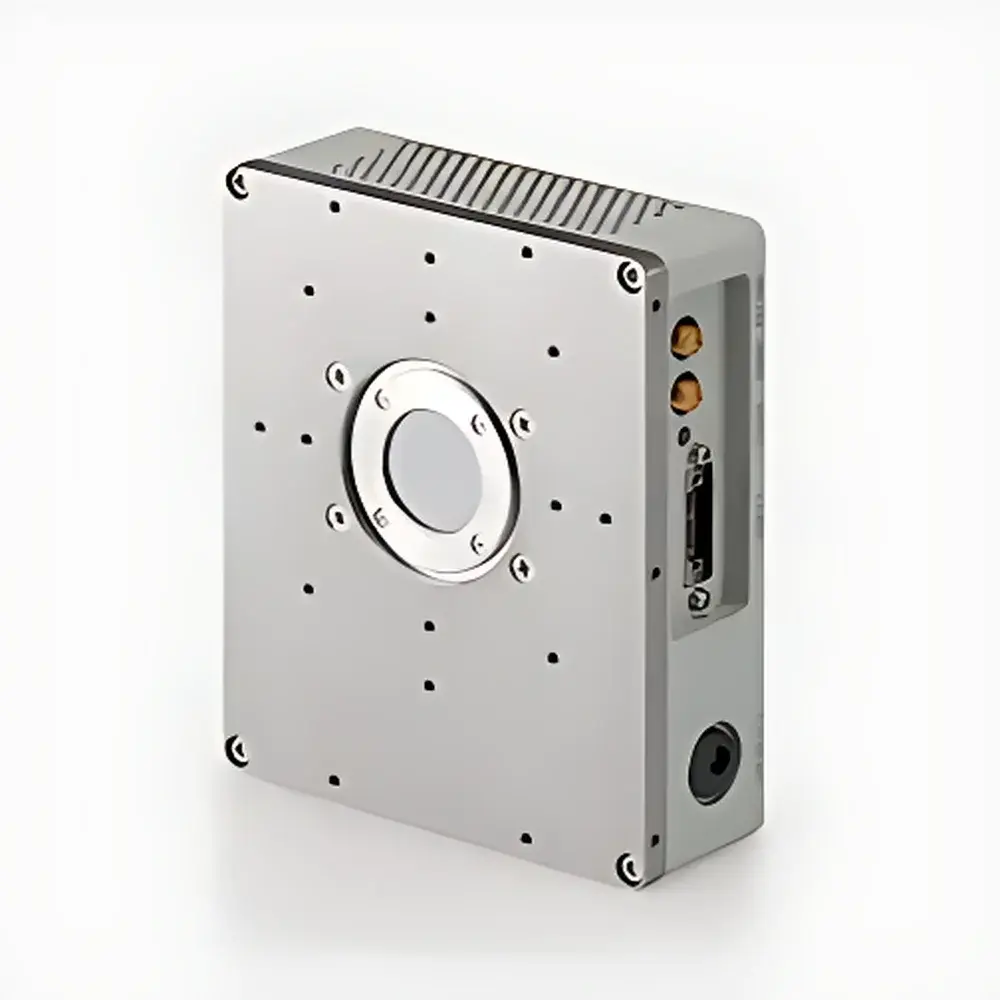
Hamamatsu C12849-111U X-ray sCMOS Camera
| Brand | Hamamatsu |
|---|---|
| Origin | Japan |
| Manufacturer Type | Original Equipment Manufacturer (OEM) |
| Product Category | Imported Scientific Imaging Device |
| Model | C12849-111U |
| Image Resolution | 33 lp/mm (with Gd₂O₂S:Tb (P43) scintillator, 10 µm thickness) |
| Pixel Size | 6.5 µm (H) × 6.5 µm (V) |
| Readout Speed | 30 fps to 25,655 fps |
| Dynamic Range | 18,000:1 (typical, calculated as ratio of full-well capacity to median read noise) |
Overview
The Hamamatsu C12849-111U is a scientific-grade, back-illuminated sCMOS camera engineered specifically for high-resolution, low-dose X-ray imaging applications. It integrates a fiber-optic plate (FOP)-coupled Gd₂O₂S:Tb (P43) scintillator with 10 µm thickness to convert incident X-ray photons into visible light, which is then captured by a high-quantum-efficiency sCMOS sensor. The system operates on the principle of indirect detection—optimized for spatial resolution preservation and photon-limited signal fidelity. With an effective imaging area of 13.312 mm × 13.312 mm and native resolution of 2048 × 2048 pixels, the camera delivers 33 line pairs per millimeter (lp/mm) modulation transfer function (MTF) performance when paired with the specified P43 scintillator—making it suitable for demanding micro-CT, nano-CT, X-ray diffraction (XRD), and X-ray absorption fine structure (XAFS) experiments where geometric magnification and detector-limited resolution are critical design constraints.
Key Features
- High spatial resolution: 33 lp/mm MTF (measured with Gd₂O₂S:Tb, 10 µm, 1:1 FOP coupling)
- sCMOS architecture enabling low-noise, high-dynamic-range imaging: median read noise of 1.6 e⁻, full-well capacity of 30,000 e⁻ (typical), yielding a dynamic range of 18,000:1
- Flexible frame rate operation: 30 fps at full resolution up to 25,655 fps in subarray mode—enabling both high-throughput tomographic acquisition and time-resolved radiography
- Programmable exposure control: 1 ms to 30 s (recommended 1–100 ms for optimal image quality; prolonged exposures >100 ms may introduce fixed-pattern artifacts)
- Robust triggering infrastructure: supports edge-trigger, level-trigger, synchronous readout trigger, and start-trigger modes; includes programmable TTL outputs for global exposure timing and system synchronization
- USB 3.0 interface ensuring high-bandwidth data streaming (up to 350 MB/s sustained) without frame loss under controlled thermal conditions
- Compact mechanical design (dimensions specified per datasheet) optimized for integration into constrained-space X-ray systems—including benchtop micro-CT gantries and synchrotron beamline endstations
Sample Compatibility & Compliance
The C12849-111U is compatible with X-ray tube voltages ranging from 25 kV to 90 kV, supporting common laboratory sources (e.g., Hamamatsu L9181-02, L10711-03) and enabling variable magnification geometries via source-to-detector distance (FDD) and source-to-object distance (FOD) tuning. Its radiation-hardened FOP coupling ensures long-term stability under repeated X-ray exposure. While not certified to IEC 61000 or ISO 13485 as a medical device, the camera complies with CE marking requirements for electromagnetic compatibility (EMC Directive 2014/30/EU) and low-voltage safety (LVD Directive 2014/35/EU). For regulated environments—such as GLP-compliant materials characterization labs or preclinical imaging facilities—the system supports audit-ready metadata embedding (timestamp, exposure parameters, trigger status) in TIFF and HDF5 output formats, facilitating traceability per FDA 21 CFR Part 11 guidelines when integrated with validated acquisition software.
Software & Data Management
Hamamatsu provides the DCAM-SDK (v4.x) for cross-platform (Windows/Linux) low-level camera control, including ROI selection, pixel binning (2×2, 4×4), and real-time histogram analysis. Third-party compatibility includes Micro-Manager (v2.0+), Python-based PyHamamatsu, and commercial CT reconstruction suites (e.g., Thermo Fisher Avizo, Bruker SkyScan CTvox). All acquired frames embed EXIF-like metadata (exposure time, gain, trigger mode, temperature) within the image header. Raw 16-bit data is streamed without compression, preserving quantitative integrity for downstream spectral deconvolution or dose calibration workflows. Optional hardware synchronization modules (e.g., Hamamatsu C3391-01) enable deterministic latency <1 µs between external X-ray pulse and image capture—critical for pulsed-source applications such as time-resolved XAFS.
Applications
- Micro- and nano-computed tomography (micro-CT/nano-CT): leverages high MTF and low read noise to resolve sub-10 µm features in biological tissue, battery electrodes, and additive-manufactured alloys
- X-ray phase-contrast imaging (PCI): benefits from high detective quantum efficiency (DQE) at low fluence, particularly when combined with grating interferometers
- Time-resolved radiography: ultra-high-speed subarray modes support dynamic studies of fluid flow, crack propagation, or powder compaction
- X-ray diffraction and scattering: stable pixel response enables accurate Bragg peak centroiding and reciprocal-space mapping
- Preclinical small-animal imaging: compact form factor and USB 3.0 interface simplify integration into shielded cabinet systems operating at ≤80 kV
FAQ
What scintillator is factory-integrated with the C12849-111U?
The unit ships with a 1:1 fiber-optic plate coupled Gd₂O₂S:Tb (P43) scintillator, 10 µm thick. Custom scintillator options (e.g., CsI:Tl, LuAG:Ce) are available under OEM agreement.
Is cooling required for extended acquisitions?
Yes. The camera employs forced-air cooling. Operation above +35 °C ambient may induce hot pixels; active thermal management is recommended for >5-minute continuous acquisition.
Can the camera be triggered externally by a synchrotron timing signal?
Yes. It supports TTL-compatible edge-trigger and programmable output timing signals, with jitter <100 ns when synchronized to a master clock.
Does the camera support hardware binning?
No—binning is performed digitally in-camera (2×2, 4×4) as part of the pixel processing pipeline; no analog charge-domain binning is implemented.
What is the maximum sustainable data throughput over USB 3.0?
At full resolution and 30 fps, sustained throughput is ~220 MB/s. At 25,655 fps in minimal subarray mode, bandwidth utilization approaches 345 MB/s—requiring SSD-backed storage and optimized driver configuration.






