
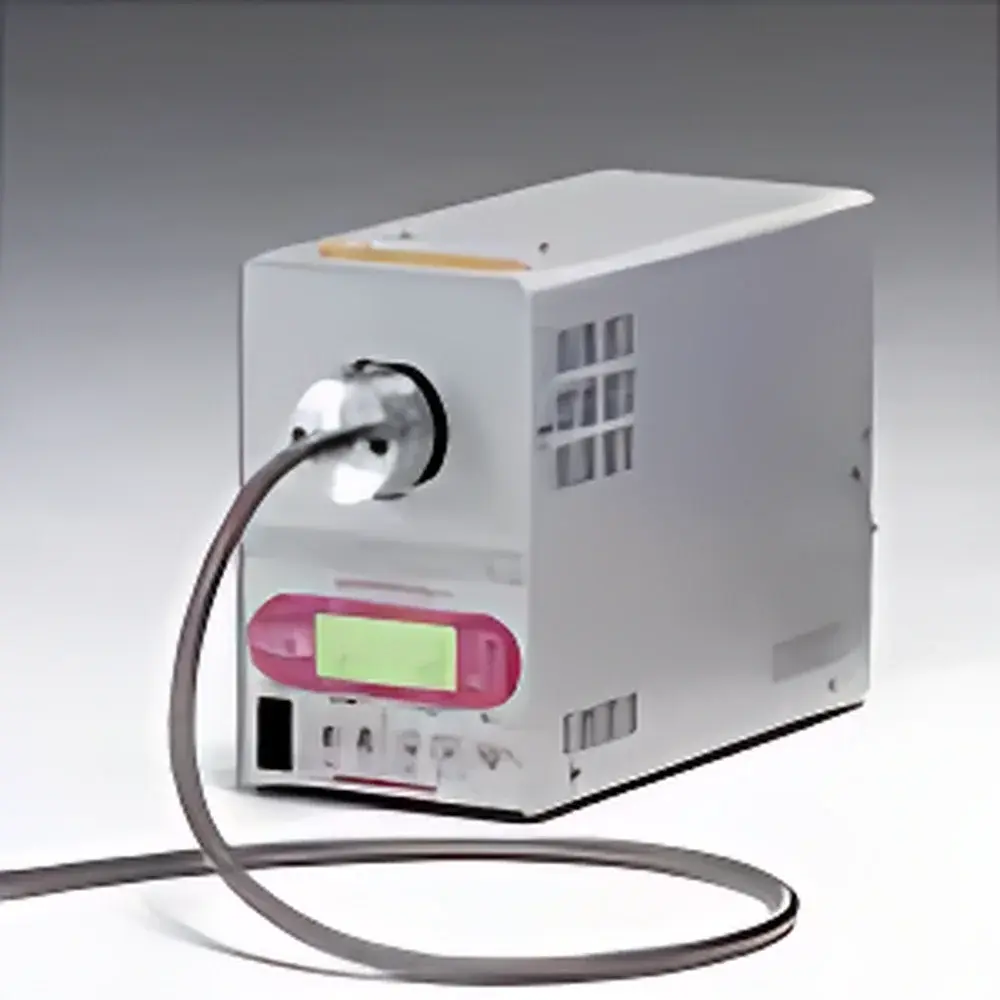
Hamamatsu UV Curing Light Source System
| Origin | Japan |
|---|---|
| Manufacturer Type | Authorized Distributor |
| Origin Category | Imported |
| Model | UV Curing Light Source |
| Pricing | Available Upon Request |
Overview
The Hamamatsu UV Curing Light Source System is a high-stability, spectrally optimized ultraviolet irradiation platform engineered for precision photopolymerization in R&D laboratories and industrial manufacturing environments. Based on Hamamatsu Photonics’ proprietary arc-lamp technology—primarily utilizing mercury-xenon (Hg-Xe) or pure mercury short-arc lamps—the system delivers intense, collimated UV output across critical wavelength bands (UVA: 315–400 nm; UVB: 280–315 nm; and select UVC lines at 254 nm), enabling controlled initiation of free-radical and cationic photoinitiators in adhesives, coatings, inks, and dental composites. Unlike broadband LED arrays, this lamp-based architecture provides broad spectral continuity and high irradiance (>100 mW/cm² at 365 nm, typical at 10 cm working distance), essential for reproducible dose-dependent curing kinetics and crosslink density validation per ISO 11577 and ASTM D4290.
Key Features
- Modular optical design with interchangeable condenser lenses and bandpass filters to tailor spectral irradiance profiles (e.g., 365 nm ±5 nm narrowband or full Hg-line spectrum)
- Integrated digital power supply with real-time arc current stabilization and closed-loop feedback control, ensuring <±1.5% irradiance stability over 8-hour continuous operation
- Thermally managed lamp housing with forced-air cooling and thermal cutoff protection, extending lamp lifetime to ≥1,000 hours (typical for Hg-Xe lamps under rated duty cycle)
- Remote analog/digital interface (0–10 V & RS-232) for synchronized triggering, intensity ramping, and integration into automated conveyor or robotic dispensing systems
- CE-compliant enclosure with interlocked shutter and UV-blocking viewport, meeting IEC 62471 Photobiological Safety requirements for Risk Group 3 (RG3) sources
Sample Compatibility & Compliance
The system accommodates diverse sample geometries—including flat substrates, cylindrical components, and microfluidic channels—via adjustable XYZ translation stages (optional) and customizable quartz or fused silica light guides (diameters: 3–12 mm). It supports standard photopolymer formulations compliant with ISO 15635 (dental materials), IPC-CC-830B (electronic conformal coatings), and JIS K 5600-7-3 (paint curing). All lamp modules are certified to IEC/EN 61000-6-3 (EMC emission limits) and designed for use in GLP-regulated environments where traceable irradiance calibration (NIST-traceable spectroradiometric verification available upon request) and audit-ready operational logs are required.
Software & Data Management
While the base unit operates via front-panel controls, optional Hamamatsu LightControl™ software (Windows-compatible) enables time-resolved irradiance logging, spectral power distribution (SPD) mapping, and dose accumulation tracking with timestamped export to CSV or XML. The software supports 21 CFR Part 11-compliant user access levels (Administrator, Operator, Reviewer), electronic signatures, and immutable audit trails—critical for FDA-regulated medical device manufacturing and pharmaceutical packaging line qualification. Raw spectral data can be exported for third-party analysis using MATLAB or Python-based radiometric modeling tools.
Applications
- Accelerated development and DOE-based optimization of UV-curable acrylates, epoxies, and silicone hybrids
- Reliability testing of optical adhesives in photonics assembly (e.g., lens bonding, fiber alignment)
- Quality assurance of printed electronics (flexible PCBs, conductive ink sintering)
- Curing validation for Class II medical device coatings per ISO 10993-13 biocompatibility protocols
- Photolithography mask alignment and resist exposure in microfabrication pilot lines
FAQ
What lamp types are supported by this system?
Standard configurations include 100 W and 300 W mercury-xenon (Hg-Xe) short-arc lamps; optional pure mercury (Hg) and deuterium (D₂) lamps are available for enhanced 254 nm or deep-UV output.
Is spectral calibration included with delivery?
A factory-installed spectroradiometric calibration certificate (traceable to NMIJ/AIST, Japan) is provided; annual recalibration services are offered through Hamamatsu’s global service network.
Can the system be integrated into a Class 100 cleanroom environment?
Yes—the lamp head and power supply meet ISO 14644-1 Class 5 particulate limits when installed with filtered exhaust ducting and non-outgassing housing materials (optional stainless-steel enclosure available).
Does the system support pulse-mode operation for thermal-sensitive substrates?
Pulsed operation (1–10 Hz, duty cycle adjustable from 5–95%) is enabled via external TTL trigger input, allowing precise thermal management during curing of thin-film polymer layers or temperature-sensitive biological scaffolds.




