
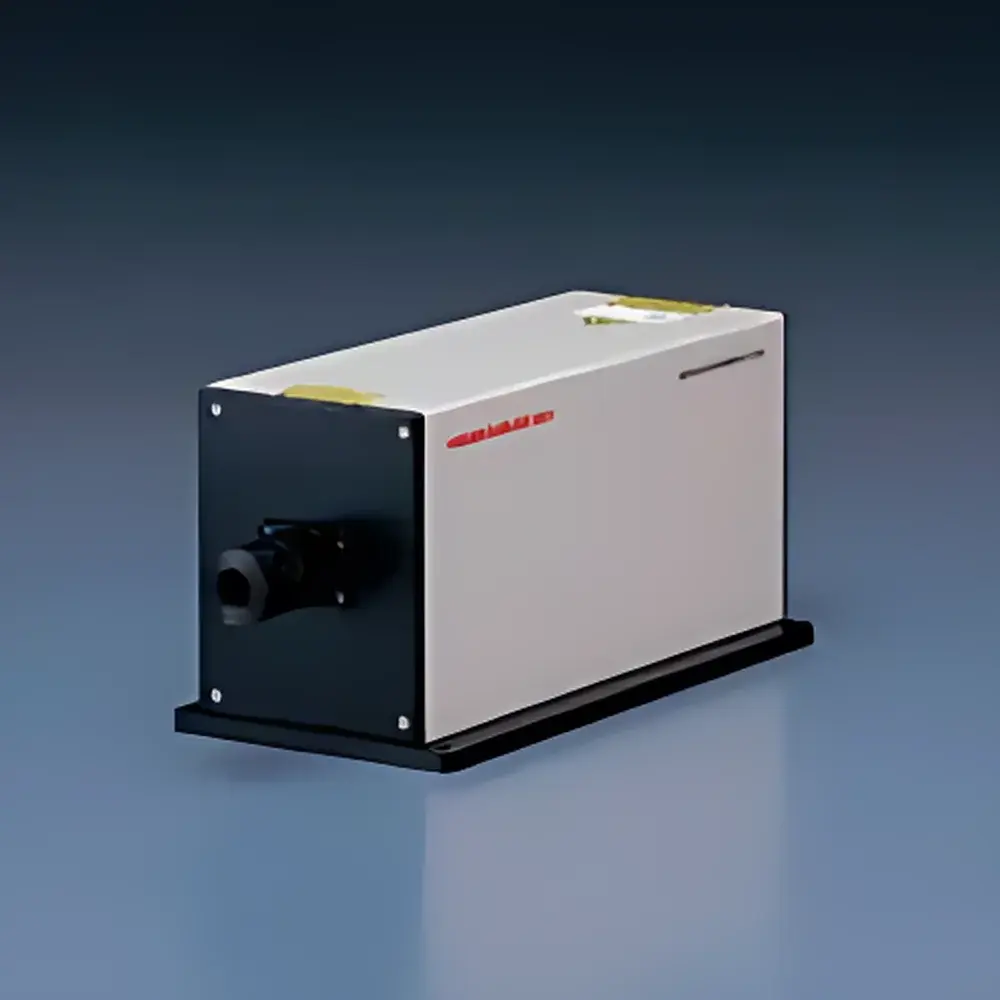
Hamamatsu FOLD Series High-Power Fiber-Coupled Laser Diodes
| Brand | Hamamatsu |
|---|---|
| Origin | Japan |
| Manufacturer Type | Original Equipment Manufacturer (OEM) |
| Product Category | Imported |
| Model | FOLD (L10718 Series) |
| Light Source Type | Semiconductor Laser Diode |
| Illumination Mode | External Irradiation |
| Output Configuration | Fiber-Coupled (SMA905 or FC/PC connector options) |
Overview
The Hamamatsu FOLD Series (L10718 series) represents a class of high-power, fiber-coupled semiconductor laser diodes engineered for industrial and precision laboratory applications requiring stable, spatially flexible, and scalable optical power delivery. Unlike free-space direct-diode lasers (DDL), the FOLD architecture integrates monolithic laser bar arrays with high-numerical-aperture (NA ≤ 0.22) multimode fiber coupling—typically 200 µm, 400 µm, or 600 µm core diameter silica fibers—enabling efficient beam transport over distances up to several meters while preserving radiometric integrity. The system operates on fundamental edge-emitting diode principles, with wavelength options spanning 790 nm to 1070 nm (including 808 nm, 915 nm, 940 nm, and 980 nm variants), selected per absorption profiles of target materials. Thermal management is achieved via integrated thermoelectric coolers (TECs) and copper-molybdenum heat spreaders, ensuring long-term wavelength stability (< ±0.3 nm/°C) and output power drift < ±2% over 8-hour continuous operation under constant-current drive.
Key Features
- High electro-optical conversion efficiency (>50% typical), minimizing waste heat generation and reducing cooling infrastructure requirements
- Fiber-coupled output enables decoupling of laser head from processing optics—ideal for robotic integration, scanning galvanometer systems, and confined-space applications
- Compact OEM module design (e.g., L10718-0051-8A: 120 × 60 × 35 mm) with standardized mechanical interfaces (M4/M5 mounting holes) and electrical connectors (LEMO or Fischer)
- Linear current-to-optical-power response (R² > 0.9998) across full operating range, supporting closed-loop analog modulation (0–5 V or 0–10 V input)
- No moving parts or consumables; maintenance-free operation compliant with ISO 9001 manufacturing traceability and RoHS 3/REACH material declarations
- Integrated monitoring photodiode with calibrated responsivity (±3% tolerance) for real-time power feedback and safety interlock compatibility
Sample Compatibility & Compliance
The FOLD series is optimized for interaction with metals (steel, aluminum, copper), thermoplastics (PA6, PBT, PC), and selective polymer composites used in transmission welding and surface annealing. Beam parameter product (BPP) values range from 12–45 mm·mrad depending on fiber core and NA selection—enabling focused spot sizes down to 80 µm (with f-theta lens). All units comply with IEC 60825-1:2014 Class 4 laser safety requirements when operated within specified optical power limits (up to 120 W CW per module). Electrical interface conforms to EN 61000-6-3 (emissions) and EN 61000-6-2 (immunity). Device firmware supports configurable safety protocols aligned with Machinery Directive 2006/42/EC and CE marking documentation packages are provided per unit batch.
Software & Data Management
Hamamatsu supplies the FOLD series with the optional LD-Controller Suite—a Windows-based application enabling USB- or RS-485–driven control of drive current, TEC setpoint, and photodiode readback. The software logs timestamped operational data (power, temperature, current) at user-defined intervals (10 ms–10 s resolution) in CSV format, supporting audit-ready records for GLP/GMP environments. For integration into automated manufacturing lines, ASCII command protocol and Modbus RTU register maps are fully documented. All firmware versions adhere to IEC 62443-3-3 security level 1 (SL1) baseline requirements, including secure boot and write-protected configuration memory.
Applications
- Conduction-mode and keyhole-mode laser welding of dissimilar metals (e.g., Cu–Al battery tab joining)
- Transmission welding of transparent-to-IR polymers (e.g., PMMA–ABS assemblies in medical device housings)
- Local thermal annealing of microstructured steel components to relieve residual stress without bulk heating
- Pre-heat and post-weld tempering in additive manufacturing support structure removal
- High-speed selective soldering of fine-pitch electronics using dynamic fiber scanning
- Photothermal ablation studies in material science labs requiring reproducible irradiance profiles (1–5 kW/cm² at focus)
FAQ
What fiber connector types are supported?
Standard configurations include SMA905 and FC/PC; custom ST or E2000 variants are available upon request with minimum order quantity.
Is spectral stabilization available?
Yes—wavelength-stabilized versions (e.g., volume Bragg grating feedback) are offered for applications demanding < ±0.1 nm spectral width (FWHM) and reduced temperature sensitivity.
Can multiple FOLD modules be synchronized for power scaling?
Yes—master-slave analog triggering and digital TTL synchronization enable coherent multi-head operation with sub-microsecond timing alignment.
What is the maximum allowable back-reflection level?
< –30 dB (0.1%) to prevent optical feedback-induced mode instability; an integrated isolator option is available for high-reflectivity target processing.
Are calibration certificates traceable to NIST or JCSS standards?
Yes—each unit ships with a factory calibration report traceable to JCSS-accredited primary standards; NIST-traceable reports are available as an add-on service.






