
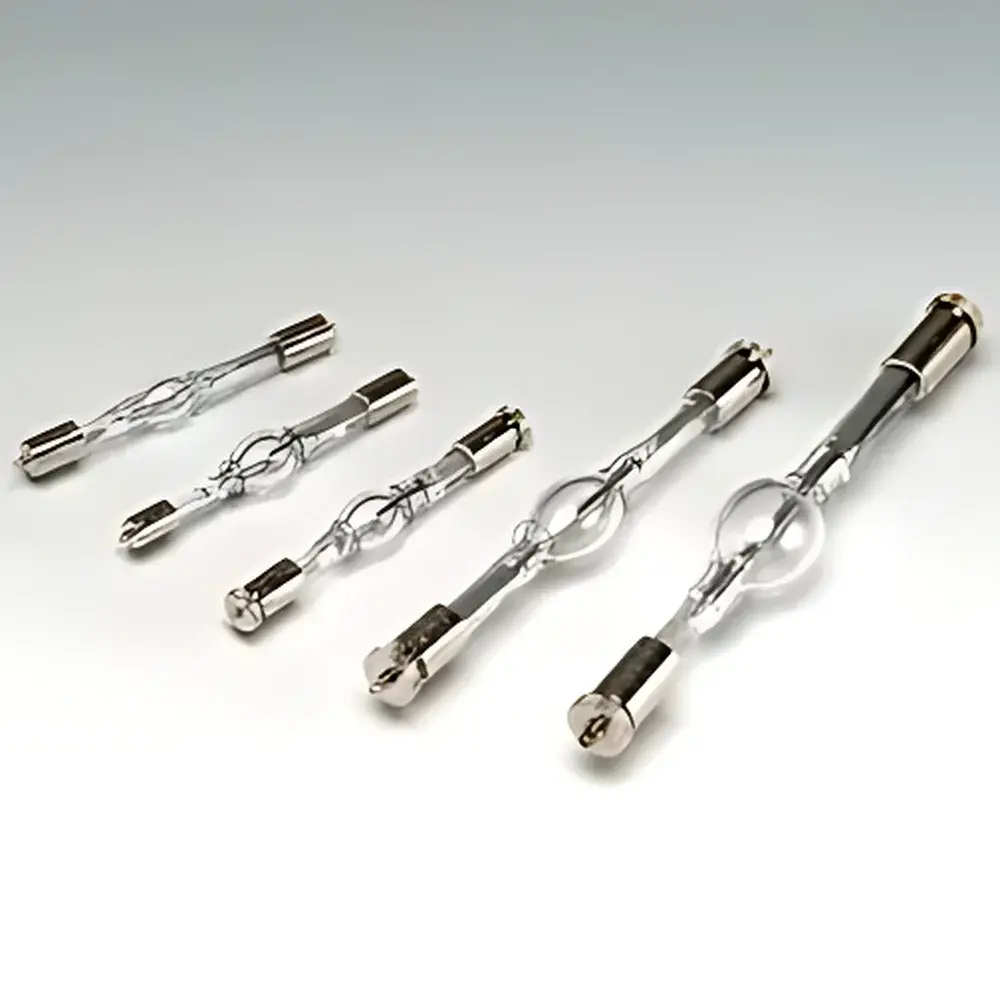
Hamamatsu Xenon Lamp L-Series
| Brand | Hamamatsu |
|---|---|
| Origin | Japan |
| Manufacturer Type | Original Equipment Manufacturer (OEM) |
| Import Status | Imported |
| Model | L-Series |
| Light Source Type | Xenon Arc Lamp |
| Illumination Mode | External Irradiation |
| Spectral Range | 185 nm – 2000 nm (model-dependent, down to 220 nm or 240 nm with optional filtering) |
| Typical Power Ratings | 35 W, 75 W, 100 W, 150 W, 200–500 W |
| Lamp Architecture | Short-Arc or Long-Life Sealed-Quartz Envelope |
| Electrode Design | High-Performance Tungsten-Thoriated Cathode |
Overview
The Hamamatsu L-Series xenon lamps are high-stability, short-arc or long-life sealed quartz discharge lamps engineered for precision optical instrumentation requiring broadband spectral continuity from deep ultraviolet (UV) through visible (VIS) to near-infrared (NIR). Operating on the principle of high-pressure DC or pulsed arc discharge in xenon gas, these lamps generate a near-blackbody continuum with correlated color temperatures exceeding 6000 K—enabling faithful replication of solar irradiance and supporting absolute radiometric calibration. Unlike conventional xenon sources prone to cathode sputtering, electrode drift, and rapid spectral degradation, Hamamatsu’s proprietary cathode formulation and hermetic quartz envelope construction ensure exceptional arc stability, low temporal noise (<0.5% RMS intensity fluctuation over 1 hour), and extended operational lifetime (up to 2000 hours at rated power, depending on model and thermal management). Designed for integration into spectrophotometers, monochromators, fluorescence excitation systems, solar simulators, and UV-curing validation platforms, the L-Series meets the stringent demands of metrology-grade applications where spectral fidelity, spatial coherence, and long-term repeatability are non-negotiable.
Key Features
- Ultra-broad spectral output spanning 185 nm to 2000 nm—select models (e.g., L11033, L2173) support transmission down to 185 nm with high-purity synthetic fused silica envelopes
- Optimized short-arc geometry (e.g., L2174, L2194) for high radiance and spatial collimation; ideal for fiber coupling and monochromator input slits
- Long-life cathode architecture featuring thoriated tungsten emitters and controlled gas fill pressure—reducing cathode erosion and maintaining arc centering over time
- DC- or pulse-operated compatibility with industry-standard lamp housings and power supplies (e.g., Hamamatsu C9015 series drivers)
- Low UV-induced ozone generation due to optimized quartz composition and optional ozone-free envelope variants (e.g., L2193, L2194-01)
- Traceable calibration data available upon request per ISO/IEC 17025-accredited measurement protocols
Sample Compatibility & Compliance
The L-Series xenon lamps are compatible with standard 1-inch or 2-inch optical mounts and integrate seamlessly into OEM instruments compliant with IEC 61000-4 (EMC), UL 61010-1 (safety), and RoHS 2011/65/EU. For regulated environments—including pharmaceutical photostability testing (ICH Q1B), materials weathering (ASTM G154, ISO 4892-3), and clinical spectrometer validation—the lamps support traceable spectral irradiance certification and can be deployed within GLP/GMP workflows. While not intrinsically FDA 21 CFR Part 11-compliant (as a passive light source), their use in validated instrument systems enables full audit trail capability when paired with Hamamatsu’s certified power supplies and calibrated reference detectors.
Software & Data Management
As standalone light sources, L-Series lamps do not include embedded firmware or native software interfaces. However, they are fully interoperable with third-party instrument control ecosystems—including LabVIEW-based DAQ systems, Python-controlled power supply APIs (e.g., via SCPI over USB/RS-232), and MATLAB-driven spectral acquisition pipelines. Hamamatsu provides comprehensive technical documentation (including spectral power distribution curves, radiant flux tables, and thermal derating charts) in standardized formats (CSV, PDF, XML) suitable for integration into LIMS and ELN platforms. Radiometric calibration reports include uncertainty budgets aligned with NIST-traceable standards (e.g., NIST SRM 2069, 2030).
Applications
- Spectrophotometric calibration of UV-VIS-NIR spectrometers (per ASTM E275, ISO 6780)
- Excitation source for steady-state and time-resolved fluorescence spectroscopy
- Irradiance reference in solar simulator classification (IEC 60904-9 Class AAA)
- Accelerated aging and photodegradation studies in polymer and coating R&D
- Photobiological safety testing (IEC 62471) and UV LED characterization
- Optical coherence tomography (OCT) system alignment and broadband interferometer referencing
FAQ
What is the minimum usable wavelength for L-Series xenon lamps?
Standard L-Series lamps transmit down to 185 nm; models with enhanced UV-transmission quartz (e.g., L11033, L2173) maintain usable output at 185 nm, while others (e.g., L2193, L2194) begin at 240 nm due to envelope absorption characteristics.
Can these lamps be operated in pulsed mode?
Yes—many L-Series models (e.g., L2174, L2194) are qualified for pulsed DC operation up to 1 kHz repetition rate with duty cycles ≤10%, provided appropriate current-limiting circuitry and thermal sinking are implemented.
Is ozone generation a concern during operation?
Lamps emitting below 200 nm (especially <190 nm) will generate ozone in ambient air; Hamamatsu offers ozone-suppressed variants and recommends forced ventilation or nitrogen purging for enclosed optical paths.
How is lamp lifetime defined and measured?
Lifetime is specified as operational hours until luminous flux drops to 80% of initial value under constant-current DC operation at rated power and optimal heat dissipation—validated per JEDEC JESD22-A108F accelerated life testing protocols.
Are spectral calibration certificates included with purchase?
Calibration reports are optional and provided upon request; they include absolute spectral irradiance (W/m²/nm) measured at 1 m distance using a NIST-traceable spectroradiometer, with expanded uncertainty (k=2) stated per GUM guidelines.





