
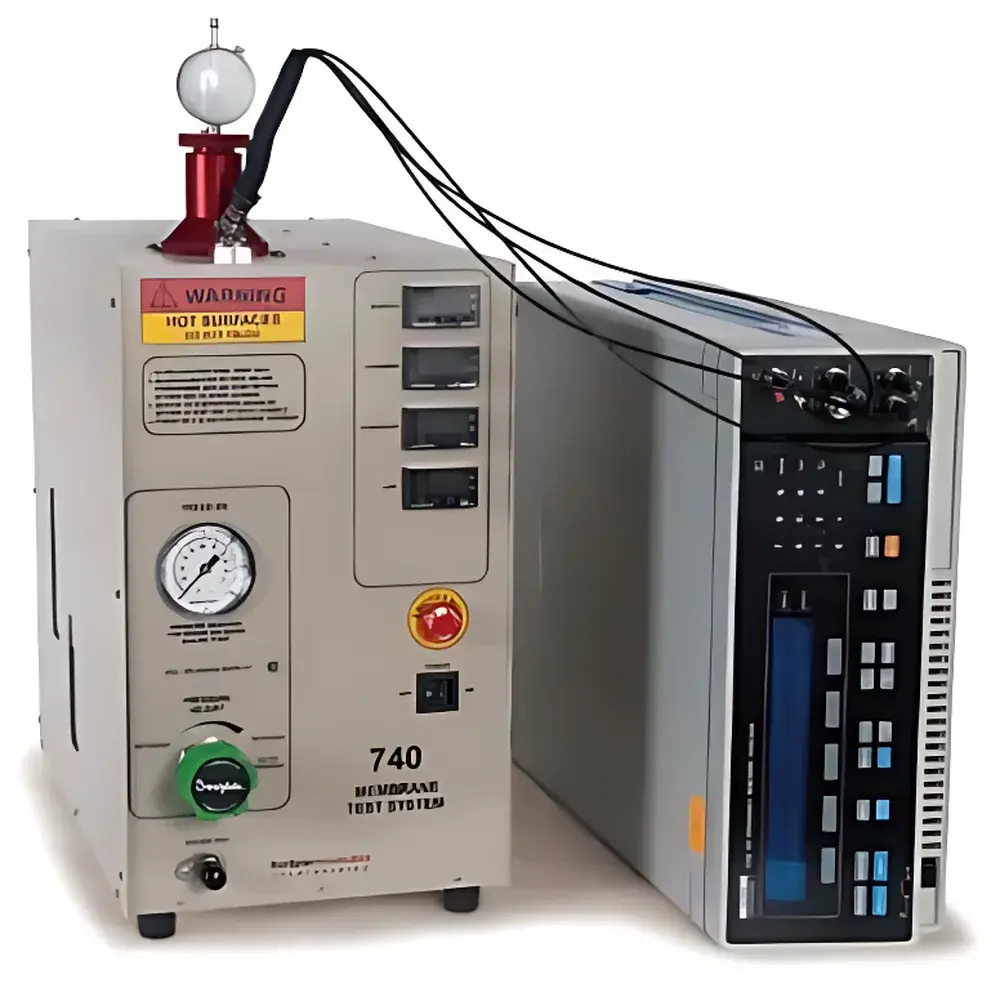
TOYO Corporation MTS740 Membrane Through-Plane Ionic Conductivity Measurement System for PEM Fuel Cell R&D
| Brand | TOYO Corporation (Japan) |
|---|---|
| Origin | Japan |
| Manufacturer Type | Authorized Distributor |
| Origin Category | Imported |
| Model | MTS740 |
| Pricing | Available Upon Request |
Overview
The TOYO Corporation MTS740 Membrane Through-Plane Ionic Conductivity Measurement System is a purpose-built electrochemical characterization platform engineered for rigorous R&D of proton exchange membranes (PEMs) used in polymer electrolyte fuel cells (PEFCs). Developed in collaboration with Scribner Associates (USA) and aligned with the U.S. Department of Energy’s High-Temperature, Low-Humidity Membrane Development Program, the MTS740 enables precise, reproducible measurement of ionic conductivity across the membrane thickness direction—i.e., the through-plane (TP) orientation—under dynamically controlled thermal, humidification, and mechanical loading conditions. Unlike conventional in-plane or bulk conductivity methods, the MTS740 replicates the actual operational stress state of a membrane electrode assembly (MEA), applying calibrated compressive force via a precision-machined sample fixture while delivering independently regulated humidified gas streams to both membrane surfaces. This architecture ensures physicochemical relevance: TP conductivity values obtained directly inform membrane hydration kinetics, interfacial resistance, and performance degradation mechanisms under realistic PEFC operating envelopes.
Key Features
- Through-plane ionic conductivity measurement with simultaneous control of temperature (30–180 °C sample temperature; 30–120 °C dew point range), relative humidity (20–95 %RH ±2 %RH), and gas pressure (1–3 atm absolute)
- Dual-path humidification system enabling independent environmental gas (3 min stabilization) and sample-side gas (7 min stabilization) conditioning—critical for rapid RH ramping protocols (e.g., 13-point 20→80→20 %RH cycle completed in ~91 min)
- Custom-engineered sample holder with pneumatic or manual compression mechanism to emulate MEA clamping pressure, ensuring consistent electrode–membrane contact resistance during impedance acquisition
- Standardized sample format: rectangular membranes 6 mm × 30 mm, thickness 10–200 μm—compatible with industry-standard membrane casting and hot-pressing workflows
- Gas compatibility: H₂, N₂, or inert carrier gases; all wetted components constructed from corrosion-resistant stainless steel and fluoropolymer seals
- Integrated MTS4 software interface supporting automated sequence execution, real-time impedance monitoring, and synchronized parameter logging (T, RH, P, Z*)
Sample Compatibility & Compliance
The MTS740 accommodates standard perfluorosulfonic acid (PFSA) membranes (e.g., Nafion®, Aquivion®), hydrocarbon-based alternatives, and composite membranes incorporating inorganic fillers (SiO₂, TiO₂, heteropolyacids). Its mechanical and environmental fidelity supports testing per ASTM D7232 (standard test method for ionic conductivity of ion-exchange membranes) and ISO 14687-2 (hydrogen fuel quality—part 2: purity specifications for hydrogen fuel cells). While not a GMP-certified instrument, its design adheres to GLP principles: full audit trail capability via MTS4 (timestamped parameter sets, user login tracking, raw impedance data export), traceable calibration routines for temperature and RH sensors (NIST-traceable references), and documented uncertainty budgets for TP conductivity derivation (based on geometric factor, electrode area, and four-terminal impedance resolution).
Software & Data Management
MTS4 software serves as the central control and analysis hub. It provides scriptable measurement sequences (e.g., isothermal RH sweeps, temperature ramps at fixed humidity, pressure-dependent impedance mapping), real-time Nyquist/Bode plot visualization, and batch processing of complex impedance spectra (Z′, Z″, |Z|, θ). Data exports comply with ASTM E2913 (standard practice for electronic recordkeeping in materials testing) and support FDA 21 CFR Part 11–compliant configurations when deployed on validated laboratory IT infrastructure (electronic signatures, role-based access, immutable audit logs). Raw impedance data is saved in ASCII-compatible .IMP format, fully interoperable with third-party analysis tools including ZView®, EC-Lab®, and Python-based impedance.py libraries.
Applications
- High-temperature PEM membrane development (120–180 °C operation with low RH)
- Hydration-dependent conductivity modeling and water uptake correlation studies
- Accelerated stress testing (AST) of membrane chemical stability under OCV hold or cyclic RH/thermal loads
- Validation of computational models (e.g., continuum-scale transport simulations, pore-network modeling)
- Quality control screening of membrane batches prior to MEA fabrication
- Interfacial resistance quantification at catalyst layer–membrane boundaries
FAQ
What impedance analyzer is required for use with the MTS740?
A four-terminal (Kelvin) impedance analyzer capable of measuring up to 3 MHz is mandatory—such as the Solartron Analytical 1260, BioLogic SP-300, or Keysight E4990A. The system does not include the analyzer; it must be procured separately and interfaced via GPIB or USB.
Can the MTS740 measure membranes thicker than 200 μm?
No—the fixture geometry and electrical field uniformity are optimized for 10–200 μm thicknesses. Thicker samples introduce excessive series resistance and field distortion, compromising TP conductivity accuracy.
Is hydrogen safety certification included?
The MTS740 itself carries CE marking and conforms to IEC 61010-1 for electrical safety. Hydrogen handling requires external compliance with local regulations (e.g., NFPA 50A, EN 15916); users must integrate appropriate gas detection, ventilation, and purge protocols.
Does MTS4 support custom scripting or API integration?
Yes—MTS4 exposes a COM-based automation interface compatible with MATLAB, LabVIEW, and Python (via pywin32), enabling integration into larger test orchestration frameworks.
How is the geometric factor determined for TP conductivity calculation?
It is derived from the active electrode area (6 mm × 30 mm = 180 mm²) and nominal membrane thickness measured ex situ with a calibrated micrometer or SEM cross-section—MTS4 applies this value to convert measured resistance (Ω) to conductivity (S/cm).
Related Products






