
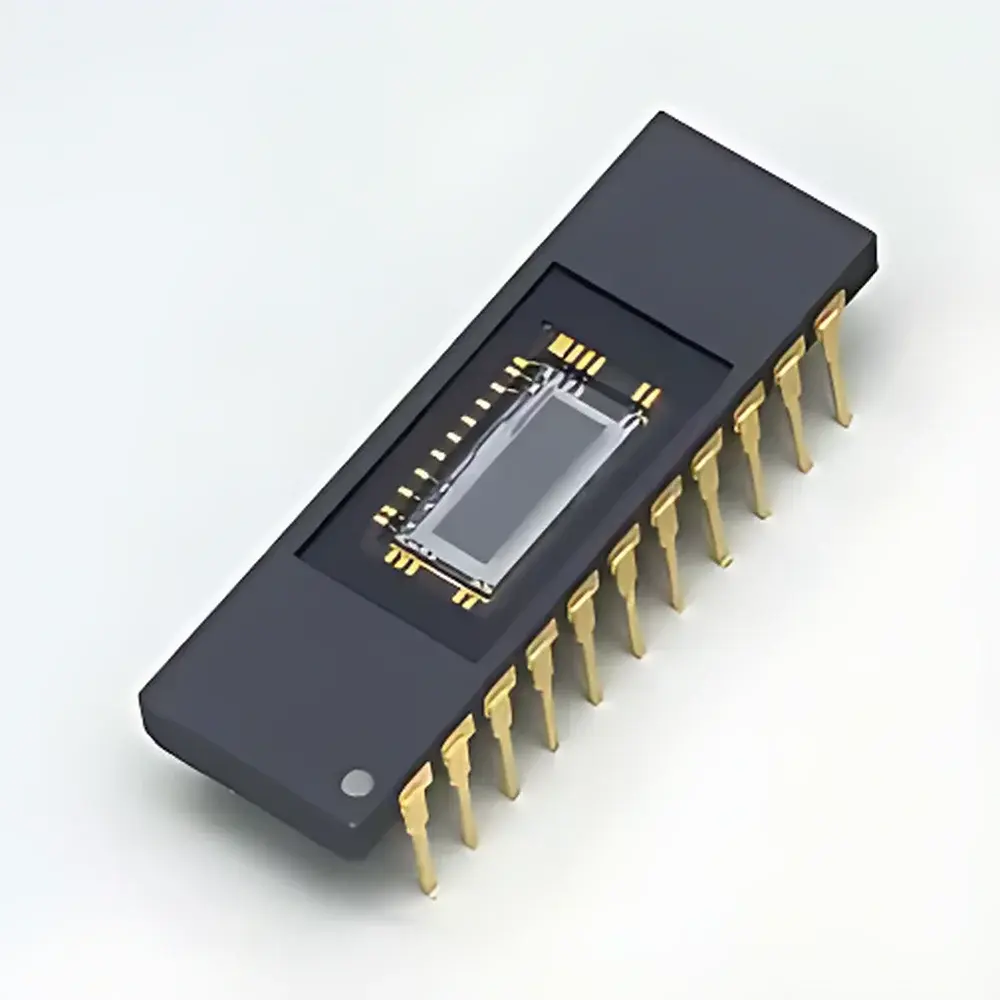
Hamamatsu CMOS Linear Image Sensor S10124-256Q-01
| Brand | Hamamatsu |
|---|---|
| Origin | Japan |
| Manufacturer Type | Original Equipment Manufacturer (OEM) |
| Product Category | Optical Component |
| Model | S10124-256Q-01 |
| Sensor Type | Self-scanning Photodiode Array |
| Spectral Range | 200–1000 nm |
| Active Area | 6.4 × 2.5 mm |
| Pixel Count | 256 × 1 |
| Pixel Pitch | 25 µm |
| Pixel Height | 2500 µm |
| Maximum Line Rate | 969 lines/s |
| Readout Architecture | Current-output, Variable Integration Time |
| Window Material | Fused Quartz |
| Package | Ceramic |
| Recommended Driver IC | C10808 or C10808-01 |
| Operating Temperature | Typical at Ta = 25 °C |
| Supply Voltage | Vdd = 5 V, Bias Voltages as Specified |
Overview
The Hamamatsu S10124-256Q-01 is a high-performance, uncooled CMOS linear image sensor engineered specifically for demanding spectroscopic applications requiring stable, high-fidelity UV-to-NIR detection. Built upon a monolithic CMOS photodiode array architecture, it operates on a self-scanning principle—integrating photodiode pixels, shift register control, and current-mode readout circuitry on a single chip. Its fused quartz window ensures high transmission down to 200 nm, enabling robust ultraviolet quantum efficiency without degradation from solarization or organic coating limitations. Unlike CCD-based alternatives, this sensor delivers low-power operation, simplified timing control, and inherent immunity to blooming and smear—critical attributes in real-time spectral acquisition systems such as OEM spectrometers, process monitoring analyzers, and laboratory-grade UV-Vis absorption instruments.
Key Features
- Enhanced UV responsivity: Optimized front-side illumination and shallow junction design yield superior quantum efficiency below 300 nm compared with prior-generation Hamamatsu linear sensors.
- Variable per-pixel integration time: Enables dynamic range extension and adaptive exposure control across heterogeneous spectral intensities—particularly advantageous in multi-peak emission or broadband reflectance measurements.
- Large photosensitive area per pixel: 25 µm pitch × 2500 µm height provides high optical fill factor and photon collection efficiency, improving signal-to-noise ratio (SNR) in low-light configurations.
- Current-output interface: Delivers analog current proportional to integrated photocurrent, compatible with transimpedance amplifiers and precision integrators used in lock-in or synchronous detection schemes.
- Ceramic hermetic package with fused quartz window: Ensures long-term environmental stability, thermal cycling resilience, and minimal spectral distortion across the full 200–1000 nm band.
- Low-voltage, low-power operation: Designed for integration into portable or embedded instrumentation where power budget and thermal management are constrained.
Sample Compatibility & Compliance
The S10124-256Q-01 is suitable for direct coupling with collimated or fiber-coupled optical paths in benchtop, industrial, and field-deployable spectrometers. Its 6.4 mm active length aligns with standard 1:1 imaging optics and common grating focal plane requirements. The sensor complies with JEDEC standards for ceramic packaging reliability and meets RoHS Directive 2011/65/EU for hazardous substance restrictions. While not certified to IEC 61000-4 EMC series by itself, its low EMI profile and differential clocking capability support system-level compliance when implemented with proper PCB layout practices (e.g., controlled impedance traces, ground plane integrity, and decoupling per Hamamatsu Application Note AN-S10124-01). It is routinely deployed in instruments validated under ISO/IEC 17025 quality frameworks for spectral calibration traceability.
Software & Data Management
As a hardware-level component, the S10124-256Q-01 does not include embedded firmware or onboard processing. However, Hamamatsu provides comprehensive driver reference designs (C10808/C10808-01 evaluation boards), timing diagrams, and SPICE models for seamless integration into FPGA- or microcontroller-based readout systems. Compatible data acquisition architectures typically employ 16- to 24-bit ADCs with programmable gain and offset correction to digitize the analog current output. Raw pixel data can be streamed via LVDS or parallel CMOS interfaces and processed using open-source libraries (e.g., Python-based SciPy for spectral smoothing, peak fitting, and baseline correction) or commercial platforms such as LabVIEW or MATLAB with Instrument Control Toolbox. Audit-trail-capable systems may implement timestamped frame logging aligned with external triggers—supporting GLP-compliant spectral data archiving when paired with compliant host software.
Applications
- OEM UV-Vis-NIR spectrometers for pharmaceutical raw material identification (per USP and EP 2.2.25)
- In-line process monitoring of semiconductor thin-film thickness via reflectometry
- Fluorescence lifetime spectroscopy systems utilizing gated integration modes
- Environmental water quality analyzers detecting nitrate, phosphate, and organic contaminants via absorption bands
- Plasma emission monitoring in fusion research and industrial plasma etching tools
- Calibration reference modules for NIST-traceable spectral irradiance standards
FAQ
What is the recommended driving clock frequency for optimal line rate performance?
The maximum line rate of 969 lines/s is achieved at f(CLK) = 200 kHz under specified bias conditions. Lower frequencies allow longer integration times but reduce temporal resolution; clock jitter must remain below ±1 ns RMS for sub-pixel position accuracy.
Can this sensor be operated in cooled mode to reduce dark current?
No—the S10124-256Q-01 is designed as a non-cooled device. Its dark current at 25 °C is characterized per datasheet (typ. 1.2 pA/pixel), and cooling is neither mechanically supported nor electrically warranted due to CMOS process optimization.
Is the quartz window AR-coated?
The standard version features uncoated fused quartz. Optional MgF₂ anti-reflection coating (200–900 nm) is available under custom order codes—contact Hamamatsu Technical Support for part number suffixes.
How is pixel-to-pixel response uniformity specified?
Typical PRNU (Photo Response Non-Uniformity) is ±2.5% across all 256 pixels at 550 nm, measured under uniform illumination and fixed integration time—verified during final test screening per Hamamatsu’s internal QA protocol.
Does Hamamatsu provide radiometric calibration data for this sensor?
Absolute spectral responsivity (A/W/nm) curves are provided in the official datasheet (Rev. D, 2023). NIST-traceable calibration services are offered separately through Hamamatsu’s Metrology Division for customers requiring certified spectral sensitivity maps.




