
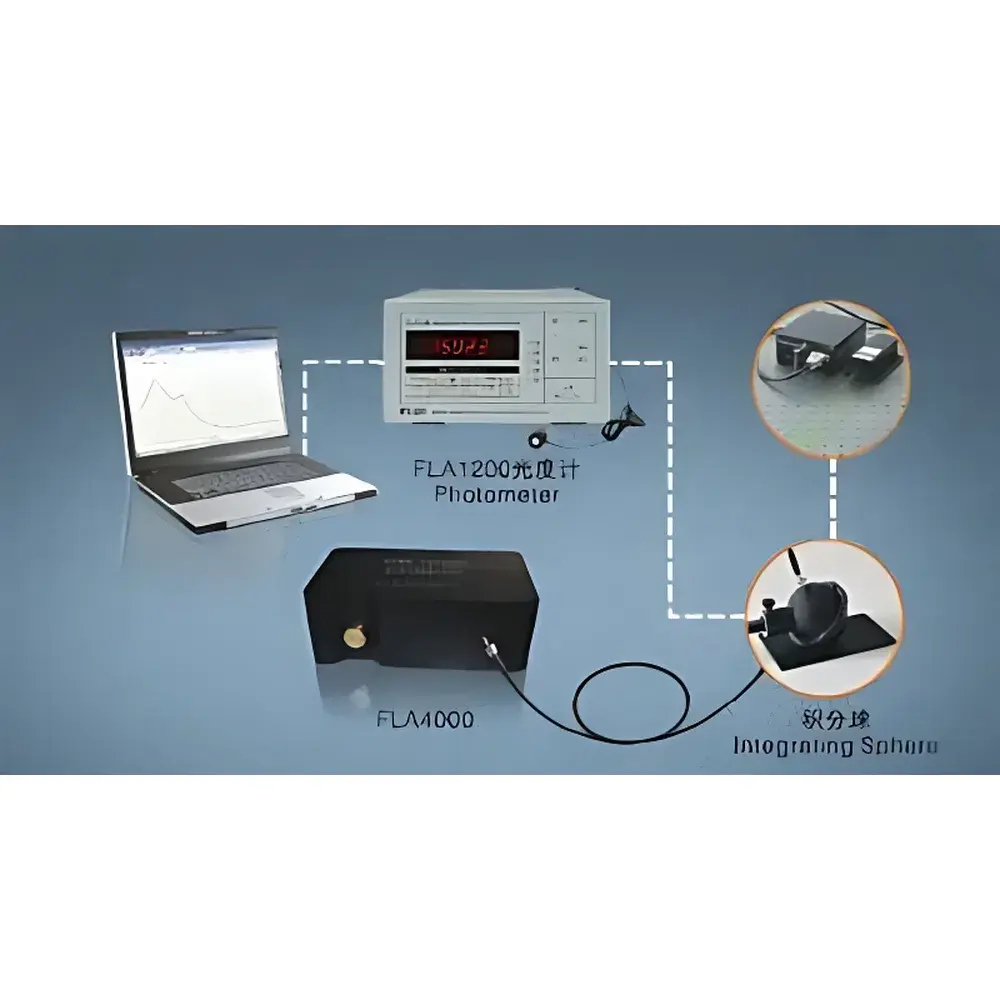
Jingfei Technology FLA Series Laser Analysis System
| Brand | Jingfei Technology |
|---|---|
| Origin | Zhejiang, China |
| Manufacturer Type | OEM Manufacturer |
| Regional Category | Domestic (China) |
| Model | FLA Series |
| Detector Type | CCD |
| Configuration | Integrated with Sphere Series Integrating Sphere and FLA1200 Photometer |
| Application Scope | Real-time in-line laser characterization |
Overview
The Jingfei Technology FLA Series Laser Analysis System is a purpose-engineered optical metrology platform designed for precise, repeatable, and traceable characterization of continuous-wave (CW) and pulsed laser sources across UV-VIS-NIR spectral ranges (typically 200–1100 nm, dependent on spectrometer grating and detector configuration). Built around the FLA series miniature fiber optic spectrometer — featuring high optical throughput, low stray light design, and thermally stabilized CCD detection — the system integrates a calibrated Sphere Series integrating sphere and the FLA1200 photometer to enable simultaneous spectral and radiometric measurement. Its core operating principle relies on spectral dispersion via holographic or ruled diffraction gratings, followed by CCD-based photon counting and calibrated radiometric conversion using NIST-traceable sphere reflectance standards and photometer responsivity curves. This architecture ensures compliance with fundamental radiometric principles defined in CIE Publication 127 and ISO/CIE 13370 for LED and laser source measurement, while supporting alignment with ASTM E308-22 (computing colorimetric quantities) and IEC 60825-1 safety classification workflows.
Key Features
- Modular architecture combining FLA-series fiber-coupled spectrometer, Sphere-series integrating sphere (e.g., Sphere-3P or Sphere-5P variants), and FLA1200 calibrated photometer for synchronized spectral + total flux acquisition
- CCD-based detection with 2048-pixel linear array, typical full-width half-maximum (FWHM) optical resolution of 0.5–2.0 nm (configurable via slit width and grating selection)
- Real-time spectral acquisition at up to 100 spectra per second, enabling dynamic monitoring of laser drift, mode hopping, or thermal wavelength shift during burn-in or aging tests
- Factory-calibrated radiometric scale traceable to national standards; optional recalibration certificates available per ISO/IEC 17025-accredited laboratories
- Rugged aluminum housing with passive thermal management; operating temperature range: 10–40 °C, relative humidity ≤80% non-condensing
- USB 2.0 interface with vendor-provided SDK (C/C++, Python, LabVIEW APIs) for integration into automated test benches or production line control systems
Sample Compatibility & Compliance
The system accommodates free-space and fiber-coupled laser sources emitting from 375 nm to 1050 nm, including diode lasers, DPSS lasers, VCSELs, and superluminescent diodes (SLDs). Input coupling is achieved via SMA905 or FC/PC fiber interfaces, with optional collimating optics for direct-beam integration. All optical components comply with RoHS Directive 2011/65/EU. Measurement protocols align with key industry standards: spectral centroid and FWHM calculations follow ISO 13694 for laser beam profiling; radiometric calibration adheres to ISO/IEC 17025 requirements when performed by accredited labs; data integrity supports GLP/GMP audit trails when used with validated software configurations. The system does not perform Class 4 laser safety interlocks but is intended for use within Class 1 or Class 3R enclosures compliant with IEC 60825-1:2014.
Software & Data Management
Jingfei’s proprietary SpectraView Pro software provides real-time spectrum visualization, automated peak detection (with centroid, FWHM, and asymmetry analysis), and radiometric unit conversion (W, W/sr, W/nm, mW/cm²). Raw spectral data is exportable in CSV, ASCII, and XML formats with embedded metadata (timestamp, integration time, calibration ID, instrument serial number). For regulated environments, optional 21 CFR Part 11-compliant software modules are available, offering electronic signatures, role-based access control, audit trail logging, and secure data archiving. All firmware and calibration files are digitally signed to prevent unauthorized modification. Data storage follows ISO 27001-aligned encryption practices for networked deployments.
Applications
- Production-line verification of laser diode wavelength binning and power consistency prior to module assembly
- Accelerated life testing of laser packages, tracking spectral shift (Δλ) and radiant flux degradation over time
- QC validation of pump laser sources in fiber amplifier manufacturing
- Development-stage characterization of tunable external cavity diode lasers (ECDLs) and swept-source OCT emitters
- Calibration support for reference laser standards in metrology labs meeting ISO/IEC 17025 scope requirements
- Education and research labs requiring cost-effective, modular laser characterization without vacuum or cryogenic infrastructure
FAQ
What spectral range is supported by the standard FLA spectrometer configuration?
Standard configurations cover 200–1100 nm; specific range depends on grating selection and detector coating — e.g., UV-enhanced CCD for 200–400 nm, back-thinned CCD for extended NIR sensitivity.
Can the system measure pulsed lasers?
Yes, with appropriate triggering synchronization via TTL input; minimum pulse width support is ≥10 µs at repetition rates up to 10 kHz.
Is NIST-traceable calibration included with purchase?
A factory radiometric calibration certificate is provided; NIST-traceable recalibration services are available as an optional add-on with documented uncertainty budgets.
Does the system support automated pass/fail decision logic for production testing?
Yes — SpectraView Pro includes configurable limit templates and binary output triggers via digital I/O port for integration with PLC-based sorting systems.
How is thermal stability maintained during extended measurements?
The spectrometer features internal thermistor feedback and passive heat-sinking; ambient temperature fluctuations >±2 °C/hour may require active chamber stabilization for sub-pixel wavelength repeatability.




