
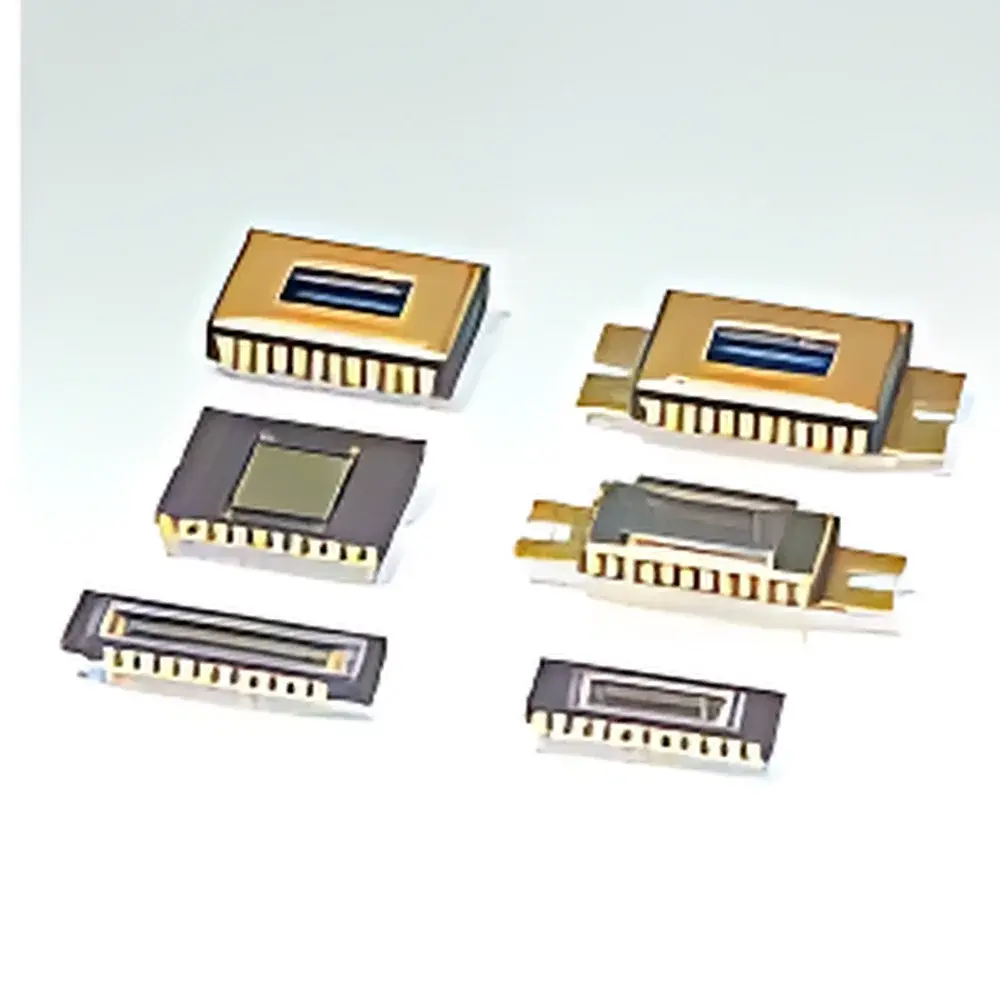
Hamamatsu S10420 / S11071 / S7030 Series Back-Illuminated CCD Sensors for Scientific Spectroscopy
| Origin | Japan |
|---|---|
| Manufacturer Type | Authorized Distributor |
| Origin Category | Imported |
| Model | CCD |
| Pricing | Request Quote |
Overview
Hamamatsu Photonics’ back-illuminated (BI) CCD sensor series—including the S10420, S11071, S7030, S7031, S10140, and S11500 families—represents a foundational imaging technology engineered for high-fidelity spectral detection in demanding scientific instrumentation. These sensors operate on the principle of charge-coupled device physics: incident photons generate electron-hole pairs in silicon; photogenerated electrons are collected in potential wells beneath each pixel and transferred sequentially to a readout amplifier with minimal loss. The back-illumination architecture eliminates absorption and scattering losses associated with gate structures, enabling quantum efficiency (QE) exceeding 90% across the 200–1100 nm range—including critical ultraviolet (UV) and near-infrared (NIR) bands. This makes them particularly suitable for low-light, high-dynamic-range applications such as Raman spectroscopy, fluorescence lifetime imaging, UV-Vis-NIR spectrometers, and time-resolved optical measurements where signal integrity, spectral fidelity, and photon budget efficiency are paramount.
Key Features
- Wide Spectral Response: Uniform sensitivity from deep UV (200 nm) to NIR (1100 nm), optimized for broadband spectroscopic systems requiring calibration traceability per ISO/IEC 17025 and ASTM E275.
- Back-Illuminated Architecture: Delivers superior QE (>80% at 200 nm, >90% at 600 nm), reduced etaloning, and enhanced MTF compared to front-illuminated alternatives—critical for resolving narrow spectral lines in atomic emission or laser-induced breakdown spectroscopy (LIBS).
- Multiple Array Configurations: Linear (1D) and area (2D) formats available—from 512×4 to 2048×506 pixels—with active areas spanning 12.3×0.096 mm² to 28.7×6.07 mm² to support slit-based monochromators, imaging spectrographs, and fiber-coupled OEM modules.
- Low-Noise Readout: Read noise as low as 4 e⁻ rms (typ.) at standard readout rates; select models (e.g., S7031, S10141, S9038) integrate single-stage thermoelectric (Peltier) cooling to suppress dark current by up to two orders of magnitude—enabling integration times from milliseconds to minutes without saturation.
- High-Speed & High-Dynamic Range Operation: Readout frequencies ranging from 0.15 MHz to 10 MHz, supporting both rapid transient capture and high-resolution averaging modes compliant with USP particulate matter analysis and FDA 21 CFR Part 11 audit-trail requirements when integrated into validated analytical platforms.
Sample Compatibility & Compliance
These CCD sensors are designed for integration into OEM optical instruments—not standalone end-user devices—and are compatible with vacuum-, nitrogen-purged, or ambient optical paths depending on UV transmission requirements. All BI-CCD variants meet RoHS Directive 2011/65/EU and are manufactured under Hamamatsu’s ISO 9001-certified quality management system. For regulated environments (e.g., pharmaceutical QC labs), sensor-level performance data—including dark current stability, linearity deviation (<0.5%), and pixel defect maps—are supplied with each unit to support IQ/OQ/PQ validation protocols aligned with GMP Annex 11 and GLP principles. No intrinsic regulatory certification (e.g., CE marking) applies at the component level; final instrument compliance remains the responsibility of the integrating manufacturer.
Software & Data Management
Hamamatsu provides comprehensive SDKs (C/C++, LabVIEW, MATLAB, Python) supporting full register-level control of timing, gain, binning, and region-of-interest (ROI) readout. Raw 16-bit digital outputs are delivered via Camera Link, USB 3.0, or LVDS interfaces—ensuring deterministic latency and frame synchronization for multi-sensor or pump-probe configurations. Data streams comply with IEEE 1394b and GenICam standards where applicable. When embedded in validated analytical instruments, these sensors support metadata tagging (wavelength calibration coefficients, exposure time, temperature) required for 21 CFR Part 11 electronic records and ALCOA+ data integrity frameworks. Firmware updates are digitally signed and version-locked to prevent unauthorized modification.
Applications
- UV-Vis-NIR spectrophotometers and array-based monochromators for chemical quantification (ASTM D5596, ISO 10477)
- Raman and fluorescence spectrometers for material identification, pharmaceutical polymorph screening, and biopharmaceutical stability studies
- DNA sequencing platforms utilizing capillary electrophoresis or microfluidic chip-based detection
- Plasma diagnostics and combustion analysis requiring nanosecond-scale temporal resolution
- X-ray imaging detectors (when coupled with scintillators or fiber-optic tapers) for dental radiography and industrial NDT per ISO 17636-2
- Astronomical instrumentation and space-borne remote sensing payloads (e.g., Earth observation spectrometers)
FAQ
Are these sensors calibrated for absolute radiometric response?
No—radiometric calibration is performed at the system level (i.e., after optical coupling, grating, and housing integration). Hamamatsu provides relative QE curves and pixel response uniformity data for OEM reference.
Can these CCDs be operated in vacuum environments?
Yes—most models (excluding those with epoxy-sealed packages) are rated for operation under 10⁻⁴ Pa vacuum. Consult Hamamatsu Technical Note TN-CCD-001 for outgassing specifications and bake-out procedures.
Do you offer custom window materials or AR coatings?
Yes—quartz, MgF₂, and fused silica windows with broadband or wavelength-specific anti-reflection coatings are available upon request for UV-enhanced or NIR-optimized configurations.
What is the typical MTBF for these sensors under continuous operation?
Based on accelerated life testing, mean time before failure exceeds 50,000 hours at 25°C ambient and nominal bias conditions—consistent with IEC 62380 reliability prediction methodology.
Is firmware update capability supported in the field?
Firmware is factory-programmed and locked; updates require return-to-factory service or authorized distributor support under warranty terms.
Related Products




