
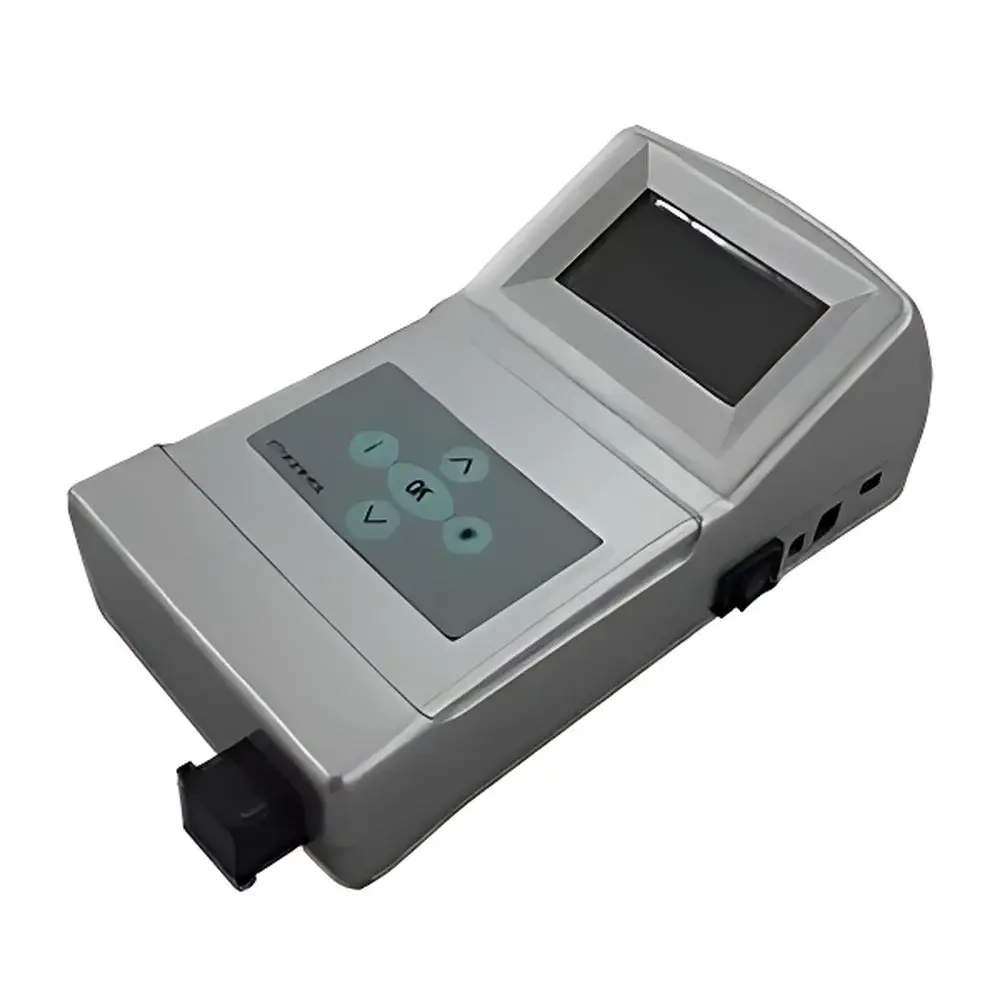
Hamamatsu Photonics BHP9505-04 ATP Bioluminescence Detector
| Brand | Hamamatsu Photonics (BHP) |
|---|---|
| Model | BHP9505-04 |
| Detection Range | 0–10⁷ RLU |
| Microbial Count Display | 0–10¹⁷ CFU/mL |
| Spectral Response | 300–650 nm |
| Integration Time | 1–300 s (user-adjustable) |
| Data Storage | 2,000 test records |
| Repeatability | ≤3% |
| Background Count Rate | ≤30 s⁻¹ |
| Dimensions | 190 × 100 × 70 mm |
| Operating Temperature | 5–30 °C |
| Relative Humidity | ≤85% |
| Power Supply | Dual AC/DC |
Overview
The Hamamatsu Photonics BHP9505-04 ATP Bioluminescence Detector is a portable, high-sensitivity luminometer engineered for rapid quantification of adenosine triphosphate (ATP) in environmental, food safety, and hygiene monitoring applications. It operates on the principle of firefly luciferase-mediated bioluminescence: in the presence of oxygen, luciferase catalyzes the oxidation of D-luciferin using ATP as a co-substrate, producing oxyluciferin and visible light (λmax ≈ 560 nm). The emitted photon flux is directly proportional to ATP concentration under enzyme- and substrate-saturated conditions. Since viable microbial cells maintain intracellular ATP pools at relatively stable levels (typically 10−18–10−17 mol per cell), total ATP measured in a sample serves as a robust proxy for metabolically active biomass. This enables real-time assessment of microbial contamination—without culturing—within seconds, supporting critical decision-making in HACCP, SSOP, and environmental monitoring programs.
Key Features
- High quantum-efficiency photodetector optimized for low-light bioluminescence detection across 300–650 nm spectral range
- User-configurable integration time (1–300 s) to balance sensitivity, dynamic range, and throughput
- On-device storage of up to 2,000 test records with timestamp, location tag, and RLU/CFU conversion
- Pre-loaded capacity for 10 customizable calibration curves—enabling direct CFU/mL readout for diverse sample matrices (e.g., rinse water, swab extracts, liquid foods)
- Large backlit LCD with intuitive Chinese-language menu interface—no specialized training required for operation or data interpretation
- USB interface compliant with standard HID protocols for seamless export of raw RLU values and metadata to Excel-compatible spreadsheets
- Compact form factor (190 × 100 × 70 mm) and dual AC/DC power support—ideal for field deployment, mobile labs, and production-floor hygiene audits
- Low intrinsic background count rate (≤30 s⁻¹) and high repeatability (≤3% CV) ensure measurement stability across repeated assays
Sample Compatibility & Compliance
The BHP9505-04 is validated for use with ATP extraction reagents compatible with ISO 22000, FDA Food Code Annex 3, and EU Regulation (EC) No 852/2004 hygiene requirements. It accepts standard commercial ATP swabs, liquid sampling kits, and filtration-based enrichment protocols. While not a replacement for culture-based enumeration per ISO 4833-1 or FDA BAM Chapter 3, it meets performance criteria outlined in AOAC Official Method 2012.05 for rapid hygiene verification. Its RLU-to-CFU correlation (r = 0.85–0.92 across typical food processing matrices) supports trending analysis and zone-specific pass/fail thresholds aligned with internal sanitation standards. Instrument firmware and data handling architecture support audit-ready traceability, including user ID logging, test location tagging, and immutable timestamping—facilitating GLP-aligned documentation and 21 CFR Part 11–compatible workflows when paired with validated laboratory information management systems (LIMS).
Software & Data Management
Data acquisition and post-processing are supported via Hamamatsu’s proprietary BHP-DataLink software (Windows-compatible). The application enables batch import of RLU files, automatic application of selected calibration curves, statistical filtering (e.g., outlier removal by Grubbs’ test), and generation of time-series hygiene dashboards. All exported datasets retain full metadata: test date/time, operator ID, sampling site code, integration duration, and raw photon counts. Export formats include CSV and XLSX; no proprietary binary formats are used. Audit logs record all software-initiated modifications to calibration parameters or curve definitions. For enterprise integration, the USB interface supports scripted automation via Python or LabVIEW through standard CDC ACM drivers—enabling scheduled data synchronization with cloud-based quality management platforms.
Applications
- Rapid verification of surface cleanliness on food contact equipment (conveyors, fillers, slicers) pre- and post-sanitization
- Real-time assessment of microbial load in potable water distribution systems and point-of-use filters
- Hygiene validation of endoscopes, surgical instruments, and cleanroom surfaces in healthcare facilities
- Monitoring organic residue accumulation on food packaging lines to prevent biofilm nucleation
- Supporting environmental monitoring programs in pharmaceutical manufacturing (ISO 14644-1 Class 5–8 zones)
- Field-deployed screening of soil and wastewater samples for biologically active contamination
- Quantitative ATP profiling in tissue homogenates for metabolic activity studies in preclinical research
FAQ
How does the BHP9505-04 differentiate between microbial ATP and ATP from food residues?
It does not chemically distinguish ATP sources. Interpretation relies on standardized sampling protocols: ATP from non-microbial sources (e.g., meat juice, dairy film) is minimized via validated rinsing steps prior to swabbing. Correlation with culture-based methods establishes matrix-specific action thresholds.
Can this instrument be used for regulatory compliance reporting?
The device itself is not certified for standalone regulatory submission. However, its data—when generated under documented SOPs, calibrated against reference standards, and integrated into a validated QMS—supports evidence-based hygiene verification under FDA, EFSA, and BRCGS frameworks.
What maintenance is required for long-term photometric accuracy?
Annual verification using NIST-traceable luminance standards is recommended. Routine cleaning of the sample chamber aperture and periodic dark-current checks (per included protocol) ensure consistent low-light response.
Is the 10¹⁷ CFU/mL display range physically meaningful?
No. That upper limit reflects mathematical extrapolation from the instrument’s RLU dynamic range (0–10⁷) and empirical calibration slopes. Practically, reliable quantification is limited to 10²–10⁶ CFU/mL for most swabbed surfaces and 10¹–10⁵ CFU/mL for liquid samples, depending on extraction efficiency.
Does the device comply with electromagnetic compatibility (EMC) directives for international use?
Yes. It conforms to IEC 61326-1:2013 (industrial EMC) and carries CE marking for operation in EU, UK, and EFTA markets. FCC Part 15 Class B compliance is verified for North American deployment.





