
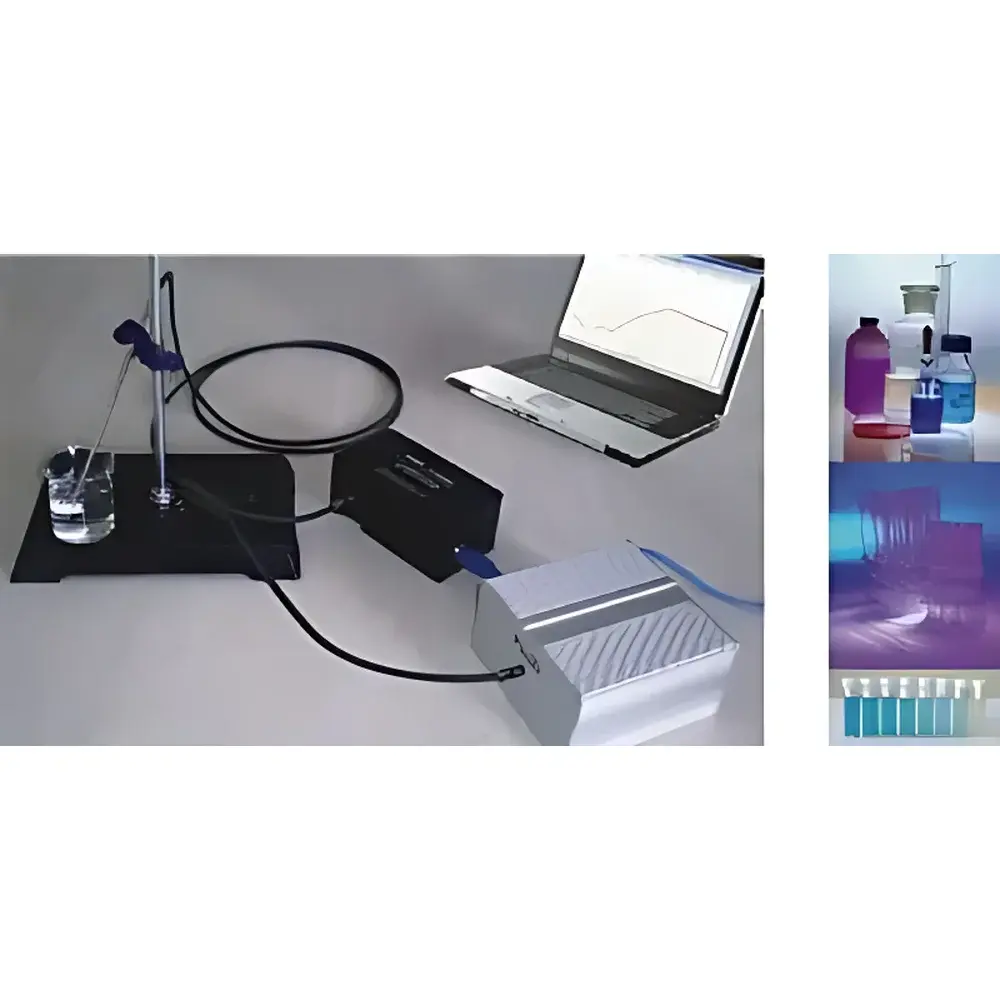
Jingfei FLA Series Absorbance Analysis System
| Brand | Jingfei |
|---|---|
| Origin | Zhejiang, China |
| Manufacturer Type | Original Equipment Manufacturer (OEM/ODM) |
| Detector Type | CCD-based Fiber Optic Spectrometer |
| Model | FLA Series |
| Compliance | CE-marked for laboratory and industrial use |
| Optical Configuration | Transmission-mode absorbance measurement with optional cuvette or flow-cell integration |
| Spectral Range | 200–1100 nm (configurable per FLA submodel) |
| Optical Resolution | ≤1.5 nm FWHM (typical, dependent on slit and grating selection) |
| Integration Time | 1 ms – 65 s |
| Data Output | USB 2.0 / UART / TTL-compatible digital interface |
Overview
The Jingfei FLA Series Absorbance Analysis System is a modular, transmission-mode optical instrumentation platform engineered for quantitative absorbance measurement across the ultraviolet, visible, and near-infrared spectral regions (200–1100 nm). It operates on the fundamental principle of Beer–Lambert law-based spectrophotometry: incident light from a stabilized broadband or LED-based D-series source passes through a sample medium, and the wavelength-dependent attenuation is resolved by a high-sensitivity CCD-array fiber optic spectrometer. Unlike conventional benchtop spectrophotometers, the FLA system decouples optical components—light source, fiber-coupled sample interface, and spectrometer—enabling robust integration into process lines, microfluidic devices, environmental sensor nodes, or portable field analyzers. Its compact footprint (<150 mm × 100 mm × 50 mm for core spectrometer module), low power consumption (<3 W), and absence of moving parts contribute to long-term operational stability in unattended monitoring applications.
Key Features
- Modular architecture supporting interchangeable D-series light sources (deuterium-halogen, UV-LED, or VIS-NIR LED arrays) matched to target absorption bands
- FLA-series miniature fiber optic spectrometers featuring thermoelectrically stabilized CCD detectors for reduced dark current drift and improved signal-to-noise ratio
- Configurable optical path: standard 10-mm quartz cuvette holder, optional 1–100 mm pathlength flow cells, or custom fiber-optic probe interfaces
- Real-time spectral acquisition at up to 100 spectra per second (dependent on integration time and resolution settings)
- Embedded firmware with onboard baseline correction, dark reference subtraction, and peak-area integration algorithms
- Ruggedized aluminum housing rated IP54 for operation in controlled industrial environments
Sample Compatibility & Compliance
The system accommodates liquid-phase samples in transparent matrices—including aqueous solutions, organic solvents, buffer systems, and clarified biological suspensions—with minimal preprocessing. It supports compliance-driven workflows: spectral data acquisition meets ISO/IEC 17025 traceability requirements when paired with NIST-traceable calibration standards (e.g., holmium oxide, neutral density filters). The hardware design conforms to IEC 61326-1 for electromagnetic compatibility in laboratory and light-industrial settings. While not intrinsically certified for hazardous locations, optional ATEX-compliant enclosures are available upon request. All firmware and driver software comply with FDA 21 CFR Part 11 principles for audit trail generation, electronic signatures, and data integrity—subject to customer-configured validation protocols.
Software & Data Management
Jingfei provides the cross-platform SpectraView Suite (Windows/macOS/Linux), offering real-time spectrum visualization, multi-wavelength kinetic profiling, batch absorbance-to-concentration conversion using user-defined calibration curves, and export to CSV, HDF5, or ASTM E1382-compliant spectral data format. The SDK includes C/C++, Python (PySerial, NumPy), and LabVIEW drivers with full register-level access to spectrometer control registers. For enterprise deployment, the system supports OPC UA server integration and MQTT publishing for seamless ingestion into SCADA, LIMS, or cloud-based analytics platforms (e.g., AWS IoT Core, Azure IoT Hub). Audit logs record operator ID, timestamp, configuration changes, and raw spectral hash values—enabling GLP/GMP-aligned review trails.
Applications
- Continuous monitoring of nitrate, phosphate, or heavy metal concentrations in wastewater effluent streams
- In-line quality control of pharmaceutical intermediates during synthesis (e.g., monitoring diazotization or oxidation endpoints)
- Enzyme kinetics assays (e.g., NADH/NADPH absorbance at 340 nm) in microplate or capillary formats
- Food safety screening: detection of adulterants (e.g., melamine via UV shift) or spoilage indicators (e.g., trimethylamine at 225 nm)
- Environmental sensor networks: solar-powered, low-duty-cycle deployments for remote lake or reservoir nutrient tracking
- Integration into OEM analytical instruments requiring embedded absorbance readout (e.g., blood gas analyzers, bioreactor controllers)
FAQ
What spectral resolution can be achieved with the FLA system?
Spectral resolution is determined by the selected grating, entrance slit width, and detector pixel pitch. Typical configurations yield full-width-at-half-maximum (FWHM) values between 0.8 nm and 2.5 nm across the 200–1100 nm range. High-resolution variants (≤0.5 nm FWHM) are available with custom optical assemblies.
Is the system compatible with third-party chemometric software?
Yes—raw spectral data (intensity vs. wavelength) is exported in ASCII or HDF5 format, fully interoperable with Unscrambler, MATLAB PLS Toolbox, Python scikit-learn, and other multivariate analysis environments.
Can the FLA system perform dual-beam referencing?
While the base configuration uses single-beam operation with periodic dark/light reference acquisition, a fiber-splitter accessory enables true dual-beam mode (sample/reference channel) with synchronous detection—ideal for applications sensitive to source intensity drift.
What calibration standards are recommended for routine verification?
We recommend annual verification using NIST-traceable holmium oxide (HO) and didymium (ND) filters for wavelength accuracy, and certified neutral density filters for photometric linearity assessment per ASTM E275 and ISO 6780 protocols.




