
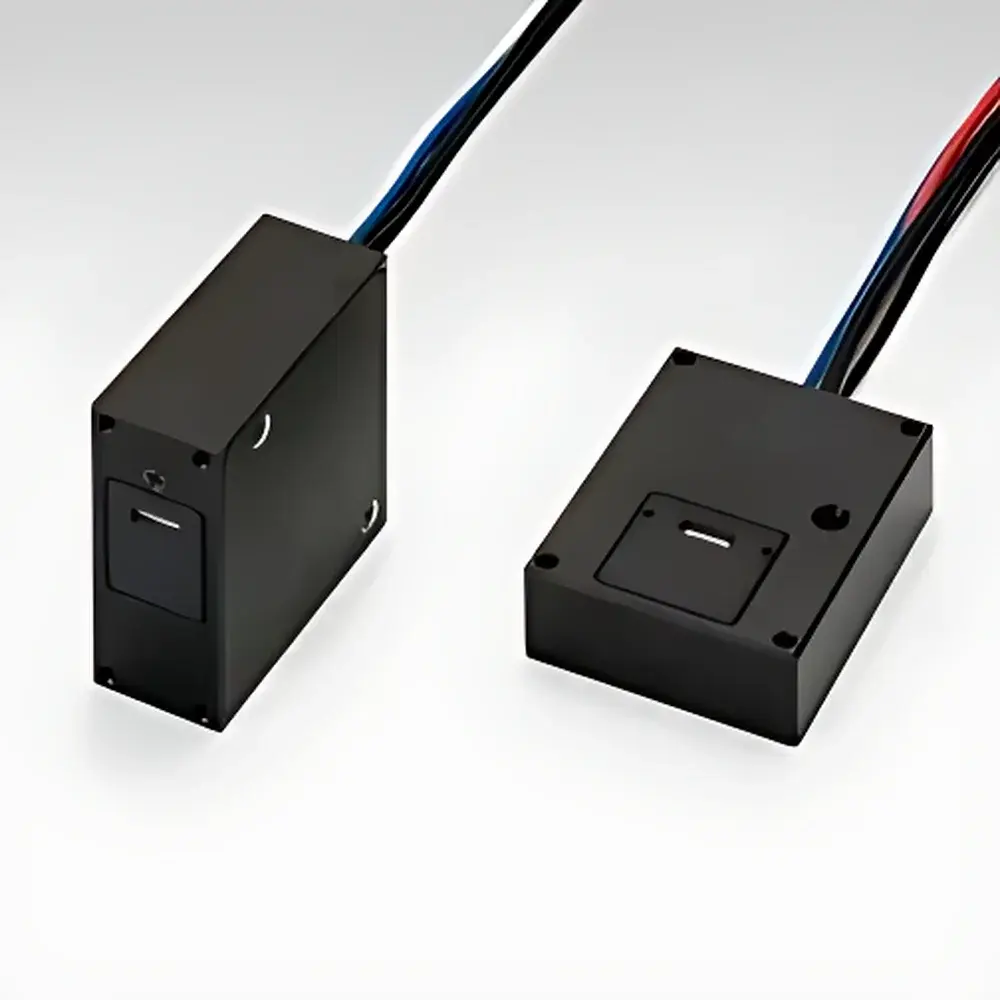
Hamamatsu H12403 Miniature Photomultiplier Tube Module
| Brand | Hamamatsu |
|---|---|
| Origin | Japan |
| Manufacturer Type | Original Equipment Manufacturer (OEM) |
| Product Category | Imported |
| Model | H12403 |
| Component Type | Optical Component |
| Operating Voltage Input | +5 V DC (typical) |
| Spectral Response Range | 300–650 nm (Bialkali photocathode) |
| Typical Anode Gain | 1 × 10⁶ at +5 V supply |
| Package Dimensions | 25.4 × 25.4 × 40.0 mm (W × D × H) |
Overview
The Hamamatsu H12403 Miniature Photomultiplier Tube Module is a fully integrated, compact photodetection solution engineered for high-sensitivity, low-light measurement applications in scientific instrumentation and industrial sensing systems. Built around a side-on bialkali photocathode PMT housed in a hermetically sealed glass envelope, the module incorporates an optimized resistive divider network and a miniature high-voltage generator—all encapsulated within a rigid, shielded metal housing. Unlike discrete PMT assemblies requiring external high-voltage supplies and voltage-divider customization, the H12403 operates from a single +5 V DC input, delivering stable gain with minimal ripple and thermal drift. Its operation relies on the photoelectric effect followed by secondary electron multiplication across discrete dynode stages—enabling photon-counting capability and analog current output with sub-nanosecond rise time. Designed for integration into space-constrained platforms—including flow cytometers, fluorescence lifetime spectrometers, radiation monitoring units, and portable analytical devices—the H12403 maintains performance consistency across ambient temperatures from –20 °C to +50 °C.
Key Features
- Integrated high-voltage generation: Eliminates need for external HV power supplies; accepts only +5 V DC input.
- Bialkali (S-20) photocathode: Delivers peak quantum efficiency >25% at 420 nm and broad spectral response from 300 nm (UV) to 650 nm (visible red).
- Compact footprint: 25.4 × 25.4 × 40.0 mm package enables PCB-mounting via solder pins or spring-loaded connectors.
- Stable gain calibration: Factory-set divider ratio ensures repeatable gain of ~1 × 10⁶ (anode current / photocathode current) under nominal conditions.
- Low-noise design: Internal electromagnetic shielding and optimized dynode geometry minimize dark current (<10 nA at 25 °C) and pulse height resolution degradation.
- Robust mechanical architecture: Aluminum housing provides EMI/RFI suppression and mechanical protection without compromising thermal dissipation.
Sample Compatibility & Compliance
The H12403 is compatible with standard optical coupling configurations—including fiber-optic tapers, lens-coupled light guides, and direct free-space illumination—provided optical alignment respects the specified active photocathode area (Φ8 mm). It complies with IEC 61000-6-3 (emission) and IEC 61000-6-2 (immunity) for industrial electromagnetic compatibility. While not certified for medical or aerospace use out-of-the-box, its construction adheres to JIS C 5401 and JEDEC J-STD-020 moisture sensitivity level (MSL) 3 protocols. For regulated environments (e.g., GLP/GMP-compliant labs), users must validate module stability per ISO/IEC 17025 clause 5.5.2 and document calibration traceability to NIST-traceable reference sources.
Software & Data Management
As a self-contained analog sensor module, the H12403 does not include embedded firmware or digital interfaces. It outputs analog current proportional to incident photon flux, typically conditioned via external transimpedance amplifiers or current-to-voltage converters. Integration with data acquisition systems (e.g., National Instruments PXI, Keysight DAQ, or custom FPGA-based front ends) requires user-defined signal conditioning and digitization. For time-resolved applications, synchronization is achieved via TTL-compatible gate input (optional variant H12403-01 includes external gating). All operational parameters—including gain drift vs. temperature and linearity deviation over 6 decades of input irradiance—are documented in Hamamatsu’s official technical note TN-0011 (Rev. D), which supports audit-ready documentation per FDA 21 CFR Part 11 when paired with validated acquisition software.
Applications
- Fluorescence and phosphorescence decay analysis in time-correlated single-photon counting (TCSPC) setups.
- Low-level chemiluminescence detection in microplate readers and immunoassay analyzers.
- Scintillation counting in radiation safety monitors and environmental gamma spectroscopy systems.
- UV-VIS absorbance and turbidity measurements in compact process analyzers for pharmaceutical water quality control.
- Particle detection in airborne particulate matter (PM2.5/PM10) sensors using laser-induced scattering.
- Research-grade photon correlation spectroscopy (PCS) and dynamic light scattering (DLS) instrumentation.
FAQ
What is the recommended load resistance for optimal linearity?
A 50 Ω termination is advised for pulse-mode operation; for analog current measurement, a 1 kΩ–10 kΩ transimpedance amplifier is typical.
Can the H12403 be operated in photon-counting mode?
Yes—when coupled with a low-noise discriminator and counter, it achieves <200 ps timing jitter (FWHM) with dark count rates <50 cps at room temperature.
Is cooling required for extended integration periods?
Not mandatory, but thermoelectric cooling to –10 °C reduces dark current by ~50% and improves signal-to-noise ratio in long-exposure spectroscopy.
Does Hamamatsu provide calibration certificates with shipment?
Standard units ship without individual calibration; NIST-traceable calibration reports are available as optional add-ons (Order Code: CAL-H12403-STD).
How does the module handle magnetic fields?
The internal mu-metal shielding provides attenuation of static fields up to 0.2 mT; for stronger fields (>0.5 mT), external magnetic shielding is recommended.



