
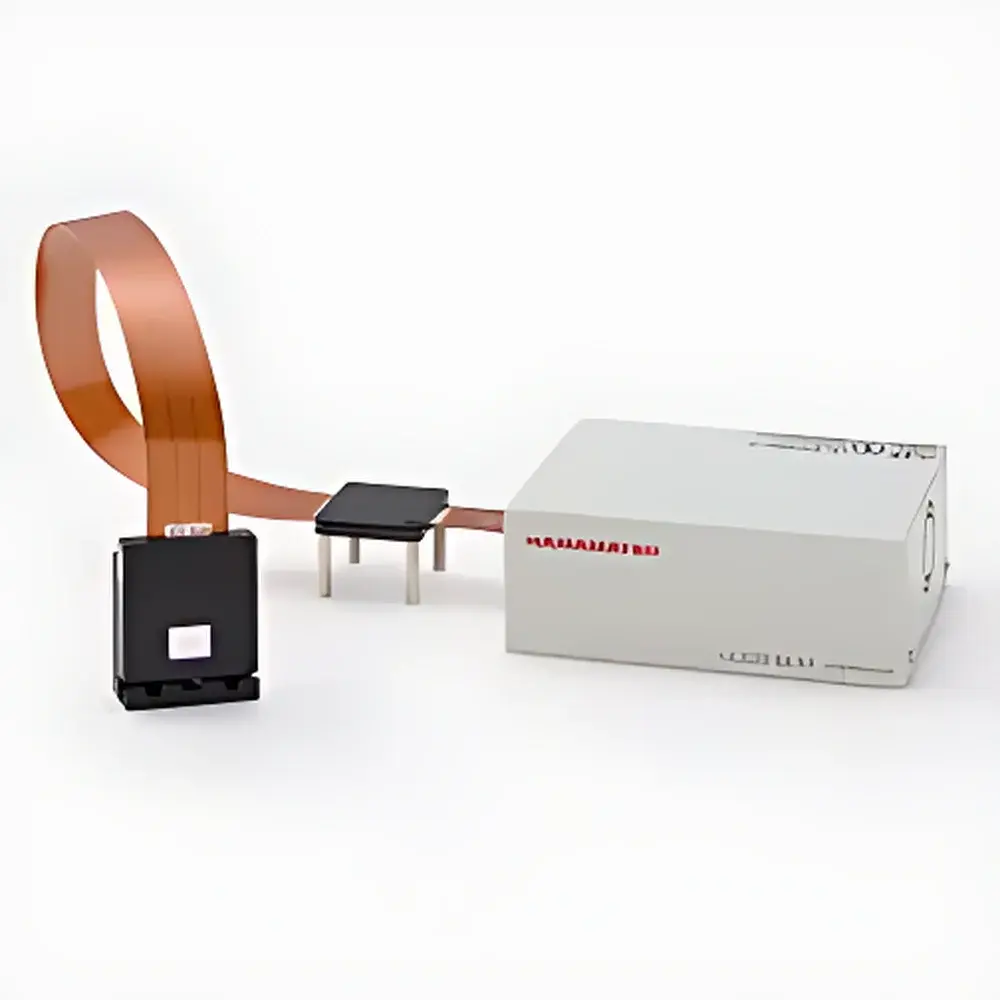
Hamamatsu LCOS-SLM X15213-03CL
| Brand | Hamamatsu |
|---|---|
| Origin | Japan |
| Manufacturer Type | Original Equipment Manufacturer (OEM) |
| Import Status | Imported |
| Model | X15213-03CL |
| Pricing | Upon Request |
| Pixel Pitch | 12.5 µm |
| Input Interface | DVI-D / USB-B (USB 2.0 High-Speed) |
| DVI Resolution | SXGA (1280 × 1024) |
| DVI Frame Rate | 60 Hz |
| Gray Levels | 256 (8-bit) |
| Active Pixel Count | 1272 × 1024 |
| Active Area | 15.9 × 12.8 mm |
| Maximum Spatial Resolution | 40 lp/mm |
| Fill Factor | 96 % |
| Rise Time | 27 ms |
| Fall Time | 83 ms |
| Readout Wavelength | 1050 ± 50 nm |
| Optical Efficiency | 97 % (measured at λ = 1064 nm) |
| Power Handling Capacity | ≥ 700 W (CW, 1050 ± 50 nm) |
Overview
The Hamamatsu LCOS-SLM X15213-03CL is a high-power reflective-phase-only spatial light modulator engineered for demanding industrial and scientific applications requiring precise, dynamic wavefront control under intense laser irradiation. Built upon silicon-based liquid crystal on silicon (LCOS) architecture, this device leverages direct voltage addressing of the nematic liquid crystal layer via an integrated CMOS backplane to achieve pixel-level phase modulation with high fidelity and temporal stability. Unlike transmissive SLMs, its reflective configuration enables superior thermal management and optical efficiency—critical for continuous-wave (CW) laser systems operating in the near-infrared regime. The core innovation lies in Hamamatsu’s proprietary thermal design, which significantly enhances heat dissipation from the LC layer, thereby suppressing thermally induced birefringence drift and phase nonuniformity. As a result, the X15213-03CL sustains stable phase modulation performance at incident optical powers exceeding 700 W (CW, centered at 1050 nm), representing a 3.5× improvement over its predecessor (X15213-03BL). This capability positions it as a foundational component in next-generation laser-based additive manufacturing, precision welding, and high-throughput micromachining systems.
Key Features
- Reflective-phase-only operation optimized for high-power NIR lasers (1050 ± 50 nm)
- Proprietary thermal architecture enabling ≥ 700 W CW power handling without performance degradation
- High-resolution active array: 1272 × 1024 pixels with 12.5 µm pitch and 96% fill factor
- Effective optical aperture: 15.9 × 12.8 mm, supporting diffraction-limited beam shaping up to 40 line pairs/mm
- Optical efficiency of 97% at 1064 nm—minimizing thermal load and maximizing usable intensity
- Dual-input interface: DVI-D for real-time pattern streaming (SXGA, 60 Hz) and USB-B (USB 2.0 HS) for firmware/configuration updates
- Fast electro-optic response: 27 ms rise time and 83 ms fall time—enabling quasi-dynamic holographic projection
- 8-bit grayscale control (256 levels) for accurate phase-depth encoding using standard Gerchberg-Saxton or direct phase mapping algorithms
Sample Compatibility & Compliance
The X15213-03CL is designed for integration into Class 4 laser systems compliant with IEC 60825-1 and ANSI Z136.1 safety standards. Its optical surface is coated for high reflectivity and low absorption across the 1050 ± 50 nm band, minimizing localized heating and ensuring long-term reliability under sustained illumination. The device meets RoHS Directive 2011/65/EU requirements and is manufactured under ISO 9001-certified quality management processes. While not a standalone medical or diagnostic device, its use in laser metal sintering platforms may support compliance with ISO/ASTM 52900 (Additive Manufacturing — General Principles) and ASTM F2792 (Standard Terminology for Additive Manufacturing Technologies) when embedded within validated system architectures. No FDA 21 CFR Part 11 or GLP/GMP-specific features are implemented, as the unit functions strictly as an optical subsystem—not a data-acquisition or regulated process controller.
Software & Data Management
Hamamatsu provides the SLM Control Software Suite (v3.x), a Windows-based application supporting DVI-driven real-time pattern loading, phase calibration, and gamma correction. The software exports phase maps in standard binary (.bin) and TIFF formats compatible with MATLAB, Python (NumPy), and commercial optical design tools (e.g., Zemax OpticStudio, CODE V). USB-B interface enables firmware version verification, temperature monitoring (via onboard thermistor), and safe-mode activation in case of thermal threshold exceedance. No cloud connectivity or remote access functionality is included; all operations occur locally to ensure deterministic latency and cybersecurity compliance in industrial environments. Audit trails for configuration changes are not maintained, as the device lacks embedded non-volatile logging—consistent with its role as a passive optical actuator rather than a regulated instrumentation endpoint.
Applications
- Laser powder bed fusion (LPBF) and directed energy deposition (DED) in metal 3D printing—enabling multi-beam parallel processing and adaptive focus scanning
- High-brightness fiber laser welding and cutting—where dynamic beam shaping improves joint penetration consistency and reduces spatter
- Adaptive optics in high-energy laser systems (e.g., inertial confinement fusion diagnostics, laser guide star correction)
- Computational lithography and maskless photomask patterning for microfabrication
- Quantum optics experiments requiring programmable phase masks for single-photon state engineering
- Structured illumination microscopy (SIM) and digital holographic microscopy (DHM) with extended depth-of-field reconstruction
FAQ
What is the maximum average power density the X15213-03CL can withstand without thermal damage?
Under collimated illumination at 1050 nm with uniform beam distribution, the device supports average power densities up to ~2.8 kW/cm² (calculated from 700 W over 15.9 × 12.8 mm active area), provided adequate mounting thermal resistance (< 0.1 K/W) and baseplate cooling are maintained.
Is the phase response linear with applied voltage?
No—the phase-voltage relationship is inherently nonlinear and device-specific. Hamamatsu supplies per-pixel calibration LUTs (Look-Up Tables) to enable linearized phase modulation across the full 0–2π range.
Can the SLM be used with pulsed lasers?
Yes—provided peak fluence remains below 0.5 J/cm² for nanosecond pulses and average power stays within the 700 W limit. Thermal accumulation effects dominate performance constraints, not dielectric breakdown.
Does the unit include built-in temperature sensing?
Yes—a calibrated thermistor is embedded near the LC layer and accessible via USB query commands for real-time thermal monitoring and system-level interlock integration.
Is there a recommended driver board or interface module for custom FPGA-based control?
Hamamatsu offers the optional SLM-Driver Kit (Model: SLDK-01), which provides LVDS-to-DVI signal conversion, timing synchronization, and ESD-protected DVI output—designed specifically for integration with industrial motion controllers and FPGA platforms.





