
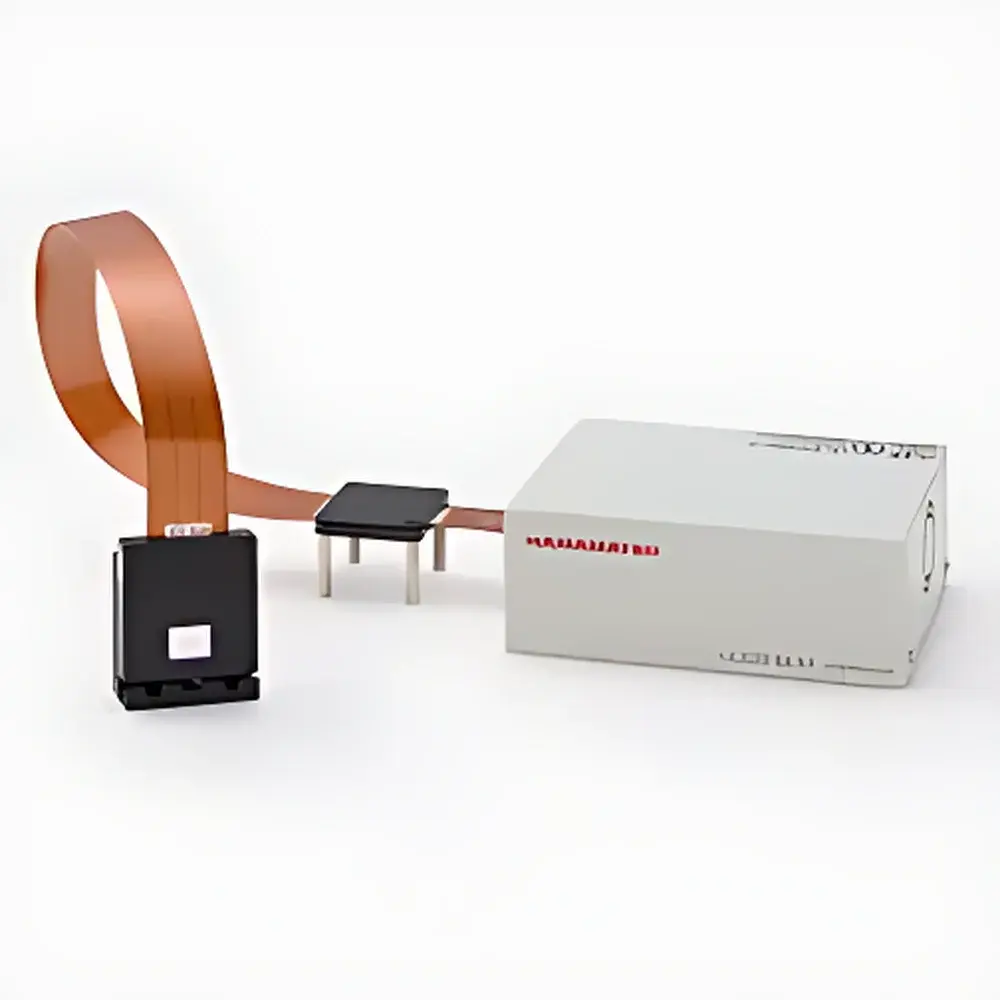
Hamamatsu LCOS-SLM X15213-03B
| Brand | Hamamatsu |
|---|---|
| Origin | Japan |
| Manufacturer Type | Original Equipment Manufacturer (OEM) |
| Import Status | Imported |
| Model | X15213-03B |
| Pricing | Available upon Request |
Overview
The Hamamatsu LCOS-SLM X15213-03B is a high-performance reflective-type pure-phase spatial light modulator engineered for precision wavefront control in advanced optical systems. Built on silicon-based liquid crystal on silicon (LCOS) technology, this device enables voltage-driven, pixel-level modulation of the optical phase profile without introducing significant amplitude distortion. Its operational wavelength range is centered at 1050 nm ± 50 nm — optimized for near-infrared applications including ultrafast laser pulse shaping, adaptive optics correction, holographic beam steering, and quantum optics experiments requiring high-fidelity phase encoding. Unlike transmissive SLMs, the reflective architecture minimizes thermal load accumulation and supports higher average optical power handling, making it suitable for integration into high-intensity laser setups such as Ti:sapphire amplifier chains or fiber laser systems operating near 1064 nm. The device achieves diffraction-limited performance through rigorous optical design, including optimized fill factor, minimized inter-pixel crosstalk, and intrinsic compensation for LC-induced wavefront aberrations.
Key Features
- Pure-phase modulation with linear, monotonic phase response across 0–2π range at 1064 nm
- High optical efficiency: >97% light utilization under specified illumination conditions (λ = 1064 nm)
- High diffraction efficiency (>85% typical for first-order holograms with optimized grating designs)
- Robust reflective LCOS architecture enabling stable operation under extended exposure to high-power NIR illumination
- SXGA resolution (1280 × 1024 active pixels) with 12.5 µm pixel pitch and 96.8% fill factor
- DVI-D interface compatibility (60 Hz frame rate) for seamless integration with standard laboratory PCs and graphics cards
- Integrated USB-B 2.0 port for firmware updates, calibration data loading, and real-time parameter adjustment
- Fast electro-optic response: 25 ms rise time and 80 ms fall time, enabling dynamic phase pattern sequencing
Sample Compatibility & Compliance
The X15213-03B is designed for use with collimated, polarized input beams aligned to its designated incidence angle (typically 45° relative to surface normal). It is compatible with standard NIR optical mounts and kinematic stages used in interferometric and holographic setups. While not certified to specific regulatory standards (e.g., CE, FDA), the device conforms to industrial-grade electromagnetic compatibility (EMC) and safety practices consistent with IEC 61326-1 for laboratory measurement equipment. Its optical performance specifications meet common requirements for ISO/IEC 17025-accredited laboratories performing phase-sensitive metrology, and its digital interface adheres to VESA DVI-D v1.0 timing and electrical specifications. Calibration files provided by Hamamatsu support traceable phase response characterization per pixel, facilitating GLP-compliant experimental documentation.
Software & Data Management
Control is implemented via Hamamatsu’s proprietary SLM Controller Software (v3.x+), which runs on Windows 10/11 and supports both GUI-driven pattern generation and API-based scripting (C++, Python SDK available). The software includes built-in tools for gamma correction, phase unwrapping, and aberration compensation using pre-measured Zernike coefficient sets. All loaded phase maps are stored with metadata (timestamp, wavelength, calibration ID), supporting audit trails required under 21 CFR Part 11 for regulated environments. Export formats include BMP, TIFF, and binary arrays compatible with MATLAB, LabVIEW, and custom CUDA-accelerated reconstruction pipelines. Firmware updates preserve user-defined LUTs and maintain backward compatibility with existing experimental protocols.
Applications
- Adaptive optics in astronomical telescopes and ophthalmic imaging systems
- Dynamic holography and computer-generated hologram (CGH) projection
- Ultrafast pulse shaping in chirped pulse amplification (CPA) systems
- Optical trapping and holographic optical tweezers (HOT)
- Quantum information processing: spatial mode encoding for OAM multiplexing
- Structured illumination microscopy (SIM) and super-resolution techniques
- Laser material processing beam homogenization and multi-spot generation
FAQ
What is the maximum average optical power the X15213-03B can handle?
The device is rated for continuous-wave (CW) operation up to 5 W/cm² at 1064 nm when properly heat-sinked; pulsed operation (e.g., ns–ps pulses) requires derating based on peak fluence and repetition rate.
Is external polarization control required?
Yes — optimal phase modulation requires linearly polarized input aligned to the SLM’s designated polarization axis; a half-wave plate and polarizer are typically integrated upstream.
Can multiple X15213 units be synchronized?
Synchronization is achievable via external trigger input (TTL-compatible) and frame-locking through DVI blanking signals; precise inter-unit phase coherence requires individual calibration.
Does the unit include factory calibration data?
Yes — each shipped unit includes a unique pixel-wise phase-response LUT and measured wavefront error map, delivered as encrypted binary files compatible with Hamamatsu’s controller software.
Is Linux driver support available?
Native Linux drivers are not provided; however, the USB interface allows low-level register access via libusb, and community-developed Python wrappers exist for basic pattern streaming.






