
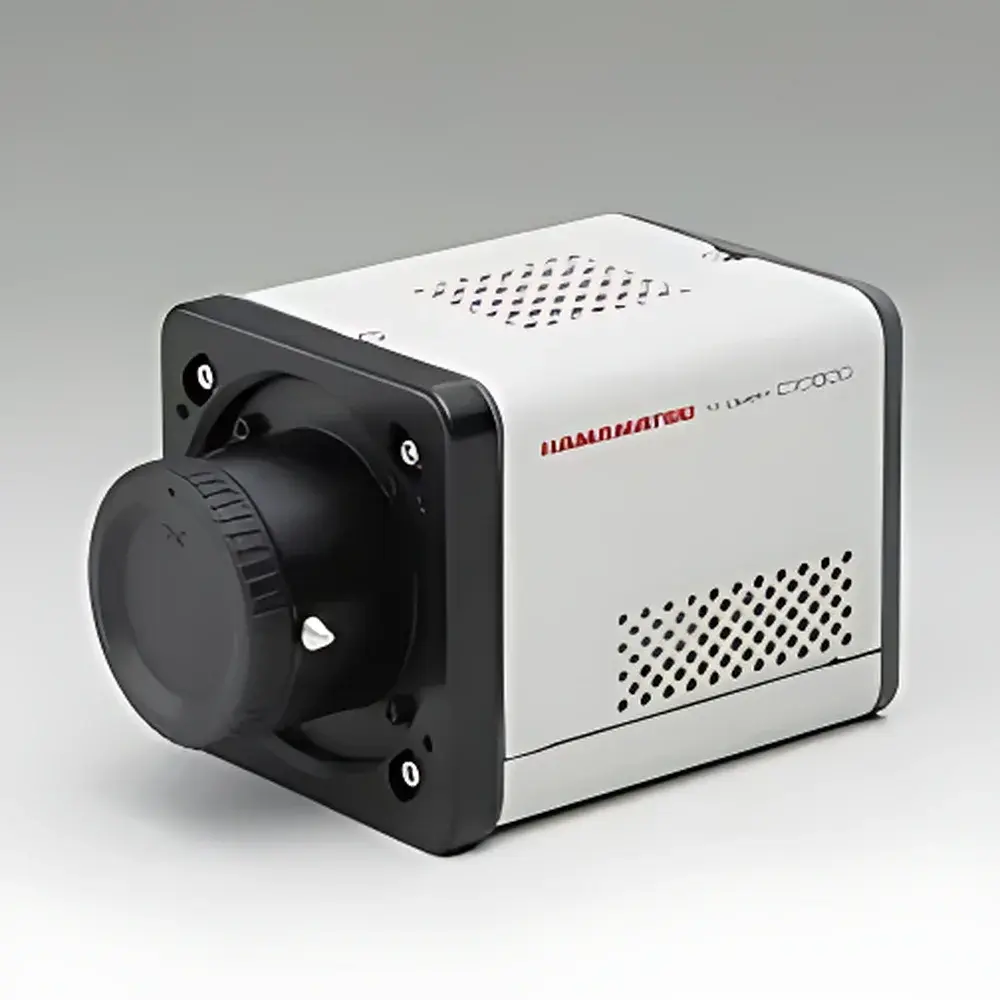
Hamamatsu TDI Camera C10000-801
| Brand | Hamamatsu |
|---|---|
| Origin | Japan |
| Manufacturer Type | Original Equipment Manufacturer (OEM) |
| Product Category | Imported Instrument |
| Model | C10000-801 |
| Price Range | USD 14,000 – 70,000 |
Overview
The Hamamatsu C10000-801 is a high-performance time-delay integration (TDI) camera engineered for demanding low-light, high-speed linear scanning applications. Unlike conventional area-scan or line-scan CCDs, the C10000-801 leverages TDI architecture—a synchronized charge-transfer technique where photogenerated electrons are shifted row-by-row in precise temporal alignment with object motion. This enables coherent integration across multiple rows (128 vertical pixels), dramatically enhancing signal-to-noise ratio (SNR) without sacrificing spatial resolution or frame rate. Designed around a back-illuminated CCD sensor, the camera delivers exceptional quantum efficiency from 200 nm (deep UV) to 1100 nm (near-infrared), making it suitable for fluorescence imaging, spectral inspection, and precision industrial metrology where photon-starved conditions prevail.
Key Features
- Back-illuminated CCD sensor with 2048 × 128 active pixels (12 µm × 12 µm pixel pitch; 24.58 mm × 1.536 mm photosensitive area)
- True TDI readout mode supporting bidirectional charge transfer and programmable line rates from 0.45 kHz to 50 kHz
- Quad-tap (4-channel) analog output architecture enabling high-speed data throughput at up to 30 MHz per pixel clock
- On-chip lateral overflow drain providing 100× anti-blooming protection for robust dynamic range handling
- 1600:1 dynamic range with 12-bit or 8-bit selectable A/D conversion and 16-step analog gain (1×–5×)
- Dedicated frame-readout mode for real-time focusing and system alignment—non-quantitative but operationally essential
- Real-time on-FPGA defect pixel correction and background subtraction for consistent image fidelity
- Camera Link interface (Mini-Camera Link SDR) with dual-tap (1024 × 2) output configuration and 60 MHz pixel clock support
- F-mount lens compatibility and universal AC power input (100–240 V, 50/60 Hz); typical power consumption: 55 W
Sample Compatibility & Compliance
The C10000-801 is optimized for continuous-motion imaging of extended or asymmetric specimens—including flat-panel displays, silicon wafers, PCB assemblies, and biological tissue sections mounted on motorized translation stages. Its TDI synchronization capability ensures sub-pixel registration stability when integrated with precision motion controllers (e.g., those compliant with IEEE 1394 or EtherCAT timing protocols). The camera meets CE marking requirements for electromagnetic compatibility (EMC Directive 2014/30/EU) and low-voltage safety (LVD Directive 2014/35/EU). While not certified under FDA 21 CFR Part 11, its deterministic trigger response, serial command logging, and non-volatile configuration storage support GLP/GMP-aligned validation workflows when deployed in regulated environments such as semiconductor fab QA labs or clinical research imaging cores.
Software & Data Management
Hamamatsu provides the proprietary HCImage Live software suite for full camera control, real-time visualization, and raw data export in TIFF, HDF5, or custom binary formats. The SDK supports Windows/Linux platforms via C/C++, Python (PyHamamatsu), and MATLAB bindings, enabling seamless integration into custom acquisition pipelines. All TDI parameters—including line rate, gain, offset, binning (2×2 or 4×4), and tap selection—are programmable via ASCII-based serial commands over Camera Link’s auxiliary channel. Timestamped metadata (exposure start, trigger edge, temperature, firmware version) is embedded in every image header, facilitating traceability in automated inspection systems requiring audit-ready data provenance.
Applications
- High-throughput fluorescence microscopy of live-cell monolayers under ultra-low illumination (e.g., single-molecule tracking, Ca²⁺ dynamics)
- Automated optical inspection (AOI) of LCD/OLED panels, solar cells, and printed electronics at production-line speeds
- Wafer-level defect detection in front-end semiconductor manufacturing, especially for patterned photoresist and thin-film uniformity analysis
- UV-visible-NIR spectroscopic line scanning in process analytical technology (PAT) setups compliant with ICH Q8/Q9 guidelines
- Forensic document analysis and archival digitization of fragile manuscripts requiring minimal light exposure
FAQ
What is the maximum usable TDI line rate under full-resolution operation?
At 2048 × 128 resolution with 4-tap readout and 30 MHz pixel clock, the theoretical upper limit is 50 kHz—achievable with appropriate optics, motion stage synchronization, and thermal stabilization.
Can the C10000-801 be operated in standard area-scan mode?
No—it does not support true area-scan integration. The “frame readout mode” is a diagnostic mode that reads all 128 rows simultaneously without TDI charge transfer; it yields static images useful only for focus verification and optical alignment.
Is external triggering supported for TDI synchronization?
Yes. The camera accepts TTL-compatible external triggers for both start-of-scan initiation and line-rate synchronization, ensuring deterministic phase lock with encoder signals from linear stages.
How is dark current managed during long-duration TDI acquisitions?
The sensor operates at ambient temperature (0–40 °C), and dark signal is mitigated via on-board background subtraction using user-acquired dark frames; active cooling is not integrated but can be implemented externally via custom mounting solutions.
Does Hamamatsu provide calibration certificates traceable to NIST standards?
Upon request, Hamamatsu offers factory-applied radiometric and geometric calibration reports—including pixel response non-uniformity (PRNU), dark signal non-uniformity (DSNU), and linearity verification—traceable to JCSS-accredited reference standards (equivalent to NIST SI units).



