
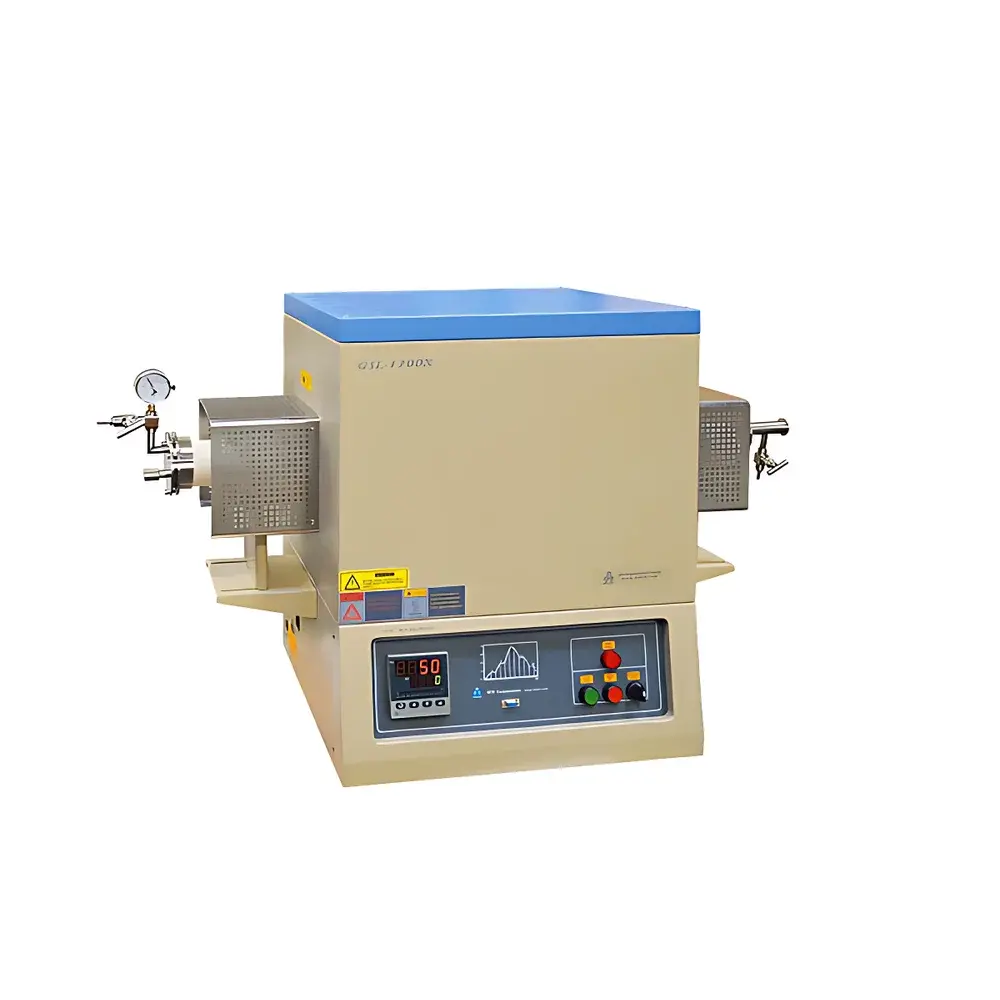
KEJING GSL-1700X High-Temperature Horizontal Tube Furnace (1700 °C)
| Brand | KEJING |
|---|---|
| Model | GSL-1700X |
| Max Temperature | 1700 °C |
| Temperature Uniformity | ±1 °C |
| Heating Rate | 10 °C/min |
| Cooling Rate | Programmable (30-segment) |
| Heating Zone Length | 457 mm |
| Isothermal Zone Length | 150 mm |
| Tube Dimensions (Std.) | 60 mm O.D. × 54 mm I.D. × 1000 mm L |
| Tube Material | High-Purity Alumina (≥99.9% Al₂O₃) |
| Heating Element | MoSi₂ (1800-grade) |
| Power Supply | 220 V AC, 50/60 Hz, 30 A circuit required |
| Max Power | 5.2 kW |
| Chamber Construction | Dual-layer steel shell with forced-air cooling |
| External Dimensions | 590 × 490 × 740 mm |
| Vacuum Compatibility | Up to 10⁻² Torr (with dual-stage rotary vane pump) |
| Certifications | CE, UL/MET/CSA compliant (>24 V components), RoHS |
Overview
The KEJING GSL-1700X is a precision-engineered horizontal tube furnace designed for high-temperature thermal processing under controlled atmospheres—including vacuum, inert gas (N₂, Ar), or reducing environments. Operating on the principle of resistive heating via high-stability molybdenum disilicide (MoSi₂) elements rated to 1800 °C, the furnace achieves stable, repeatable operation up to 1700 °C in continuous service. Its double-walled, air-cooled housing maintains external surface temperatures below 60 °C during full-load operation—ensuring laboratory safety and minimizing ambient heat load. The furnace features a 457 mm heating zone and a verified 150 mm isothermal region (±1 °C), enabling uniform thermal treatment critical for sintering, annealing, calcination, and crystal growth applications in advanced ceramics, battery materials, and functional oxides.
Key Features
- High-purity alumina tube (≥99.9% Al₂O₃) with precise dimensional tolerance: 60 mm outer diameter × 54 mm inner diameter × 1000 mm length—optimized for gas-tight sealing and thermal shock resistance.
- 30-segment programmable PID temperature controller with RS232 interface; supports real-time monitoring and remote program upload via optional PC software (sold separately).
- Dual stainless-steel vacuum flanges with high-temperature silicone O-rings; compatible with KF25 quick-connect fittings, Swagelok® 1/8″ stainless compression fittings (for inlet gas lines), and flexible stainless bellows (optional).
- Integrated vacuum pressure gauge port and needle valve assembly; base vacuum performance of ≤10⁻² Torr achievable with standard dual-stage rotary vane pump.
- Optional digital vacuum gauges available: standard range (1×10⁻³ to 10³ Torr) or corrosion-resistant wide-range gauge (3.8×10⁻⁵ to 1125 Torr) with gas-independent calibration—no correction factors required.
- Hinged flange option enables rapid tube access without full disassembly; mobile trolley (600×600 mm) available for ergonomic repositioning within shared lab spaces.
Sample Compatibility & Compliance
The GSL-1700X accommodates powder samples, pressed pellets, thin films, fibers, and small crucibles placed directly inside the alumina tube or within secondary containment (e.g., graphite, zirconia, or platinum boats). Its design conforms to ISO 17025-relevant environmental control requirements for thermal testing laboratories. All electrical components rated above 24 V carry UL, MET, and CSA certifications; the system bears CE marking per Directive 2014/35/EU (Low Voltage) and 2014/30/EU (EMC). Upon customer request—and at additional cost—the unit can be individually certified by TÜV SÜD (Germany) or CSA Group to meet local regulatory acceptance for GMP-aligned R&D facilities. The furnace’s mechanical construction adheres to ASTM E1112 (Standard Specification for Laboratory Furnaces) for structural integrity and thermal stability reporting.
Software & Data Management
The integrated temperature controller logs setpoint, actual temperature, and elapsed time at user-defined intervals (default: 1 s). Via RS232 connection and optional KEJING Furnace Control Software (v3.2), users can import/export multi-step ramp-soak profiles, generate timestamped CSV reports, and overlay real-time curves for comparative process validation. Audit-trail functionality—though not natively 21 CFR Part 11-compliant—can be implemented through third-party validated data acquisition systems interfaced via analog output (0–5 V) or Modbus RTU (optional add-on module). All firmware updates are distributed via secure KEJING support portal with version-controlled release notes and traceable calibration metadata.
Applications
- Sintering of solid-state electrolytes (e.g., LLZO, LATP) and cathode precursors (NMC, LFP) under argon glovebox-integrated setups.
- Controlled-atmosphere annealing of transition metal dichalcogenides (MoS₂, WS₂) for defect engineering and phase stabilization.
- Thermal decomposition studies of MOFs and COFs under dynamic vacuum or programmed gas flow (0.1–500 sccm).
- Pre-oxidation of silicon carbide fiber preforms prior to CVD coating.
- Heat treatment of dental zirconia blanks and biomedical Ti-6Al-4V specimens per ISO 13356 and ASTM F136 protocols.
FAQ
What is the recommended procedure for achieving optimal vacuum integrity?
Ensure alumina tube ends are sealed with matching high-purity alumina plugs before pump-down; verify O-ring seating and torque all flange bolts to 12–15 N·m using a calibrated torque wrench.
Can the furnace operate continuously at 1700 °C?
Yes—rated for continuous duty at 1700 °C with proper ventilation and periodic element inspection; maximum service life of MoSi₂ rods exceeds 2000 h under clean, dry inert conditions.
Is the alumina tube included with the standard configuration?
Yes—the furnace ships with one high-purity alumina tube (60/54/1000 mm); spare tubes and custom lengths are available as consumables (P/N: ALU-TUBE-GSL-1700X).
Does the system support automated gas flow control?
Not natively—but it integrates seamlessly with mass flow controllers (MFCs) via 0–5 V analog input/output terminals; KEJING offers compatible MFC kits (e.g., BROOKS 5850E series) with pre-configured mounting brackets.
What maintenance is required during routine operation?
Monthly visual inspection of MoSi₂ element integrity and O-ring elasticity; quarterly cleaning of air-cooling vents and fan filters; annual recalibration of thermocouple input channel using NIST-traceable reference source.



