
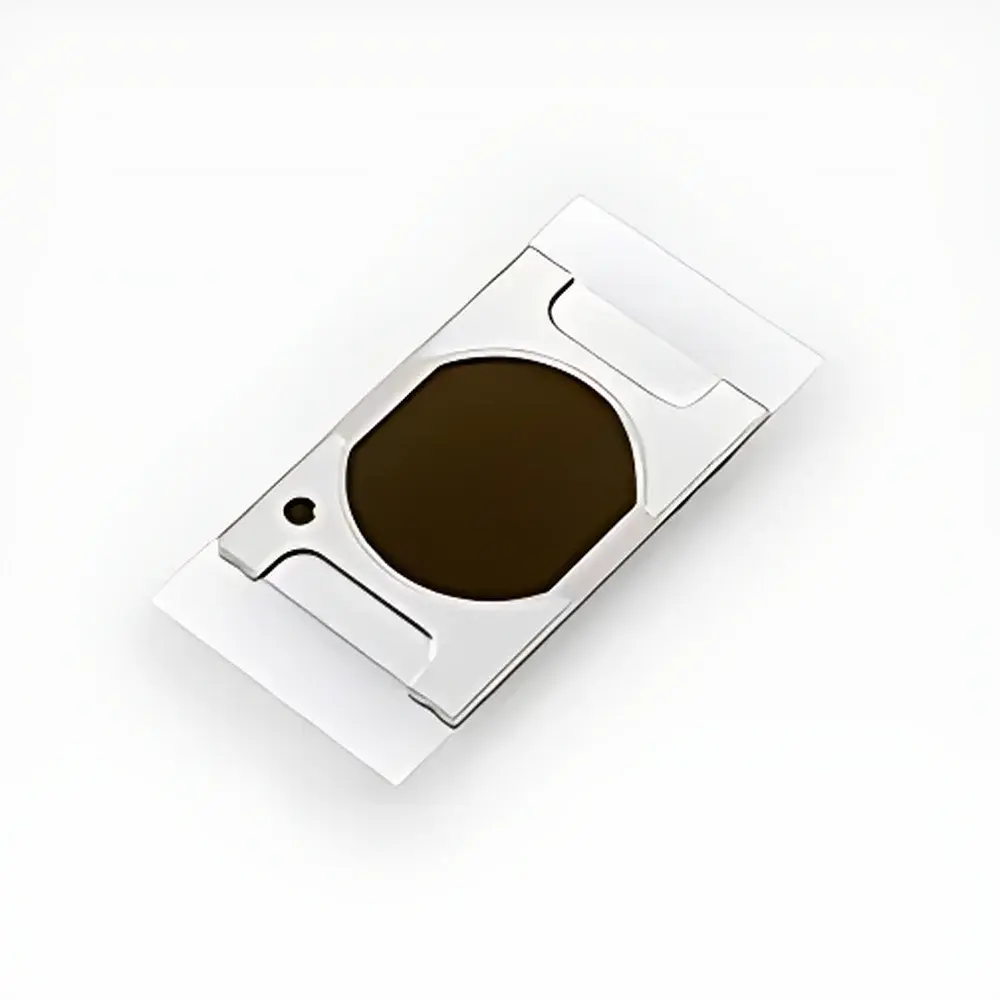
Hamamatsu DIUTHAME Porous Alumina Ionization Substrate A13331-18-2
| Brand | Hamamatsu |
|---|---|
| Origin | Japan |
| Manufacturer Type | Original Equipment Manufacturer (OEM) |
| Product Category | Imported |
| Model | A13331-18-2 |
| Pricing | Upon Request |
Overview
The Hamamatsu DIUTHAME (Desorption Ionization Using Through-Hole Alumina Membrane) Porous Alumina Ionization Substrate A13331-18-2 is an engineered surface-assisted laser desorption/ionization (SALDI) platform designed for matrix-free, high-fidelity mass spectrometry imaging (MSI). Unlike conventional MALDI, which requires homogeneous co-crystallization of analytes with organic matrix compounds—a process prone to spatial inhomogeneity, chemical noise, and suppression effects—DIUTHAME leverages a precisely fabricated, anodized aluminum oxide (AAO) membrane with vertically aligned, uniform nanopores (typically 10–20 nm diameter, ~60 µm thickness). This nanostructured substrate enables direct analyte adsorption, thermal energy transfer, and efficient secondary ion emission upon UV laser irradiation—without exogenous matrix addition. The A13331-18-2 variant features a Φ18 mm active aperture optimized for large-area tissue section imaging, supporting seamless integration with commercial MALDI-TOF-MS, MALDI-FT-ICR-MS, and hybrid IMS platforms. Its design eliminates matrix-related background interference in the low-mass region (<500 Da), enhances signal reproducibility across repeated acquisitions, and reduces sample preparation time by up to 90% compared to standard MALDI protocols.
Key Features
- Matrix-free ionization: Eliminates crystallization artifacts and suppresses chemical noise below m/z 500, enabling robust detection of small molecules (e.g., metabolites, lipids, drugs, additives)
- High spatial fidelity: Uniform pore architecture ensures consistent laser energy coupling and ion yield across the entire Φ18 mm active area
- Rapid workflow compatibility: Direct blotting or vapor-phase deposition enables sub-minute sample loading—no matrix spotting, drying, or washing steps required
- Thermal and chemical stability: Anodized alumina substrate withstands repeated laser irradiation, solvent exposure (e.g., MeOH, ACN, H₂O), and ambient handling without degradation
- Reproducible quantitative potential: Demonstrated intra- and inter-day CVs <12% for endogenous lipid species in frozen tissue sections under standardized laser fluence and raster conditions
- OEM-grade manufacturing: Produced in Hamamatsu’s ISO 9001-certified cleanroom facility in Japan; lot-to-lot consistency verified via SEM pore morphology mapping and contact angle validation
Sample Compatibility & Compliance
The A13331-18-2 substrate supports diverse biological and synthetic samples via three validated transfer modalities: (1) direct blotting of frozen tissue sections (e.g., mouse brain, strawberry, chicken muscle), (2) vapor-phase extraction using humidified carrier gas for volatile/semi-volatile analytes, and (3) mist-assisted deposition for polymer additives and industrial materials. It complies with widely adopted analytical frameworks including ASTM E2948–22 (Standard Guide for Mass Spectrometry Imaging Data Reporting) and ISO/IEC 17025:2017 (General requirements for competence of testing and calibration laboratories). While not a regulated medical device, its use in preclinical research aligns with GLP principles for data traceability—particularly when paired with audit-trail-enabled acquisition software (e.g., Bruker flexImaging v5.0+, Shimadzu Imaging MS Solution v2.1+). No regulatory filings (e.g., FDA 510(k), CE-IVD) apply, as DIUTHAME functions solely as a consumable analytical interface.
Software & Data Management
The substrate operates transparently within existing vendor MS acquisition environments. No proprietary drivers or firmware are required. Raw spectral data generated using DIUTHAME retain native .fid (Bruker), .raw (Thermo), or .d (Shimadzu) formats—ensuring full compatibility with open-source (e.g., SCiLS Lab, Cardinal, MSI-QC) and commercial (e.g., MSiReader, HDI Imaging) image reconstruction pipelines. When used in regulated environments, instrument control systems must implement 21 CFR Part 11-compliant electronic signatures and audit trails for method parameters (laser power, raster speed, pixel size), particularly for QC/QA documentation in pharmaceutical development or polymer characterization workflows. Hamamatsu provides detailed SOP templates—including cleaning validation (isopropanol rinse + N₂ purge), storage conditions (desiccated, room temperature), and shelf-life verification (18 months from manufacture date)—to support laboratory quality system integration.
Applications
- Pharmaceutical R&D: Spatial profiling of drug distribution and metabolism in rodent tissue sections without matrix interference
- Food science: High-resolution mapping of flavonoids, alkaloids, and pesticide residues in plant tissues (e.g., black rice, strawberry, chocolate)
- Materials science: Additive migration analysis in polymeric films and industrial composites using mist-assisted SALDI
- Neuroscience: Unbiased lipidomics of mouse brain coronal sections at 20–50 µm spatial resolution
- Clinical translational research: Rapid screening of surgical biopsy specimens for onco-metabolite signatures (e.g., succinate, 2-hydroxyglutarate)
- Environmental analytics: Detection of surfactants and plasticizers on filter membranes via vapor-phase capture
FAQ
Can DIUTHAME A13331-18-2 be reused?
No—this is a single-use, disposable substrate. Pore occlusion and surface contamination after laser ablation compromise ionization efficiency and reproducibility.
Is surface cleaning required before use?
Yes. Prior to sample application, wipe gently with lint-free cloth pre-moistened with isopropanol, then dry under filtered N₂ stream for ≥30 seconds.
What laser wavelengths are compatible?
Optimized for 337 nm nitrogen lasers; also validated with 355 nm Nd:YAG and 266 nm quadrupled Nd:YAG sources. UV transmission >85% across 250–360 nm range.
Does DIUTHAME require vacuum-compatible mounting?
Yes. The substrate is designed for standard MALDI target plates (e.g., Bruker MTP 384, AB Sciex Opti-TOF 24-well). Adhesive-backed variants are available for non-standard geometries.
How does DIUTHAME compare to other SALDI substrates (e.g., silicon nanowires, graphene oxide)?
Unlike top-down nanostructured surfaces, DIUTHAME’s self-ordered AAO architecture offers superior batch uniformity, higher thermal conductivity (>30 W/m·K), and negligible carbon-based background—critical for low-mass metabolite analysis.
Related Products





