
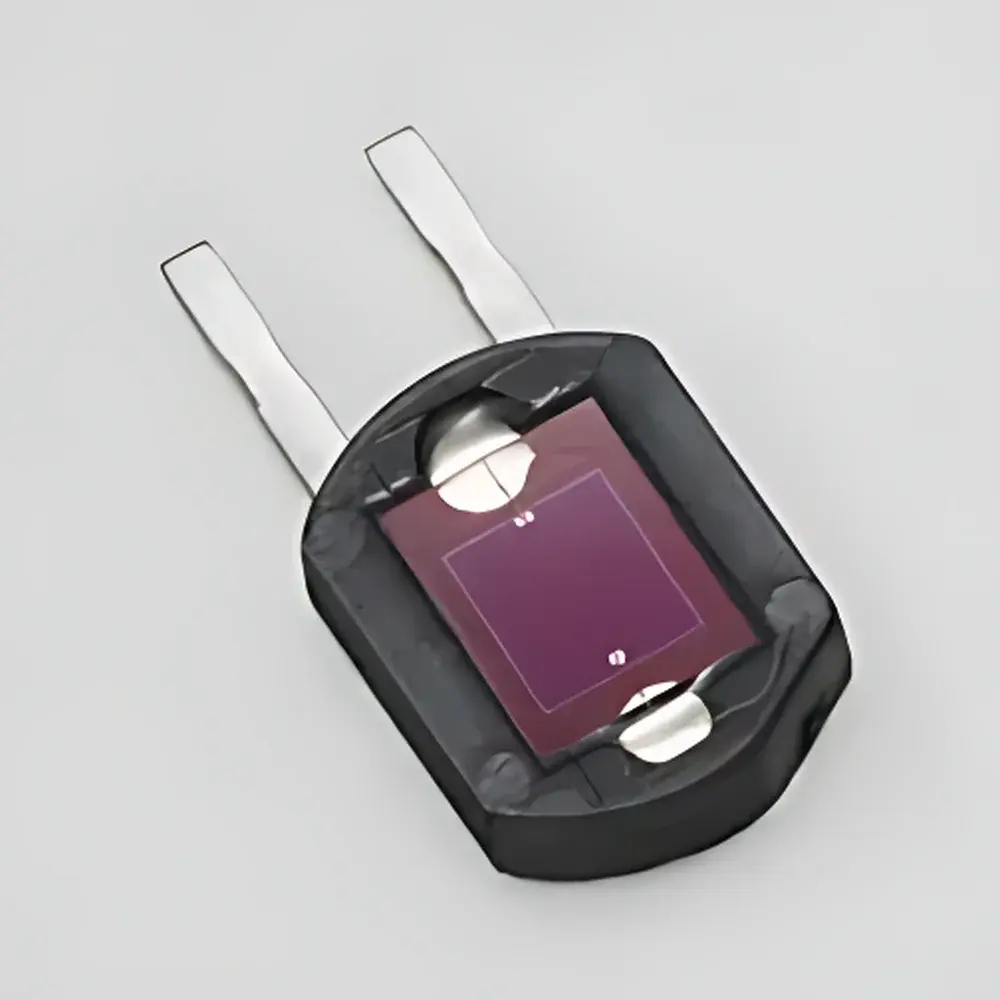
Hamamatsu S64 Series Monochromatic Color Sensors
| Brand | Hamamatsu |
|---|---|
| Origin | Japan |
| Manufacturer Type | Original Equipment Manufacturer (OEM) |
| Import Status | Imported |
| Model | S6428-01 / S6429-01 / S6430-01 |
| Component Category | Optical Sensor Element |
| Spectral Peak Wavelengths | 460 nm (blue), 540 nm (green), 660 nm (red) |
| Active Area | 2.8 × 2.4 mm² |
| Spectral Response Ranges | 400–540 nm (S6428-01), 480–600 nm (S6429-01), 590–720 nm (S6430-01) |
| Package | Molded Plastic Housing |
| Detector Material | Silicon Photodiode |
Overview
The Hamamatsu S64 Series Monochromatic Color Sensors are precision silicon photodiode-based optical detection modules engineered for selective spectral response in narrowband visible-light applications. Unlike broadband or RGB color sensors, the S64 series employs three discrete, spectrally optimized variants—S6428-01 (blue-centered), S6429-01 (green-centered), and S6430-01 (red-centered)—each fabricated with tailored anti-reflection coatings and junction depth control to achieve high quantum efficiency near its designated peak wavelength (λp). These sensors operate on the principle of photon-to-current conversion under reverse bias or photovoltaic mode, delivering linear analog output proportional to incident irradiance within their specified spectral windows. Their compact molded plastic housing, standardized active area (2.8 × 2.4 mm²), and stable responsivity make them suitable for integration into OEM optical systems requiring reliable, repeatable monochromatic signal acquisition—particularly where spectral crosstalk must be minimized and calibration traceability is essential.
Key Features
- Three dedicated spectral variants: S6428-01 (400–540 nm, λp = 460 nm), S6429-01 (480–600 nm, λp = 540 nm), S6430-01 (590–720 nm, λp = 660 nm)
- Silicon photodiode architecture with high shunt resistance (>1 GΩ) and low dark current (<1 nA at 25°C), ensuring signal integrity in low-light conditions
- Uniform active area of 2.8 × 2.4 mm² with consistent spatial responsivity across the sensing surface
- Molded plastic package offering mechanical robustness, thermal stability (operating range: −20°C to +70°C), and compatibility with standard surface-mount or through-hole PCB assembly
- No integrated amplifier or ADC—designed as a raw transducer element for system-level signal conditioning, enabling full control over gain, filtering, and sampling architecture
- Compliant with JEDEC J-STD-020 moisture sensitivity level (MSL) 1, supporting reflow soldering processes without preconditioning
Sample Compatibility & Compliance
The S64 series is compatible with collimated or diffused visible-light sources including LEDs, laser diodes, and filtered tungsten-halogen lamps. Its spectral response profiles are characterized under standard CIE illuminant A conditions and referenced to NIST-traceable spectral irradiance standards. While not certified as a standalone medical or safety device, each variant meets IEC 60825-1:2014 Class 1 laser product requirements when used within specified optical power limits. The sensors adhere to RoHS Directive 2011/65/EU and REACH Regulation (EC) No. 1907/2006 for hazardous substance restrictions. For regulated environments—including ISO/IEC 17025-accredited laboratories or GLP-compliant analytical workflows—the S64 series supports documented calibration protocols using calibrated reference detectors (e.g., Hamamatsu C12880MA) and spectral radiometers (e.g., Ocean Insight HDX).
Software & Data Management
As passive analog sensor elements, the S64 series does not include embedded firmware or digital interfaces. Integration requires external signal conditioning circuitry—typically a transimpedance amplifier (TIA) followed by analog-to-digital conversion—and synchronization with host data acquisition systems (e.g., National Instruments PXIe-6363, Keysight 34972A). Hamamatsu provides comprehensive SPICE models and spectral responsivity datasets (.csv, .mat) for SPICE simulation and MATLAB/Simulink-based system modeling. Raw output signals are compatible with industry-standard data logging frameworks compliant with ASTM E2500-18 (verification of automated systems) and FDA 21 CFR Part 11 when paired with audit-trail-capable DAQ software (e.g., LabVIEW with NI DIAdem or Python-based solutions using PyVISA and Pandas).
Applications
- Colorimetric endpoint detection in microfluidic immunoassays and lateral flow tests
- Spectral channel separation in multi-wavelength fluorescence excitation monitoring
- Wavelength-specific feedback control in tunable LED illumination systems for horticultural photobiology
- Reference channel normalization in dual-beam spectrophotometers and filter photometers
- Calibration transfer between benchtop and portable optical analyzers via matched spectral sensitivity
- Teaching laboratories for hands-on exploration of spectral selectivity, Beer-Lambert law validation, and photodiode physics
FAQ
Are the S64 sensors calibrated upon shipment?
No. Hamamatsu delivers these sensors as uncalibrated transducer elements. Calibration must be performed in-system using traceable light sources and reference detectors appropriate for the intended application and measurement uncertainty budget.
Can the S64 series be used under UV or NIR illumination?
No. The silicon photodiode structure exhibits negligible responsivity below 400 nm (UV) and above 1100 nm (NIR). Operation outside the specified spectral ranges will yield subthreshold signal levels and increased temperature-dependent noise.
Is there a recommended bias voltage or operating mode?
The devices are optimized for photovoltaic (zero-bias) operation to minimize dark current drift, though reverse bias up to −5 V may be applied to reduce junction capacitance in high-speed applications. Consult Hamamatsu’s S64 datasheet (PN: S64_DS_E05) for detailed IV curves and linearity specifications.
Do these sensors support hermetic packaging or custom spectral filtering?
Standard S64 units use plastic encapsulation. Hermetic TO-can variants (e.g., S64xx-02 series) and custom interference filters are available under OEM agreement—contact Hamamatsu Photonics K.K. Technical Support for feasibility assessment and lead-time quotation.




