
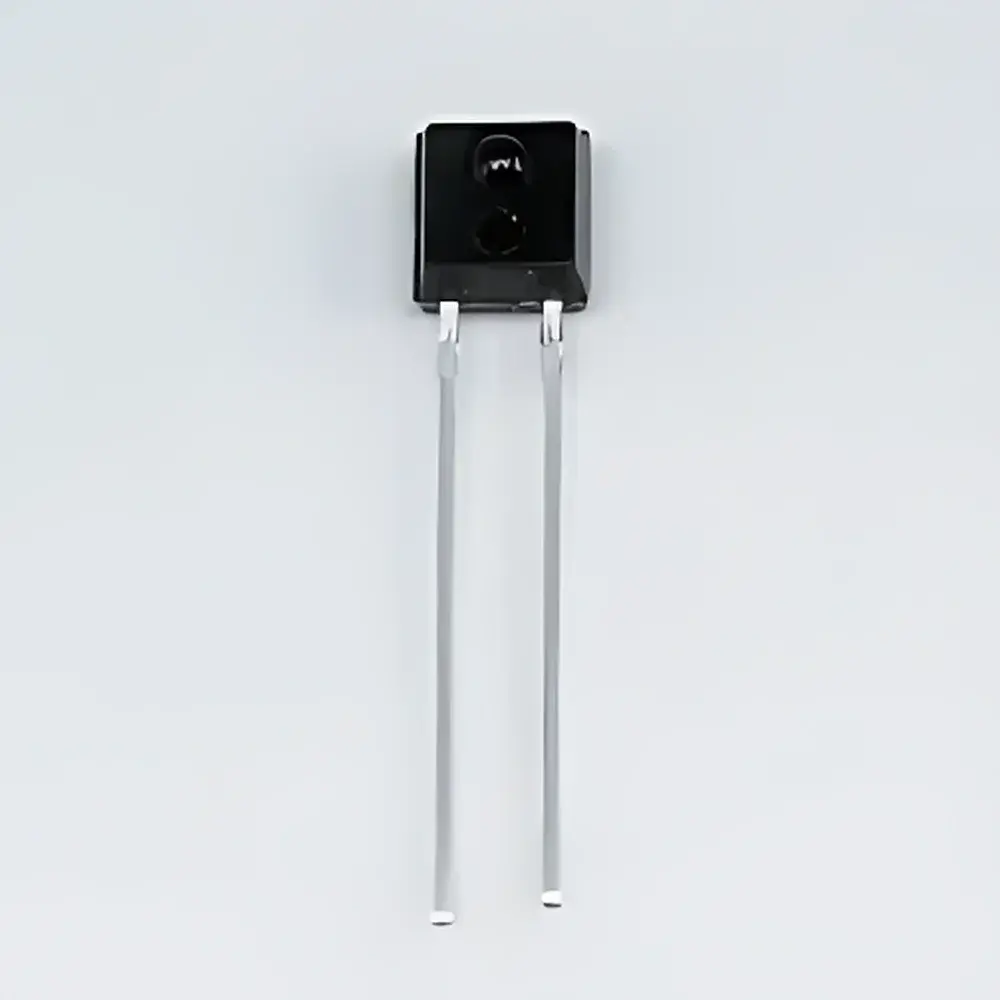
Hamamatsu S4404 Phototransistor
| Brand | Hamamatsu |
|---|---|
| Origin | Japan |
| Manufacturer Type | Original Equipment Manufacturer (OEM) |
| Import Status | Imported |
| Model | S4404 |
| Component Category | Optical Component |
| Package | Plastic with Integrated Lens |
| Photocurrent (Typ., 5 V CE, 1 mW/cm² @ 870 nm) | 2.5 mA |
| Dark Current (Max., 5 V CE) | 100 nA |
| Collector–Emitter Voltage (Max.) | 0.4 V |
| Peak Spectral Response Wavelength | 870 nm |
Overview
The Hamamatsu S4404 is a silicon-based NPN phototransistor engineered for high-sensitivity optical detection in low-light and modulated light environments. Unlike photodiodes, which generate current proportional to incident photon flux but require external amplification, the S4404 integrates photodetection and current gain within a single semiconductor junction—leveraging transistor action to deliver amplified photocurrent output directly. Its internal lensed plastic package enhances optical coupling efficiency, enabling reliable operation under collimated or diffuse illumination. Designed for DC and pulsed light detection up to several hundred kHz, the device operates in common-emitter configuration with a maximum collector–emitter voltage rating of 0.4 V—indicating optimized use in low-voltage, high-impedance signal conditioning circuits typical in precision optical sensing systems.
Key Features
- Silicon NPN planar phototransistor with integrated epoxy lens for improved irradiance collection and angular response control
- Peak spectral responsivity at 870 nm—well-aligned with near-infrared (NIR) LED and laser sources commonly used in industrial encoders, optocouplers, and proximity sensors
- High photocurrent output (2.5 mA typical under 1 mW/cm² irradiance at 870 nm), enabling direct interfacing with microcontroller input pins or op-amp front ends without additional gain stages
- Low dark current (≤100 nA at 5 VCE) ensures minimal offset error and stable baseline performance in temperature-stable environments (−25°C to +75°C operating range)
- Robust plastic TO-18–compatible housing with lead-free, RoHS-compliant materials—qualified per J-STD-020 moisture sensitivity level (MSL) 1
- No built-in base connection; operates in photovoltaic mode by default—simplifying circuit design and reducing component count in space-constrained PCB layouts
Sample Compatibility & Compliance
The S4404 is compatible with standard surface-mount and through-hole assembly processes, including reflow soldering (per JEDEC J-STD-020) and wave soldering. It meets IEC 60825-1:2014 for Class 1 laser product safety when used with compliant emitters, and conforms to ISO 9001-certified manufacturing protocols at Hamamatsu Photonics’ Japanese production facilities. While not intrinsically certified for hazardous locations, its low-voltage operation (VCE ≤ 0.4 V) supports integration into SIL-2–compliant subsystems when paired with appropriate current-limiting and isolation circuitry. Device-level traceability is maintained via batch-coded date marks and wafer-level test records accessible through Hamamatsu’s OEM documentation portal.
Software & Data Management
As a passive analog sensor component, the S4404 does not incorporate embedded firmware or digital interfaces. However, it is routinely deployed in systems that comply with FDA 21 CFR Part 11 requirements for electronic records and signatures—particularly in medical device OEM applications where photocurrent linearity, repeatability, and long-term drift (<±3% over 10,000 hours at 25°C) are validated during IQ/OQ/PQ qualification. Hamamatsu provides comprehensive SPICE-compatible behavioral models and spectral responsivity curves (350–1100 nm) in CSV and MATLAB formats, supporting simulation-driven design verification and Monte Carlo tolerance analysis in optical subsystem development workflows.
Applications
- Optical interrupters and slotted optoswitches in laboratory automation platforms and analytical instrument position feedback loops
- NIR light barrier systems for cleanroom monitoring and particle detection in semiconductor fabrication tooling
- Low-power ambient light sensing in portable spectrophotometer shutter control and reference beam monitoring
- Modulated light receivers in closed-loop optical power stabilization circuits for tunable laser sources
- Cost-sensitive industrial presence detection where high gain-to-area ratio reduces optical alignment complexity and mechanical tolerance demands
FAQ
What is the recommended load resistance for optimal linearity in DC detection mode?
A 1–10 kΩ collector resistor is typically used to maintain VCE 95% photocurrent linearity across the specified irradiance range.
Can the S4404 be operated with reverse bias on the collector–emitter junction?
No—its absolute maximum VCE is +0.4 V; reverse biasing violates junction integrity and may cause irreversible degradation.
Is spectral calibration data available for individual units?
Hamamatsu provides wafer-level spectral responsivity characterization reports upon request; unit-level calibration is not standard but can be arranged as a custom service.
How does temperature affect dark current and gain stability?
Dark current approximately doubles per 10°C rise above 25°C; gain remains stable within ±5% from −25°C to +60°C when operated within rated VCE.
Does this device support pulsed operation at frequencies above 100 kHz?
Yes—transition time (tr/tf) is typically 5 µs; bandwidth exceeds 70 kHz at 50% photocurrent amplitude with proper load and layout optimization.




