
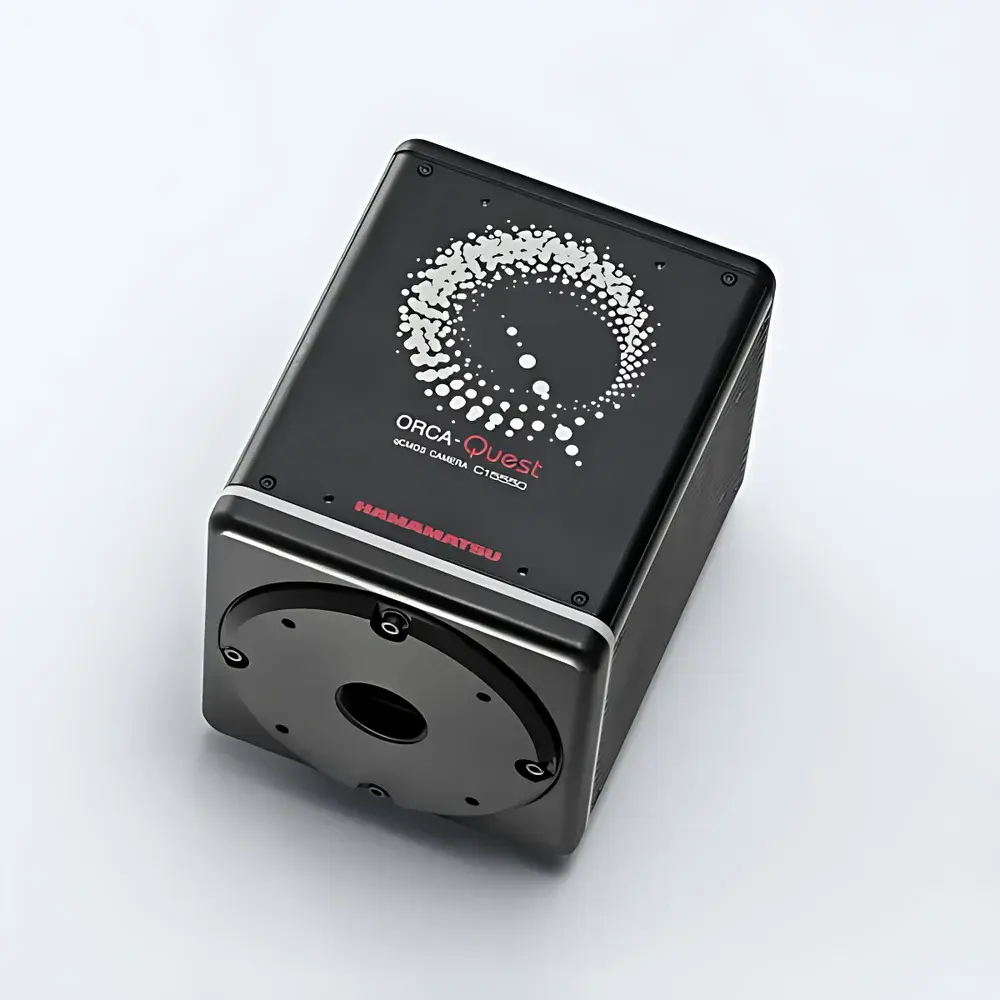
Hamamatsu ORCA-Quest qCMOS Camera C15550-20UP
| Brand | Hamamatsu |
|---|---|
| Origin | Japan |
| Manufacturer Type | Original Equipment Manufacturer (OEM) |
| Product Category | Imported Scientific Imaging Device |
| Model | C15550-20UP |
| Image Resolution | 4096 × 2304 pixels (effective) |
| Pixel Size | 4.6 µm (H) × 4.6 µm (V) |
| Sensor Active Area | 18.841 mm (H) × 10.598 mm (V) |
| Full Well Capacity | 7000 e⁻ (Typ.) |
| Read Noise | Standard Scan: 0.43 e⁻ rms (Typ.), Ultra Quiet Scan: 0.27 e⁻ rms (Typ.) |
| Dynamic Range | 25,900:1 (Typ., calculated from full well / ultra quiet read noise) |
| Peak Quantum Efficiency | 90 % |
| Frame Rates | Standard Scan: 120 fps (CoaXPress), 17.6 fps (USB) |
| Ultra Quiet Scan | 5 fps (both interfaces) |
| Exposure Range | Standard Scan: 7.2 µs – 1800 s |
| Ultra Quiet Scan | 172.8 µs – 1800 s |
| Cooling | Peltier-based forced-air or water cooling (–20 °C standard |
| Dark Current | 0.016 e⁻/pixel/s (@ –20 °C), 0.006 e⁻/pixel/s (@ < –35 °C) |
| Trigger Modes | Edge, Global Reset Edge, Level, Global Reset Level, Sync Readout, Start (Area & Lightsheet variants) |
| Interface | USB 3.1 Gen 1, Quad CoaXPress (CXP-6) |
| ADC | 16-bit / 12-bit / 8-bit selectable |
| Lens Mount | C-mount |
Overview
The Hamamatsu ORCA-Quest C15550-20UP is a scientific-grade qCMOS™ camera engineered for quantitative photon-limited imaging where single-electron-level precision, temporal stability, and spatial fidelity are non-negotiable. Unlike conventional sCMOS or EM-CCD architectures, the ORCA-Quest integrates a back-illuminated, trench-isolated qCMOS sensor with hardware-accelerated photon number resolving (PNR) capability—enabling deterministic quantification of photoelectron counts per pixel across the full 4096 × 2304 active array. Its measurement principle relies on sub-electron read noise performance (< 0.27 e⁻ rms in Ultra Quiet Scan mode), combined with pixel-wise gain calibration and real-time defect correction, to resolve discrete photoelectron populations without statistical averaging. This architecture is particularly suited for applications requiring absolute intensity linearity, shot-noise-limited detection, and long-term radiometric stability—such as quantum state readout, low-light spectroscopy, and time-resolved fluorescence lifetime mapping.
Key Features
- Photon Number Resolving (PNR) Architecture: Delivers deterministic photoelectron counting via ultra-low-noise readout electronics and per-pixel calibration, enabling quantitative intensity reconstruction without Poisson averaging assumptions.
- Back-Illuminated Trench-Isolated qCMOS Sensor: Achieves 90% peak quantum efficiency while suppressing inter-pixel crosstalk through deep-trench pixel isolation—preserving spatial resolution despite backside illumination.
- Multi-Mode Readout Optimization: Offers two distinct scan modes: Standard Scan (120 fps @ full resolution via CoaXPress) for high-throughput acquisition, and Ultra Quiet Scan (5 fps, 0.27 e⁻ rms) for ultimate sensitivity and PNR fidelity.
- Thermally Stabilized Detection: Integrated Peltier cooling supports forced-air or water-cooled operation down to < –35 °C, reducing dark current to 0.006 e⁻/pixel/s and ensuring baseline stability over multi-hour acquisitions.
- Flexible Digital Interface & Timing Control: Dual interface support (USB 3.1 Gen 1 and quad-channel CoaXPress-6) enables system integration flexibility; programmable trigger outputs and sub-microsecond trigger delay (0–10 s in 1 µs steps) support synchronized multi-modal experiments.
Sample Compatibility & Compliance
The ORCA-Quest C15550-20UP is designed for integration into regulated and research-grade optical systems—including confocal microscopes, quantum optics testbeds, Raman spectrometers, and astronomical lucky-imaging platforms. Its C-mount interface ensures mechanical compatibility with standard lens assemblies and filter wheels. The camera complies with CE, FCC, and RoHS directives. For laboratories operating under GLP or GMP frameworks, the device supports audit-ready metadata logging (exposure time, gain, temperature, trigger configuration) when used with Hamamatsu’s HCImage Live software. While not FDA 21 CFR Part 11–certified out-of-the-box, its deterministic output format (16-bit linear TIFF with embedded calibration headers) facilitates traceable data workflows compatible with validated analysis pipelines.
Software & Data Management
Hamamatsu provides HCImage Live—a platform-independent acquisition and analysis suite supporting real-time PNR visualization, histogram-based electron-count distribution analysis, and batch-mode calibration application. All raw frames retain full 16-bit depth with embedded sensor metadata (temperature, exposure, read mode, gain setting), enabling post-hoc reprocessing without loss of quantitative integrity. The camera SDK (C/C++, Python, MATLAB) exposes low-level register access for custom synchronization protocols, including lightsheet-specific timing sequences and global reset edge triggering. Export formats include TIFF (with IEEE 754-compliant floating-point metadata), HDF5 (for time-series volumetric datasets), and Numpy-compatible binary streams—ensuring interoperability with open-source analysis ecosystems such as ImageJ/Fiji, Python’s scikit-image, and PyTorch-based denoising models.
Applications
- Quantum Information Science: High-fidelity readout of neutral atom arrays and ion trap fluorescence, where single-photon-level discrimination enables >99.5% state assignment fidelity in quantum logic gate verification.
- Astronomical Lucky Imaging: Sub-millisecond frame capture at full resolution allows selection and stacking of diffraction-limited frames from atmospheric turbulence-corrupted sequences—achieving near-diffraction-limited resolution from ground-based observatories.
- Raman Microspectroscopy: Enables rapid acquisition of weak Raman signals from monolayer materials or biological tissues without spectral distortion from read noise floor, supporting chemometric modeling of molecular vibrations.
- Delayed Fluorescence Imaging in Plant Physiology: Quantifies nanosecond-to-second delayed chlorophyll fluorescence decay kinetics under controlled stress conditions, providing non-invasive biomarkers for pathogen response and abiotic stress resilience.
- Single-Molecule Localization Microscopy (SMLM): Supports PALM/STORM modalities requiring high localization precision and minimal background bias, thanks to its uniform pixel response and absence of multiplicative noise sources inherent in EM gain stages.
FAQ
What distinguishes photon number resolving (PNR) from conventional photon counting?
PNR quantifies the *expected number* of photoelectrons per pixel within a single exposure using sub-electron read noise and calibrated gain—whereas photon counting requires discrete avalanche events (e.g., in SPADs or PMTs) and is limited to very low flux regimes. ORCA-Quest achieves PNR at up to ~10⁵ photons/pixel/frame.
Can the ORCA-Quest operate in vacuum or cryogenic environments?
No—the camera is rated for ambient laboratory use only (0–40 °C, 30–80% RH, non-condensing). Its Peltier cooler requires external heat dissipation via air or water; direct immersion or vacuum operation is not supported.
Is firmware update capability available for field calibration refinement?
Yes—Hamamatsu releases periodic firmware updates via the HCImage Live updater tool. These include improvements to hot pixel mapping algorithms, timing jitter compensation, and enhanced dark current modeling for extended cooling conditions.
How does the qCMOS sensor differ from standard back-illuminated sCMOS?
While both use backside illumination, the qCMOS architecture incorporates deep trench isolation between pixels and proprietary charge-to-voltage conversion circuitry—eliminating lateral diffusion effects that degrade modulation transfer function (MTF) in conventional BI-sCMOS sensors.
What is the recommended data storage strategy for sustained PNR acquisition?
For continuous Ultra Quiet Scan operation (5 fps × 16-bit × 9.4 MP), sustained write bandwidth exceeds 900 MB/s. We recommend RAID-0 NVMe SSD arrays or dedicated CXP frame grabbers with onboard buffering to prevent frame drop during long-duration acquisitions.



