
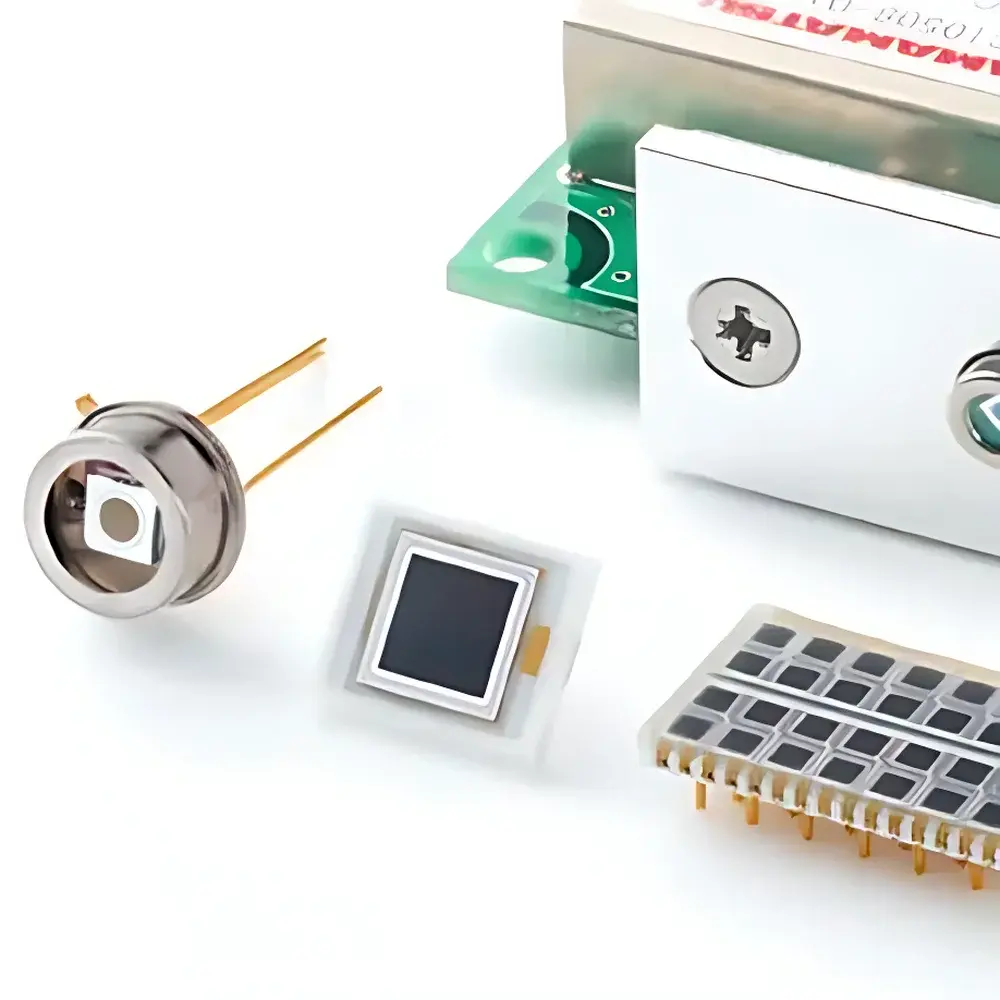
Hamamatsu Avalanche Photodiode (APD) Modules
| Brand | Hamamatsu |
|---|---|
| Origin | Japan |
| Manufacturer Type | Original Equipment Manufacturer (OEM) |
| Product Origin | Imported |
| Model Range | Full Series |
| Component Category | Optical Component |
| Pricing | USD 1–499 (per unit, ex-works) |
Overview
Hamamatsu Avalanche Photodiodes (APDs) are solid-state photodetectors engineered for high-sensitivity, low-light-level optical detection through internal carrier multiplication via controlled avalanche breakdown. Operating under reverse bias near or above the breakdown voltage, APDs achieve internal gain (typically 10–1,000×) while maintaining nanosecond-scale temporal response and excellent quantum efficiency in the UV–NIR spectrum (185–1,700 nm, depending on structure and coating). Unlike PIN photodiodes, APDs deliver superior signal-to-noise ratio (SNR) in photon-starved conditions—making them indispensable in time-resolved spectroscopy, single-photon counting (when operated in Geiger mode), LIDAR rangefinding, fiber-optic communication receivers, radiation detection (e.g., scintillation light readout), and quantum optics experiments. Hamamatsu’s APD portfolio includes discrete devices, monolithic linear and 2D arrays, integrated modules with thermoelectric coolers (TEC), transimpedance amplifiers (TIA), and high-voltage bias circuitry—all designed to meet rigorous laboratory and industrial performance requirements.
Key Features
- High internal gain (M = 10–1,000) with stable, temperature-compensated operation
- Low dark current (down to ~0.1 nA at room temperature for Si-based devices; sub-pA for cooled InGaAs variants)
- Fast rise/fall times (<1 ns for Si, <100 ps for specialized ultrafast structures)
- Wavelength coverage spanning 185 nm (solar-blind UV) to 1,700 nm (extended InGaAs)
- Available in TO-can, surface-mount, and hermetically sealed ceramic packages
- Optional integration with thermoelectric cooling (−40 °C to +25 °C stabilization) for reduced thermal noise and enhanced stability
- OEM-ready designs supporting custom active area geometry, anti-reflection coatings, and spectral filtering
Sample Compatibility & Compliance
Hamamatsu APDs are compatible with standard optical breadboards, fiber-coupled setups (FC/PC, SMA-905), free-space collimated beams, and scintillator coupling (e.g., LYSO, BGO, NaI:Tl). Device selection depends on application-specific trade-offs among responsivity, gain-bandwidth product, excess noise factor (k ≈ 0.02 for Si, 0.3–0.5 for InGaAs), and afterpulsing probability. All APDs comply with RoHS 2011/65/EU and REACH (EC 1907/2006) directives. Selected high-reliability variants meet MIL-STD-750D test protocols for vibration, thermal shock, and humidity exposure. For regulated environments—including clinical instrumentation and aerospace telemetry—Hamamatsu provides traceable calibration reports (NIST-traceable irradiance and spectral responsivity) and supports documentation per ISO 9001:2015 and IATF 16949 quality management systems.
Software & Data Management
While discrete APDs operate as analog front-end sensors, Hamamatsu offers complementary evaluation kits (e.g., C13362 series) featuring USB-controlled bias supply, real-time gain adjustment, temperature monitoring, and digitized output via 14-bit ADC. These kits integrate with Hamamatsu’s LightCatcher™ software for waveform capture, pulse-height analysis, coincidence timing, and dark-current drift compensation. Export formats include CSV, HDF5, and TDMS—enabling seamless ingestion into MATLAB, Python (NumPy/Pandas), LabVIEW, and Igor Pro workflows. For GxP-compliant applications, optional firmware supports audit-trail logging, user-access control, and electronic signatures aligned with FDA 21 CFR Part 11 requirements when deployed within validated instrument architectures.
Applications
- Laser distance measurement (time-of-flight, phase-shift LIDAR)
- Fluorescence lifetime imaging microscopy (FLIM) and time-correlated single-photon counting (TCSPC)
- Positron emission tomography (PET) and gamma-ray spectroscopy detector readout
- Quantum key distribution (QKD) receiver modules
- Ultra-low-light spectroscopy (Raman, LIBS, cavity ring-down)
- High-speed optical interconnect monitoring (10–100 Gbps NRZ/PAM4)
- Environmental sensing (aerosol backscatter, differential absorption LIDAR)
FAQ
What is the typical operating bias voltage range for Hamamatsu APDs?
Most silicon APDs require 100–400 V DC reverse bias; InGaAs/InP devices typically operate at 30–90 V. Exact values depend on device structure, temperature, and desired gain—refer to the individual datasheet’s “Recommended Operating Conditions” table.
Do Hamamatsu APDs require active cooling?
Cooling is optional but strongly recommended for low-dark-current operation, especially for InGaAs APDs and long-integration measurements. TEC-integrated modules maintain junction temperature stability within ±0.1 °C.
Can Hamamatsu APDs be used in photon-counting mode?
Yes—selected models (e.g., S12049 series) are optimized for Geiger-mode operation with quenching circuits. Others support analog gain-mode detection; photon counting requires external discriminators and time-tagging electronics.
Are custom spectral response profiles available?
Yes. Hamamatsu offers tailored AR coatings (e.g., UV-enhanced, NIR-optimized), hybrid filter integration (interference, edge, bandpass), and substrate thinning for improved blue/UV QE.
How is gain calibrated and stabilized across temperature?
Gain exhibits strong temperature dependence. Hamamatsu provides gain-vs.-temperature lookup tables and recommends closed-loop bias control using integrated thermistors or external PID controllers for precision applications.




