
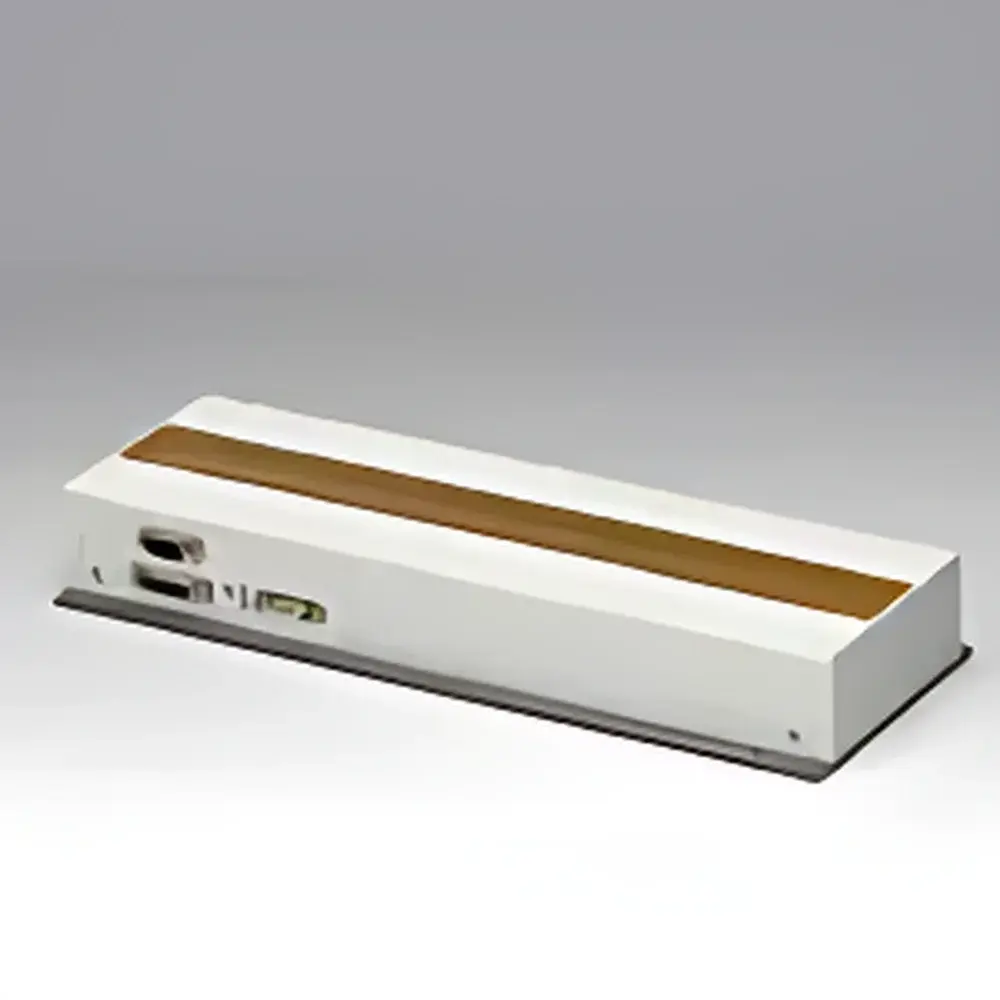
Hamamatsu C12200-321 TDI X-ray Line-Scan Camera
| Brand | Hamamatsu |
|---|---|
| Origin | Japan |
| Manufacturer Type | Original Equipment Manufacturer (OEM) |
| Import Category | Imported |
| Model | C12200-321 |
| Pricing | Upon Request |
| Sensor Architecture | Time-Delay Integration (TDI) CCD |
| Effective Pixel Count | 4608 (H) × 110 (V) |
| Pixel Size | 48 µm × 48 µm |
| Active X-ray Detection Area | 221 mm (H) × 6 mm (V) |
| Max. TDI Line Rate | 8.0 kHz (23.04 m/min) |
| Output Bit Depth | 12-bit |
| Interface | Camera Link (Base Configuration) |
| Power Supply | DC +15 V (±1 V) |
| Max. Power Consumption | 40 W |
| Scintillator | Fiber-Optic Scintillator (FOS) |
| Recommended X-ray Tube Voltage Range | 25–90 kV |
| Max. X-ray Exposure Rating | 130 kV, 80 µA |
| A/D Gain Range | 0–14 dB (64 steps) |
| Clock Frequency | 40.0 MHz (Camera Link), 5.0 MHz (CCD pixel clock) |
| Real-time Dark Current & Flat-Field Correction | Yes |
| Frame Readout Mode for Simplified Calibration | Yes |
Overview
The Hamamatsu C12200-321 is a high-performance, industrial-grade Time-Delay Integration (TDI) X-ray line-scan camera engineered for continuous, high-fidelity radiographic imaging of moving objects in automated inspection systems. Unlike conventional area-scan or single-line CCD detectors, the C12200-321 employs synchronized charge transfer across 110 parallel TDI stages—each aligned with the object’s transport velocity—to accumulate photon signal over time without motion blur. This architecture delivers exceptional sensitivity at low X-ray flux levels (e.g., sub-50 kV tube voltages), enabling robust detection of subtle density variations such as micro-voids in BGA solder joints, delamination in battery electrodes, or solder bridging on densely populated PCBs. Its 221 mm active width supports wide-field inline inspection without mechanical scanning, while the 48 µm pixel pitch ensures spatial resolution compliant with IPC-A-610 and JEDEC J-STD-001 standards for electronic assembly verification.
Key Features
- Time-Delay Integration (TDI) architecture with 110-stage charge-coupled accumulation for high quantum efficiency under low-dose X-ray illumination
- 221 mm effective scan width—eliminates need for lateral stage movement in long-part inspection (e.g., lithium-ion battery electrodes, flexible PCBs)
- 12-bit digital output with programmable gain (0–14 dB, 64-step resolution) and real-time dark current/flat-field correction to maintain SNR stability across thermal and exposure drift
- Camera Link Base configuration (40 MHz pixel clock) ensuring deterministic frame timing and compatibility with industrial vision controllers (e.g., NI PXI, Matrox Imaging Library)
- Single +15 V DC power supply simplifies integration into space-constrained shielded enclosures; max. 40 W consumption enables air-cooled deployment
- Dedicated frame-readout mode streamlines optical alignment and geometric calibration—reducing setup time during system commissioning or maintenance
- Fiber-optic scintillator (FOS) coupling optimized for 25–90 kV X-ray spectra, delivering high light yield and minimal afterglow for high-speed acquisition
Sample Compatibility & Compliance
The C12200-321 is validated for use with sealed-tube microfocus and minifocus X-ray sources rated up to 130 kV / 80 µA. Its radiation-hardened packaging and FOS-based detection stack meet IEC 61000-6-2 (immunity) and IEC 61000-6-4 (emissions) requirements for industrial environments. For regulated manufacturing—such as medical device PCB assembly or automotive battery production—the camera supports traceable calibration workflows aligned with ISO/IEC 17025 documentation practices. While the device itself does not carry FDA 21 CFR Part 11 certification, its deterministic Camera Link interface and stable analog-to-digital conversion enable integration into audit-ready inspection platforms that implement electronic signatures, data integrity controls, and revision-locked firmware versions.
Software & Data Management
Hamamatsu provides the C12200-321 SDK (Windows/Linux) with native support for GenICam-compliant drivers, allowing seamless integration into HALCON, Common Vision Blox, or custom C++/Python applications. Raw 12-bit TDI frames are delivered with embedded timestamping and line-synchronization pulses—enabling precise registration with encoder-triggered motion control systems. Post-acquisition, one-dimensional projection profiles can be reconstructed into pseudo-3D topographic maps via intensity-threshold segmentation and Z-axis mapping algorithms. All correction parameters (dark reference, gain lookup tables, pixel defect masks) are stored in non-volatile memory and applied in hardware prior to digitization—ensuring reproducible grayscale fidelity across shifts and maintenance cycles.
Applications
- Inline BGA void detection: Localized fan-beam irradiation reduces total dose by >90% versus CT-based methods—critical for radiation-sensitive ICs and wafer-level packages
- Real-time solder joint integrity assessment on SMT-assembled boards, including underside weld evaluation without disassembly
- Continuous dimensional metrology of lithium-ion battery anode/cathode foils—free from edge distortion inherent in 2D flat-panel detectors
- Automated inspection of wire-bond pull-test samples, ceramic substrates, and hermetic package seals
- High-throughput quality gate for flex-rigid PCBs, where traditional stop-and-stare radiography introduces bottlenecks
FAQ
What X-ray source configurations are recommended for optimal performance?
The C12200-321 is optimized for microfocus sources (≤5 µm focal spot) operating between 25 kV and 90 kV. For maximum resolution, magnification should be set so that the 48 µm pixel pitch corresponds to ≤25 µm object-plane resolution at the target feature size.
How is geometric distortion corrected in TDI mode?
Unlike area-scan detectors, TDI inherently avoids keystone or pincushion distortion because each line integrates only along the direction of motion. Spatial accuracy relies on precise encoder synchronization—not lens calibration—making it ideal for conveyor-based metrology.
Can the camera operate in variable-speed conveyor environments?
Yes. The TDI line rate is configurable via external trigger (pulse-width modulation) or internal oscillator. Closed-loop velocity matching ensures consistent integration gain across speed changes from 0.1 m/min to 23.04 m/min.
Is dead zone compensation supported in firmware?
Dead zones between CCD dies are fixed in physical layout. Hamamatsu provides pixel-mapping files and interpolation guidance in the SDK; full correction requires application-level masking or bilinear resampling based on known magnification and source geometry.
Does the camera support FDA 21 CFR Part 11 compliance?
The C12200-321 is a measurement transducer—not a standalone software system. When integrated into a validated inspection platform with audit-trail logging, user authentication, and electronic signature modules, it contributes to Part 11–compliant data acquisition workflows.



