
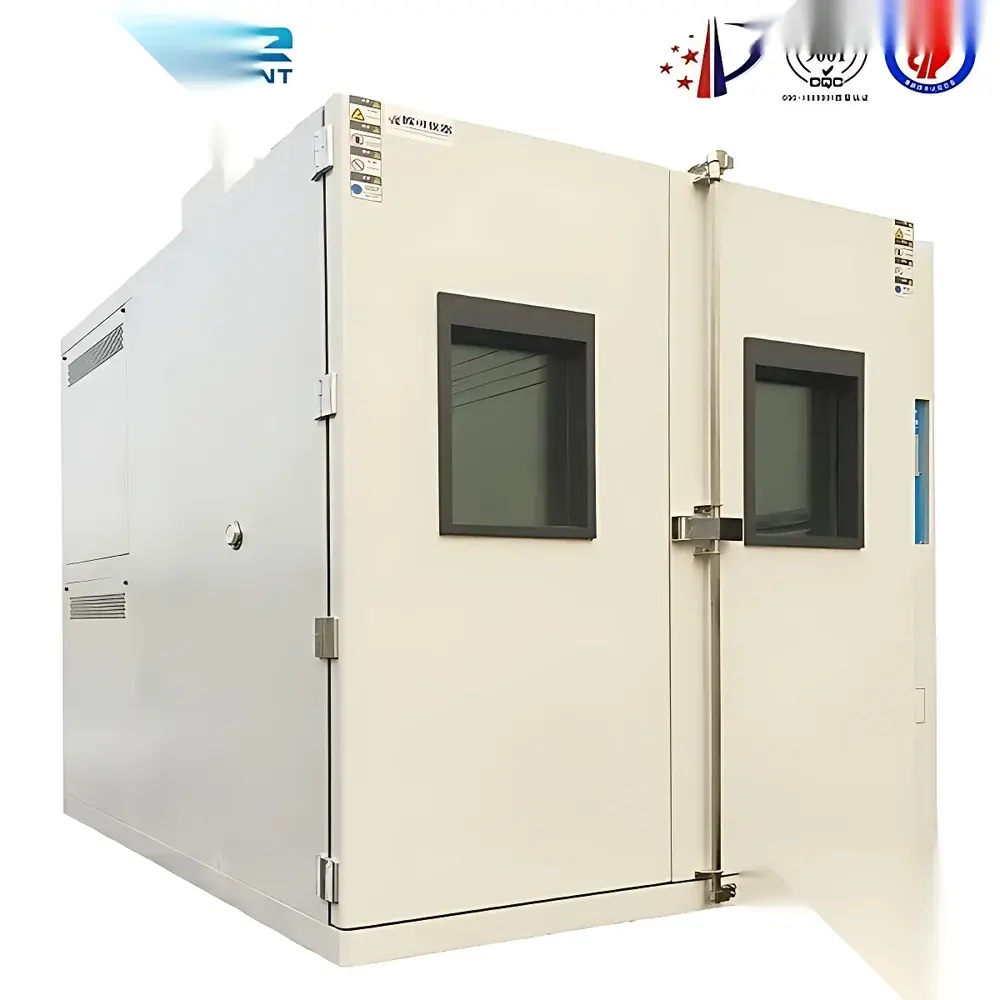
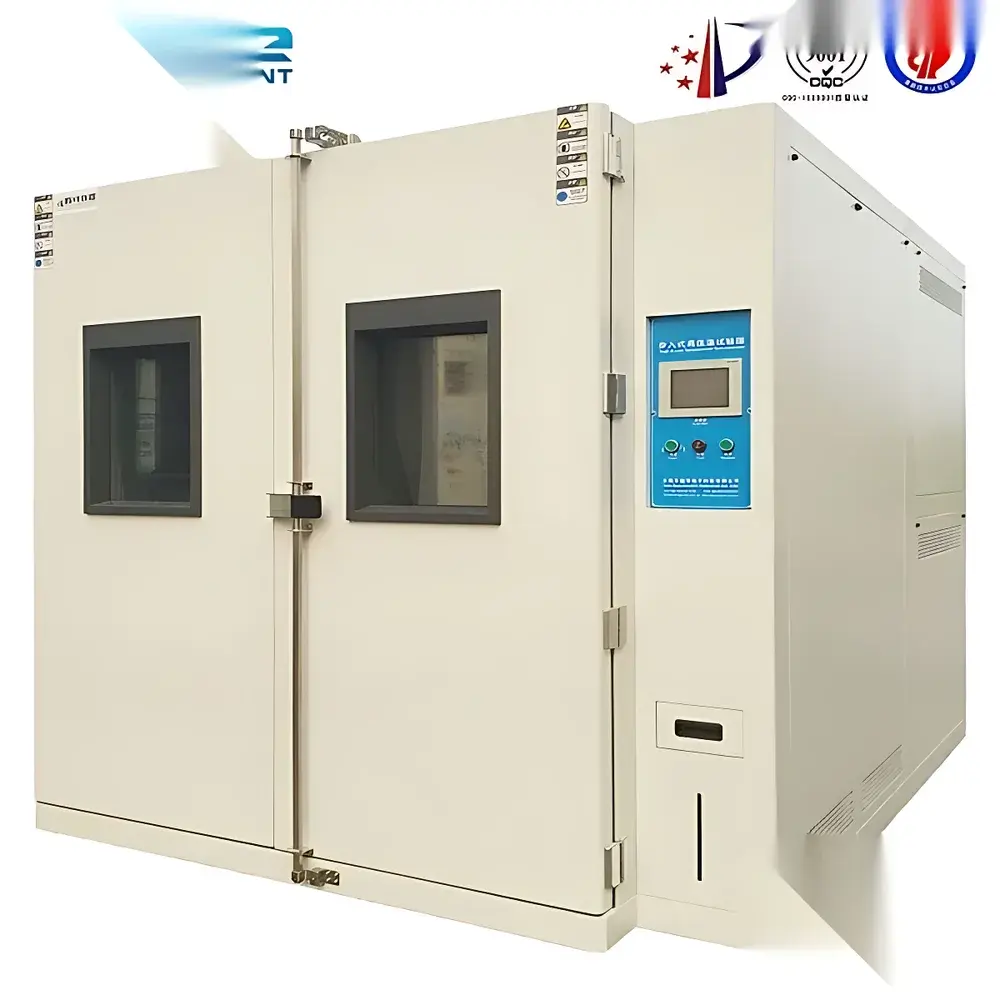
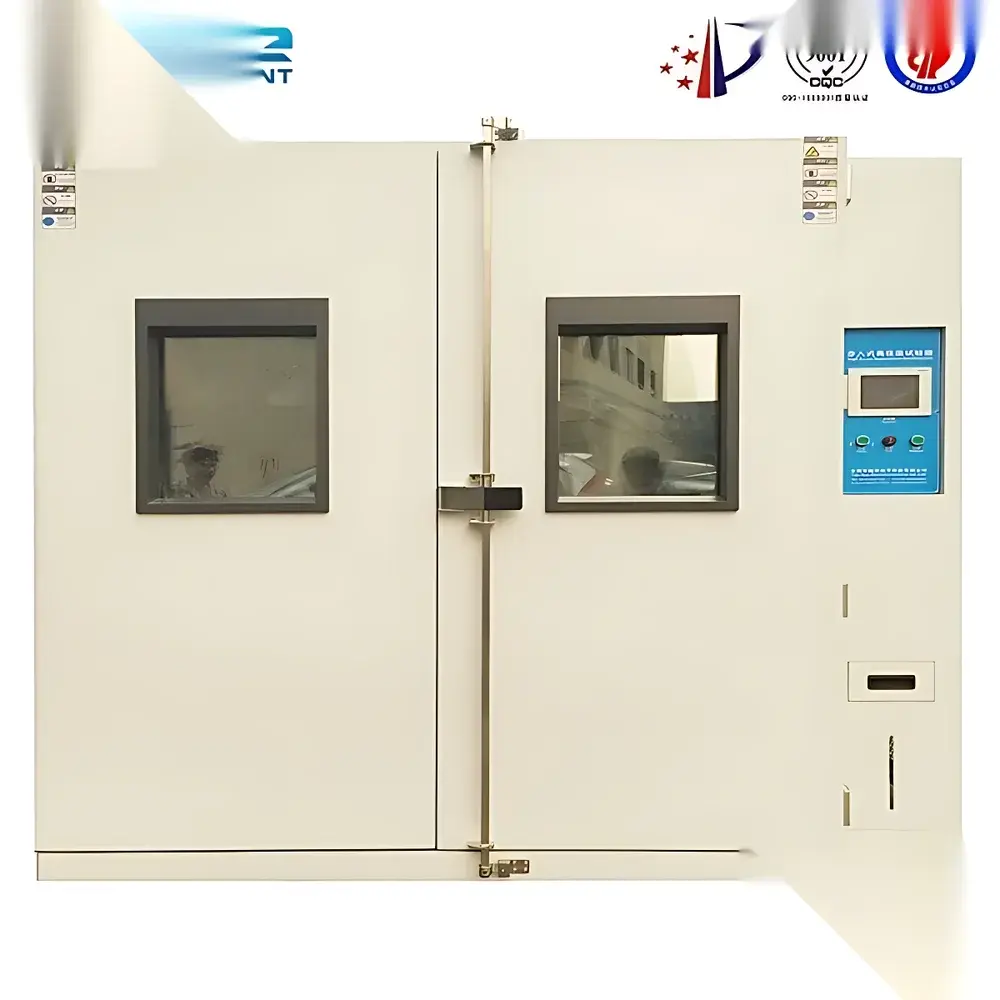
Walk-In Constant Temperature & Humidity Environmental Chamber
| Brand | Other Brands |
|---|---|
| Origin | Imported |
| Manufacturer Type | Authorized Distributor |
| Temperature Range | 0°C to 80°C (Optional Low-Temp Models: –20°C, –40°C, –60°C) |
| Humidity Range | 20–98% RH (Customizable: 5–98% RH, 10–98% RH) |
| Control System | Microprocessor-Based PID + SSR + Timer |
| Air Circulation | Forced Convection with Extended-Shaft Centrifugal Blower (Motor External-Mounted) |
| Heating | Nickel-Chromium Alloy Resistive Heaters (Spiral Design, High Surface Area) |
| Cooling | High-Efficiency Finned-Tube Air Heat Exchanger |
| Humidification | Stainless Steel Steam Generator with Integrated Pure Water System |
| Dehumidification | Surface Cooling via Refrigerated Coil |
| Safety Protections | Compressor Overheat/Overcurrent/High-Pressure Protection, Condenser Fan Overheat, Oil Pressure Monitoring, Phase Sequence & Phase Loss Detection, Earth Leakage Protection, Dry-Run Prevention for Heating/Humidification, Overload & Short-Circuit Protection, Independent Over-Temperature Cut-Off, Sample Power Output: Relay-Controlled AC220V / ≤2A (Fail-Safe Open on Fault) |
| Data Interface | USB Storage Export (Historical Curves & Raw Data), RS-232C Bidirectional Communication, Ethernet-Based Remote Monitoring & Control (Intranet-Compatible) |
| Compliance | Designed per ISO 17025-relevant environmental test infrastructure requirements |
Overview
The Walk-In Constant Temperature & Humidity Environmental Chamber is an engineered precision conditioning system designed for long-duration, large-volume stability testing, accelerated aging, and product validation under tightly controlled thermal and hygroscopic conditions. Unlike benchtop chambers, this walk-in configuration enables full-scale equipment, automotive components, medical devices, or packaging systems to be evaluated in situ—without disassembly or spatial compromise. Its operational principle relies on balanced forced-air recirculation: real-time temperature and humidity sensors feed analog signals to a microprocessor controller, where analog-to-digital conversion, non-linear compensation, and PID-based closed-loop regulation dynamically modulate heating, refrigeration, humidification, and dehumidification subsystems. This ensures thermodynamic equilibrium between energy input and chamber losses—achieving high reproducibility (< ±0.5°C temperature uniformity, < ±2% RH stability over 24 h) across volumetric loads up to 10 m³ (customizable).
Key Features
- Optimized air distribution architecture with extended-shaft centrifugal blower and external motor mounting—minimizing internal heat load and enhancing long-term reliability.
- Eco-friendly refrigerant compliant with international environmental directives (e.g., EU F-Gas Regulation, EPA SNAP program); fully sealed cooling circuit with oil pressure monitoring and high-pressure cut-off.
- Intuitive LCD HMI with dialog-driven interface—supports multilingual operation, parameter locking, and user-level access control (Operator/Engineer/Admin).
- Comprehensive safety architecture: dual-stage over-temperature protection (independent mechanical thermostat backup), dry-run prevention for steam generator and heaters, and relay-isolated sample power output with automatic fault-triggered de-energization.
- Integrated pure water system eliminates manual refilling; stainless steel steam generator ensures corrosion resistance and consistent vapor quality across extended runtime.
- Real-time diagnostics: on-screen fault code display with descriptive English text (e.g., “E07 – Humidifier Flow Fault”) accelerates root-cause identification and service response.
Sample Compatibility & Compliance
This chamber accommodates heterogeneous test specimens—including electronic enclosures, pharmaceutical packaging, aerospace subassemblies, and industrial control panels—without requiring dimensional modification. Internal dimensions are fully customizable to fit facility constraints (minimum clear height: 2.0 m; standard floor loading capacity: 500 kg/m²). Structural insulation meets ASTM C518 thermal conductivity standards (≤0.025 W/m·K). All electrical components comply with IEC 61000-6-3 (EMC emissions) and IEC 61000-6-2 (immunity). The system is compatible with ISO 14644-1 Class 8 cleanroom integration when equipped with HEPA-filtered recirculation option. For regulated industries, optional 21 CFR Part 11-compliant software modules provide electronic signatures, audit trails, and data integrity controls aligned with FDA and EMA expectations.
Software & Data Management
Embedded firmware supports native USB mass storage export: time-stamped CSV files containing second-resolution temperature/humidity logs, setpoint history, and alarm timestamps can be directly copied without auxiliary software. RS-232C serial interface enables bidirectional SCPI-like command control (e.g., :TEMP:SET 45.0, :HUMID:READ?) for integration into LabVIEW, Python, or custom MES platforms. Optional Ethernet module enables secure HTTP/HTTPS remote access via corporate intranet—supporting live parameter viewing, setpoint adjustment, and event log download without VPN dependency. Data retention complies with ISO/IEC 17025 clause 7.5.2: raw sensor outputs are buffered for ≥72 h during network interruption and auto-sync upon recovery.
Applications
- Accelerated life testing of lithium-ion battery modules under combined thermal-hygric stress (per UN 38.3, IEC 62133).
- Stability studies for sterile medical device packaging (ISO 11607-1), including peel strength and seal integrity validation at elevated humidity.
- Environmental stress screening (ESS) of avionics hardware per MIL-STD-810H Method 507.6 (Temperature/Humidity Bias).
- Pharmaceutical excipient compatibility testing under ICH Q1A(R2) long-term and accelerated storage conditions.
- Automotive ECUs validation per ISO 16750-4 (Climate Load) and GMW15001 Section 5.3.1 (Humidity Cycling).
FAQ
What is the standard temperature uniformity specification across the working volume?
Typical uniformity is ±0.8°C at 25°C and ±1.5°C at extremes (–40°C and 80°C), measured per ISO 16750-4 Annex D using 9-sensor mapping protocol.
Can the chamber operate continuously for 30 days without maintenance?
Yes—designed for unattended 7×24 operation; preventive maintenance intervals are specified at 500 operating hours or 6 months, whichever occurs first.
Is third-party calibration certification available?
Factory calibration certificates traceable to NIST or PTB standards are provided; UKAS-accredited field calibration services can be arranged separately.
Does the system support ramp-soak profiles?
Yes—up to 99 programmable segments with independent rate control (0.1–10°C/min, 0.1–5% RH/min), dwell timing, and loop repetition.
What is the minimum required ambient room condition for installation?
Ambient temperature: 15–35°C; relative humidity: ≤80% non-condensing; ventilation: ≥300 m³/h fresh air exchange; floor loading: ≥5 kN/m².



