
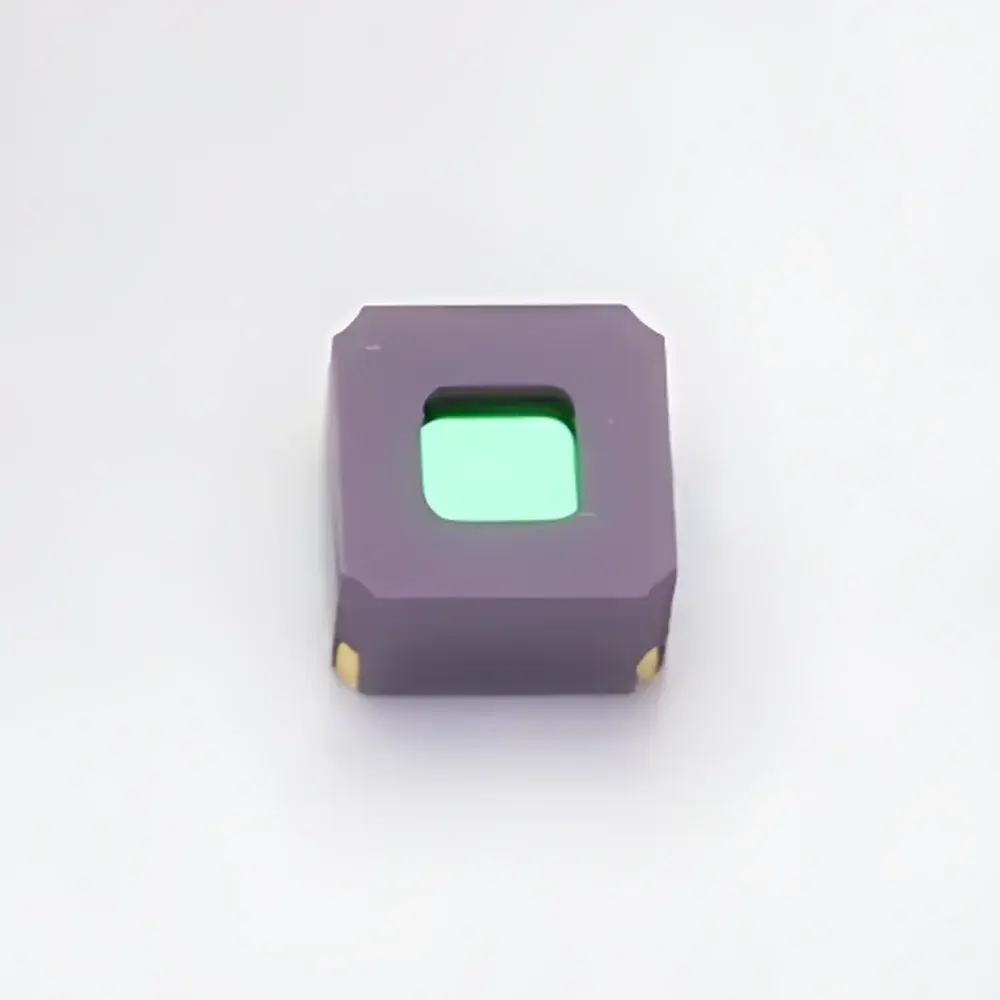
Hamamatsu P13243-011CA InAsSb Photovoltaic Infrared Detector
| Brand | Hamamatsu |
|---|---|
| Origin | Japan |
| Manufacturer Type | Original Equipment Manufacturer (OEM) |
| Product Origin | Imported |
| Model | P13243-011CA |
| Price Range | USD 280–700 (FOB Japan) |
| Active Area | 0.7 × 0.7 mm² |
| Pixel Count | 1 |
| Package Type | Plastic TO-can |
| Cooling | Uncooled |
| Cutoff Wavelength (typ.) | 5.3 µm |
| Peak Spectral Responsivity Wavelength (typ.) | 3.5 µm |
| Responsivity (typ.) | 0.0045 A/W @ 3.5 µm, Ta = 25 °C |
| Shunt Resistance (typ.) | >10⁶ Ω |
| Rise Time (typ.) | <100 ns |
| Dark Current (typ.) | <10 nA @ −0.1 V bias |
Overview
The Hamamatsu P13243-011CA is a single-element, uncooled photovoltaic infrared (IR) detector fabricated from lattice-matched indium arsenide antimonide (InAsSb) on GaSb substrates. Engineered for mid-wave infrared (MWIR) detection in the 1–5.3 µm spectral range, it operates without thermoelectric or cryogenic cooling—enabling compact, low-power, and highly reliable integration into portable and embedded gas sensing platforms. Its photovoltaic operation mode eliminates the need for external bias, resulting in inherently low power consumption and minimal Johnson–Nyquist noise. The detector’s peak responsivity at 3.5 µm aligns with fundamental vibrational absorption bands of key industrial and environmental gases—including CO, CO₂, CH₄, NO, SO₂, and volatile organic compounds (VOCs)—making it especially suited for non-dispersive infrared (NDIR) and photoacoustic spectroscopy (PAS) gas analyzers.
Key Features
- Uncooled photovoltaic operation: Zero-bias, low-noise detection with no thermal stabilization required
- High detectivity (D* > 1 × 10¹⁰ cm·√Hz/W @ 3.5 µm, 25 °C): Enables ppm-level gas concentration resolution in optimized optical paths
- Rapid temporal response: Typical rise time <100 ns supports high-frequency modulation schemes (e.g., 1–10 kHz chopping) for lock-in amplification and ambient noise rejection
- High shunt resistance (>10⁶ Ω): Minimizes leakage current and improves signal-to-noise ratio (SNR) in low-light conditions
- Robust plastic TO-46 package: Hermetically sealed, moisture-resistant housing with integrated IR-transmissive window (typically ZnSe or Ge-coated BK7)
- Small form factor (Ø5.6 × 4.3 mm): Facilitates dense array configurations and miniaturized optical bench designs
Sample Compatibility & Compliance
The P13243-011CA is compatible with standard NDIR gas cell geometries (e.g., 1–10 cm path lengths) and integrates seamlessly with broadband IR sources (e.g., MEMS thermal emitters) and narrowband optical filters (e.g., interference filters centered at 4.26 µm for CO₂). Its spectral cutoff at 5.3 µm ensures suppression of long-wavelength background radiation in ambient-temperature environments. The device complies with JEDEC J-STD-020 moisture sensitivity level (MSL) 3 specifications and meets RoHS Directive 2011/65/EU and REACH Regulation (EC) No. 1907/2006 requirements. While not certified as intrinsically safe per IEC 60079-0, it is routinely deployed in Zone 2/Class I, Division 2 gas monitoring systems when paired with appropriate barrier circuits and enclosure ratings (e.g., IP65/NEMA 4X).
Software & Data Management
As a component-level sensor, the P13243-011CA does not include embedded firmware or digital interfaces. It outputs analog photocurrent proportional to incident IR irradiance. Signal conditioning is implemented externally using transimpedance amplifiers (TIAs), programmable gain stages, and 16–24-bit ADCs. When integrated into OEM gas analyzers, raw detector output is typically processed via real-time algorithms compliant with ASTM D6348–21 (standard test method for determining gaseous contaminants by IR absorption) and ISO 12039:2000 (stationary source emissions—determination of carbon monoxide, carbon dioxide and oxygen concentrations—performance characteristics of automated measuring systems). Full audit trails, calibration history, and data integrity are maintained in accordance with FDA 21 CFR Part 11 when deployed in regulated environmental monitoring applications under GLP or EPA Method 20.0 frameworks.
Applications
- Fixed and portable NDIR gas analyzers for ambient air quality monitoring (e.g., urban CO networks, landfill CH₄ leak detection)
- Industrial process gas analyzers in petrochemical, semiconductor, and fertilizer production facilities
- Combustion efficiency analyzers for boiler and furnace optimization (CO/O₂ dual-channel systems)
- Photoacoustic gas sensors requiring fast, low-drift detectors with wide dynamic range
- Multi-gas detection modules in smart building HVAC control systems (CO₂ + VOC + NOx)
- Research-grade FTIR spectrometer focal plane alternatives for rapid-scanning MWIR spectroscopy
FAQ
Is the P13243-011CA suitable for continuous outdoor deployment?
Yes—when housed in temperature-stabilized, weatherproof enclosures with desiccant-filled optical windows and calibrated against NIST-traceable reference gases, it maintains stable responsivity over −20 °C to +60 °C ambient ranges.
What optical filtering is recommended for CO₂ detection?
A 4.26 ± 0.05 µm bandpass filter with OD > 4 outside the passband is standard; edge filters with steep cut-on/cut-off slopes may be used to suppress water vapor interference near 2.7 µm.
Can this detector be operated in photodiode mode with reverse bias?
No—it is strictly photovoltaic (zero-bias) configured; applying reverse bias risks degrading the InAsSb junction and voiding warranty.
Does Hamamatsu provide calibration certificates with each unit?
Calibration is performed at wafer level and provided as typical performance curves (responsivity vs. wavelength, I–V characteristics); NIST-traceable unit-level calibration is available as an OEM service option.







