
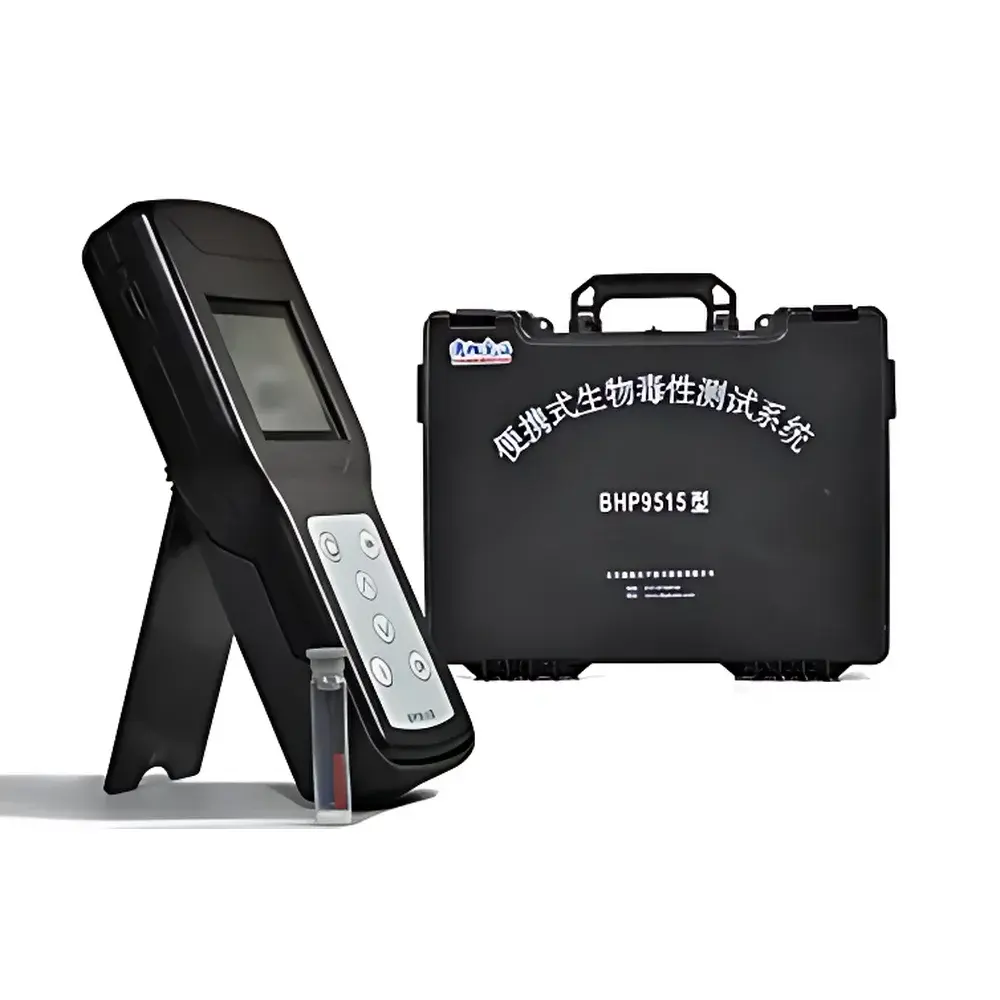
Hamamatsu BHP9515 Portable Bioluminescent Bacterial Toxicity Analyzer
| Brand | Hamamatsu Photonics (BHP) |
|---|---|
| Model | BHP9515 |
| Type | Portable Toxicity Analyzer |
| Biological Indicator | *Aliivibrio fischeri* (formerly *Vibrio fischeri*) bioluminescent bacteria |
| Operating Temperature | 5–40 °C |
| Relative Humidity | 10–90% RH (at 25 °C) |
| Minimum Assay Time | 5 min |
| Continuous Operation | ≥8 h on battery |
| Data Storage Capacity | 1,000 measurements per mode (ISO / Basic / RLU) |
| Detection Wavelength Range | 320–1000 nm |
| Luminescence Measurement Range | 0–65,535 RLU (Relative Light Units) |
| Instrument Weight | 258 g (including batteries) |
| Dimensions | 202 × 78 × 30 mm |
| Power Supply | 3 V DC (AA alkaline battery pack) |
Overview
The Hamamatsu BHP9515 Portable Bioluminescent Bacterial Toxicity Analyzer is a field-deployable instrument engineered for rapid, quantitative assessment of acute aquatic toxicity using standardized bioluminescent bacterial bioassays. It operates on the principle of metabolic inhibition: viable *Aliivibrio fischeri* cells emit stable bioluminescence via the luciferase enzyme system under optimal conditions; exposure to toxicants suppresses cellular respiration and ATP synthesis, resulting in measurable reduction of light output within minutes. This photometric endpoint correlates with toxicant concentration and is traceable to ISO 11348-3 (Water quality — Determination of the inhibitory effect of water samples on the light emission of *Vibrio fischeri* — Part 3: Method using freeze-dried bacteria). Unlike vertebrate or macroinvertebrate bioassays, this method eliminates animal use, reduces assay time from days to minutes, and maintains high reproducibility across laboratories when performed under controlled reconstitution and incubation protocols.
Key Features
- Three standardized operational modes: ISO-compliant mode (pre-configured for ISO 11348-3), Basic mode (user-defined incubation and measurement timing), and RLU mode (calibrated relative light unit quantification compatible with ATP-based assays)
- Integrated photomultiplier tube (PMT) detector with spectral response optimized for bacterial bioluminescence (peak ~490 nm), coupled with optical filtering to minimize ambient light interference
- Onboard real-time data acquisition and automatic toxicity threshold alerting—configurable alarm triggers based on % inhibition relative to control
- Internal non-volatile memory storing up to 1,000 datasets per mode, each timestamped and annotated with sample ID, operator code, and environmental metadata (temperature, humidity)
- Ultra-portable architecture: compact form factor (202 × 78 × 30 mm), lightweight design (258 g with batteries), and ruggedized carrying case rated for field transport and incidental impact
- Battery-powered operation (3 V DC, AA alkaline) supporting ≥8 hours of continuous use—no external power source required during emergency deployments or remote sampling
Sample Compatibility & Compliance
The BHP9515 is validated for direct analysis of liquid environmental matrices including raw and treated wastewater, surface water, groundwater, seawater, drinking water, and leachates. Sample pretreatment—such as pH adjustment (to 6.0–8.5), dilution (for highly toxic samples), and filtration (0.45 µm)—follows ISO 11348-3 guidelines to ensure bacterial viability and assay fidelity. The system supports compliance with national and international regulatory frameworks including China’s HJ 1182–2021 (Standard Method for Acute Toxicity Testing Using Bioluminescent Bacteria), EPA Method 100.2 (Modified), and EU Water Framework Directive (WFD) screening requirements. All measurement data are structured to support GLP-aligned documentation, including audit trails for calibration history, user logins, and result modifications.
Software & Data Management
Hamamatsu provides dedicated PC software (BHP-DataLink v3.x) for bidirectional communication via USB interface. The software enables batch export of RLU values, calculation of EC50/IC50 using probit or logistic regression models, generation of dose-response curves, and automated report generation compliant with ISO/IEC 17025 documentation standards. Data files include embedded metadata (instrument ID, firmware version, test mode, operator ID) and support digital signature integration for 21 CFR Part 11–compliant environments. Raw luminescence traces and background-subtracted kinetics can be exported in CSV or XML formats for third-party statistical analysis (e.g., R, Python, GraphPad Prism).
Applications
- Rapid emergency response: On-site screening of industrial spills, accidental discharges, or post-disaster water sources
- Wastewater treatment plant monitoring: Real-time evaluation of influent toxicity, activated sludge health, and effluent compliance
- Drinking water safety: Verification of disinfection by-product formation potential and residual biocide efficacy
- Pharmaceutical QC: Screening of antibiotic activity and cytotoxic impurities in process streams
- Ecotoxicological research: High-throughput comparative toxicity profiling of emerging contaminants (e.g., microplastics, PFAS, nanomaterials)
- Regulatory compliance: Routine monitoring for environmental agencies, CDC laboratories, and accredited testing facilities under national water quality standards
FAQ
What bacterial strain is used in the BHP9515 system?
The instrument is calibrated and validated for use with lyophilized *Aliivibrio fischeri* (ATCC 49387 or equivalent ISO-certified strains). Reconstituted cultures must be used within 15 minutes of hydration per ISO 11348-3.
Can the BHP9515 quantify specific toxicants like heavy metals or pesticides?
No—it measures total acute toxicity (nonspecific metabolic inhibition). Identification and quantification of individual compounds require complementary analytical techniques such as ICP-MS or GC-MS.
Is temperature control built into the instrument?
The BHP9515 does not include active thermal regulation; users must perform assays within the specified ambient range (5–40 °C) and record temperature at time of measurement for data normalization.
How is instrument calibration verified?
Daily verification uses a certified neutral-density optical standard (NIST-traceable); full performance validation includes reference toxicant testing (e.g., 3,5-dichlorophenol) with acceptance criteria defined in ISO 11348-3 Annex B.
Does the system support multi-user access control?
Yes—the PC software supports role-based login (operator, supervisor, administrator) with configurable permissions for data viewing, editing, and report approval, aligning with ISO/IEC 17025 clause 7.11.2.







