
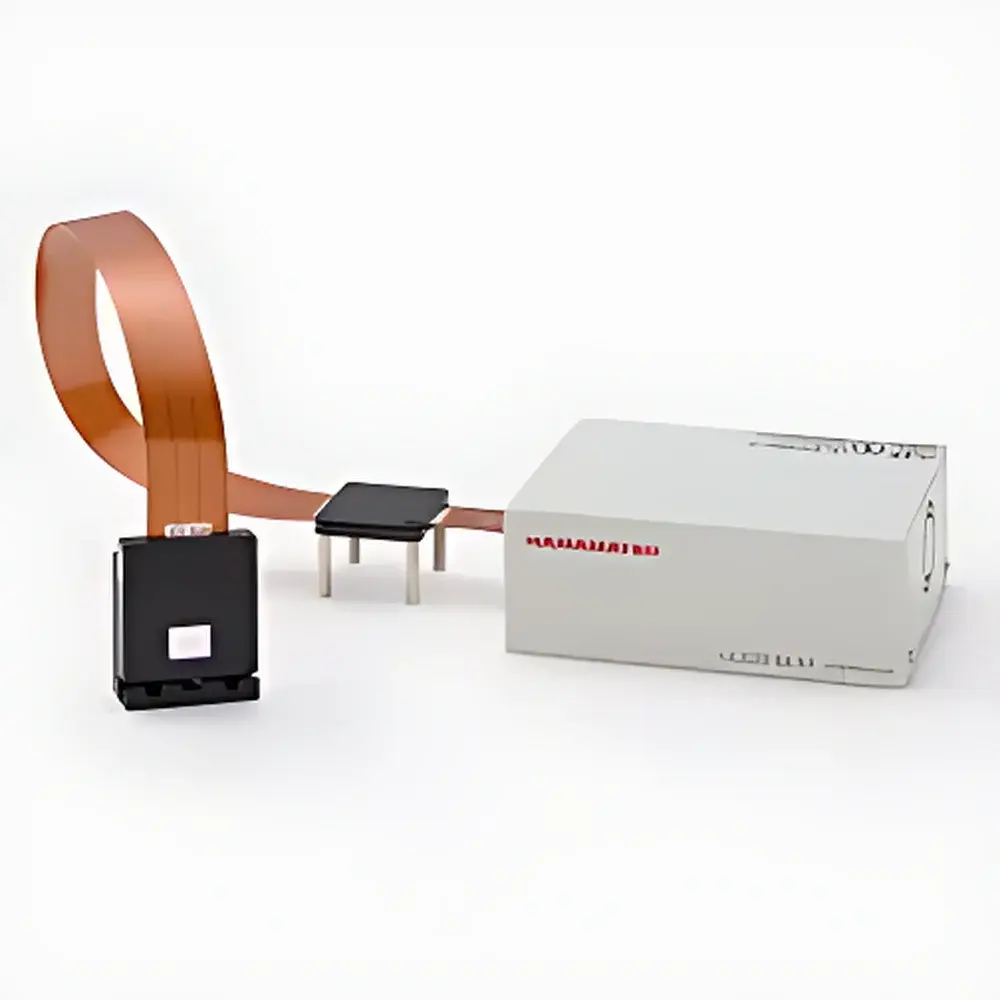
Hamamatsu LCOS-SLM X15213-02 Reflective Pure-Phase Spatial Light Modulator
| Brand | Hamamatsu |
|---|---|
| Origin | Japan |
| Manufacturer Type | Original Equipment Manufacturer (OEM) |
| Import Category | Imported Instrument |
| Model | X15213-02 |
| Pricing | Upon Request |
| Pixel Pitch | 12.5 µm |
| Active Area | 15.9 × 12.8 mm |
| Resolution | 1272 × 1024 pixels (SXGA) |
| DVI Input Format | SXGA @ 60 Hz |
| Signal Interface | DVI-D + USB-B (USB 2.0 High-Speed) |
| Gray Levels | 256 (8-bit) |
| Fill Factor | 96% |
| Rise Time | 30 ms |
| Fall Time | 80 ms |
| Operating Wavelength | 800 ± 50 nm |
| Optical Efficiency | 97% (measured at λ = 785 nm) |
| Maximum Spatial Frequency | 40 lp/mm |
| Modulation Type | Reflective, Pure-Phase |
Overview
The Hamamatsu LCOS-SLM X15213-02 is a high-performance reflective pure-phase spatial light modulator engineered for precision wavefront control in advanced optical systems. Built on silicon-based liquid crystal on silicon (LCOS) technology, this device enables pixel-level voltage-driven phase modulation of incident light without amplitude disturbance—critical for applications demanding diffraction-limited beam shaping, adaptive optics, holographic projection, and quantum optics experiments. Unlike transmissive SLMs, its reflective architecture minimizes thermal load and supports higher average optical power handling. The device operates within a narrow spectral band centered at 800 nm (±50 nm), optimized for Ti:sapphire laser systems, ultrafast pulse shaping, and near-infrared interferometry. Its monolithic LCOS chip integrates high-fidelity phase response calibration, compensating for intrinsic nonlinearity and wavefront distortion via real-time correction algorithms embedded in the controller firmware.
Key Features
- Reflective pure-phase modulation with negligible amplitude coupling—ensures high-fidelity wavefront reconstruction
- 97% optical efficiency at 785 nm, achieved through anti-reflection coatings, high fill factor (96%), and minimized inter-pixel diffraction artifacts
- SXGA resolution (1272 × 1024 pixels) with 12.5 µm pitch and 15.9 × 12.8 mm active area—enabling fine spatial sampling and high angular resolution in Fourier-plane applications
- DVI-D video interface compatibility (60 Hz refresh rate) for seamless integration with standard laboratory PCs—no proprietary frame grabbers or GPU drivers required
- USB-B (USB 2.0 High-Speed) port for bidirectional communication, firmware updates, and real-time phase map loading
- Linearized 8-bit grayscale input (256 levels) with factory-calibrated phase response—guarantees reproducible, monotonic phase shifts across full dynamic range
- Rise/fall times of 30 ms / 80 ms—sufficient for quasi-static hologram switching and moderate-speed closed-loop adaptive optics
Sample Compatibility & Compliance
The X15213-02 is designed for integration into Class 1 and Class 3R laser optical benches compliant with IEC 60825-1:2014 and ANSI Z136.1-2022 standards. Its reflective geometry and thermally stable silicon substrate support continuous-wave and pulsed laser operation up to 2 W/cm² average irradiance (within specified wavelength band), provided appropriate beam homogenization and thermal management are implemented. The device meets RoHS Directive 2011/65/EU and REACH Regulation (EC) No. 1907/2006 requirements. While not certified for medical or industrial safety-critical environments, it is routinely deployed in ISO/IEC 17025-accredited metrology labs for optical path difference calibration and interferometric reference generation. No FDA 21 CFR Part 11 compliance is applicable, as the unit functions exclusively as a passive optical component—not a data acquisition or diagnostic system.
Software & Data Management
Hamamatsu provides the X15213-02 with a cross-platform software development kit (SDK) supporting Windows, Linux, and macOS. The SDK includes C/C++, Python, and MATLAB APIs for direct DVI frame buffer control and USB-based phase map synchronization. All phase patterns are loaded as 8-bit grayscale bitmaps conforming to SXGA dimensions; no proprietary file format is required. The controller implements hardware-level gamma correction and phase-to-voltage lookup tables (LUTs), ensuring traceable, repeatable modulation behavior across instruments. Audit logs—including timestamped pattern upload events, firmware version, and temperature-stabilized calibration parameters—are accessible via USB query commands, supporting GLP-aligned documentation practices. Data export supports TIFF, PNG, and binary RAW formats for post-processing in third-party optical design tools (e.g., Zemax OpticStudio, MATLAB Wavefront Toolbox).
Applications
- Adaptive optics in astronomy: dynamic correction of atmospheric turbulence using deformable mirror emulation
- Holographic optical trapping: real-time generation of multiple 3D optical tweezers for single-molecule biophysics
- Ultrafast pulse shaping: spectral phase modulation in 4f zero-dispersion compressors for femtosecond laser systems
- Quantum information processing: programmable mode sorting and spatial-mode entanglement engineering in photonic circuits
- Structured illumination microscopy (SIM): high-contrast, multi-angle pattern projection for super-resolution imaging
- Laser beam homogenization and focus shaping: generation of Bessel, Airy, or flat-top intensity profiles for materials processing
FAQ
Is the X15213-02 compatible with HDMI or DisplayPort sources?
No—it requires a native DVI-D signal (single-link, digital-only). HDMI or DisplayPort outputs must be converted using an active, timing-accurate converter that preserves SXGA@60Hz pixel clock integrity.
Can phase maps be updated at rates exceeding 60 Hz?
No—the DVI interface limits frame rate to 60 Hz. For higher update rates, custom FPGA-based controllers interfacing directly with the LCOS driver ASIC are required (not supplied by Hamamatsu).
What is the recommended method for calibrating phase response?
Hamamatsu supplies factory-measured phase-voltage LUTs. Users may perform independent interferometric calibration using a Twyman–Green or Mach–Zehnder setup with a reference mirror and phase-shifting algorithm.
Does the device require external temperature stabilization?
Operation within 15–30°C ambient is sufficient for <0.02π RMS phase error drift over 1 hour. For sub-mrad stability over extended periods, mounting on a Peltier-stabilized baseplate is advised.
Is the 97% optical efficiency measured at normal incidence only?
Yes—efficiency degrades gradually beyond ±10° angle of incidence due to polarization-dependent reflectivity and LC birefringence effects; performance data for oblique illumination is available in Hamamatsu Technical Note TN-X15213-02-EN.




