
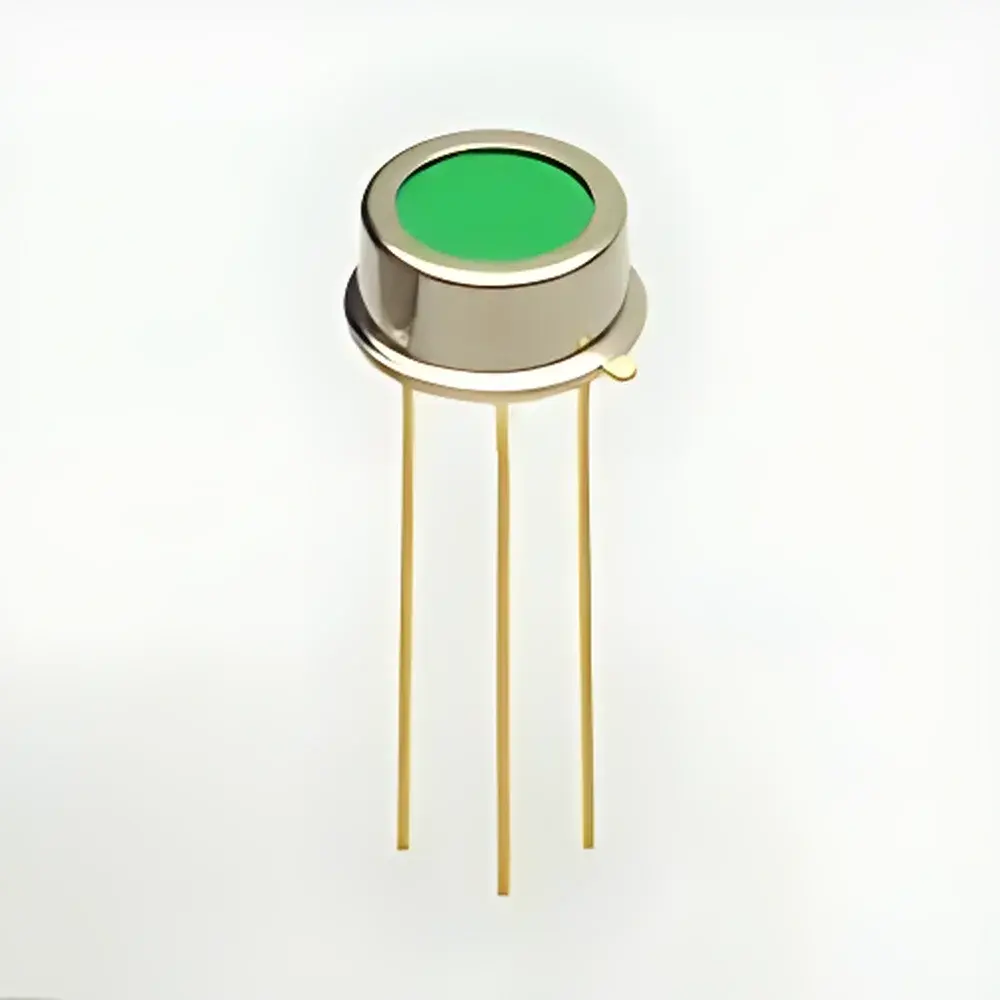
Hamamatsu P13894-011MA InAsSb Photovoltaic Infrared Detector
| Brand | Hamamatsu |
|---|---|
| Origin | Japan |
| Manufacturer Type | Original Equipment Manufacturer (OEM) |
| Product Category | Imported |
| Model | P13894-011MA |
| Price Range | USD 1,250 – 2,500 |
Overview
The Hamamatsu P13894-011MA is a single-element, uncooled photovoltaic infrared detector fabricated from lattice-matched indium arsenide antimonide (InAsSb) grown on GaSb substrates using Hamamatsu’s proprietary crystal growth and epitaxial process technology. Engineered for mid-wave infrared (MWIR) detection in continuous or pulsed operation, it operates without thermoelectric or cryogenic cooling—enabling compact, low-power, maintenance-free integration into portable and embedded gas sensing platforms. Its spectral response spans 1.0–11.0 µm (cutoff wavelength λc = 11 µm at Ta = 25 °C), with peak responsivity centered at 5.6 µm—a region critical for fundamental vibrational absorption bands of hydrocarbons (e.g., CH4, C2H6), CO, CO2, NO, SO2, and volatile organic compounds (VOCs). The detector employs a planar-doped junction architecture to achieve high shunt resistance (>10⁶ Ω at zero bias), low 1/f noise, and fast intrinsic response time (<100 ns), making it suitable for non-dispersive infrared (NDIR) and photoacoustic spectroscopy (PAS) configurations requiring high signal-to-noise ratio (SNR) and temporal fidelity.
Key Features
- Uncooled photovoltaic operation—eliminates power-hungry TECs and thermal stabilization circuits
- High specific detectivity D* > 1 × 10¹⁰ cm·√Hz/W (at 5.6 µm, 25 °C, 1 Hz bandwidth)
- Active area: 1.0 × 1.0 mm² with TO-5 metal can package (hermetically sealed, gold-plated Kovar base)
- Low dark current density (<5 nA/mm² at 0 V, 25 °C), enabling DC-coupled readout topologies
- Integrated guard ring structure suppresses edge leakage and enhances spatial uniformity
- Compatible with standard IR-transmissive windows (e.g., BaF₂, ZnSe, Ge) and optical chopper synchronization
Sample Compatibility & Compliance
The P13894-011MA is designed for use in extractive and open-path gas analyzers targeting regulated and industrial emission monitoring per EPA Method 10, EN 15267-3, and ISO 12039. Its spectral selectivity supports dual-wavelength ratio referencing—essential for compensating source intensity drift, window fouling, and ambient temperature fluctuations in field-deployed systems. The device meets RoHS Directive 2011/65/EU and conforms to IEC 61000-4-2 (ESD immunity) and IEC 60068-2 environmental stress testing protocols. While not intrinsically safe certified, it may be integrated into ATEX/IECEx-compliant enclosures when paired with appropriate barrier circuits per IEC 60079-11.
Software & Data Management
As a component-level sensor, the P13894-011MA does not include embedded firmware or communication interfaces. It interfaces directly with transimpedance amplifiers (TIAs), lock-in amplifiers, or analog front-end (AFE) ICs such as the Texas Instruments LMP7721 or Analog Devices ADA4530-1. Hamamatsu provides SPICE-compatible behavioral models and spectral responsivity calibration data (NIST-traceable at 25 °C) in CSV format for system-level simulation and algorithm development. When deployed in FDA-regulated or GxP environments (e.g., stack emission QA/QC labs), full traceability—including lot-specific responsivity curves, dark current histograms, and burn-in test reports—is supplied with each shipment to support 21 CFR Part 11 audit trails and GLP documentation requirements.
Applications
- Fixed and mobile NDIR analyzers for landfill methane (CH₄), refinery flare gas, and biogas composition monitoring
- Portable VOC sniffers and fugitive emission detectors compliant with EPA OOOOa and LDAR programs
- Industrial safety systems detecting CO, H₂S, NH₃, and refrigerants (R-134a, R-410A) in HVAC and cold chain logistics
- Research-grade FTIR spectrometer detector arrays (when tiled with matching elements)
- Calibration transfer standards for IR source stability verification in metrology laboratories
FAQ
Is the P13894-011MA compatible with standard TO-5 socket holders?
Yes—it uses industry-standard 9-pin TO-5 pinout (anode/cathode leads plus mechanical ground) and fits common ceramic or metal TO-5 sockets with 0.1-inch pitch.
What is the maximum permissible reverse bias voltage?
None—the device is strictly photovoltaic mode only; reverse bias degrades junction integrity and voids warranty.
Can this detector be used in vacuum environments?
Yes, provided the TO-5 package remains hermetically sealed; outgassing tests confirm compliance with NASA ASTM E595 for space-qualified applications.
Does Hamamatsu provide spectral calibration certificates?
Yes—each unit ships with a NIST-traceable spectral responsivity curve measured at 25 °C ± 0.1 °C under collimated blackbody illumination.
How does temperature variation affect cutoff wavelength?
λc shifts approximately +0.012 µm/°C; system designers must implement passive thermal mass or closed-loop ambient compensation for ppm-level gas quantification.







