
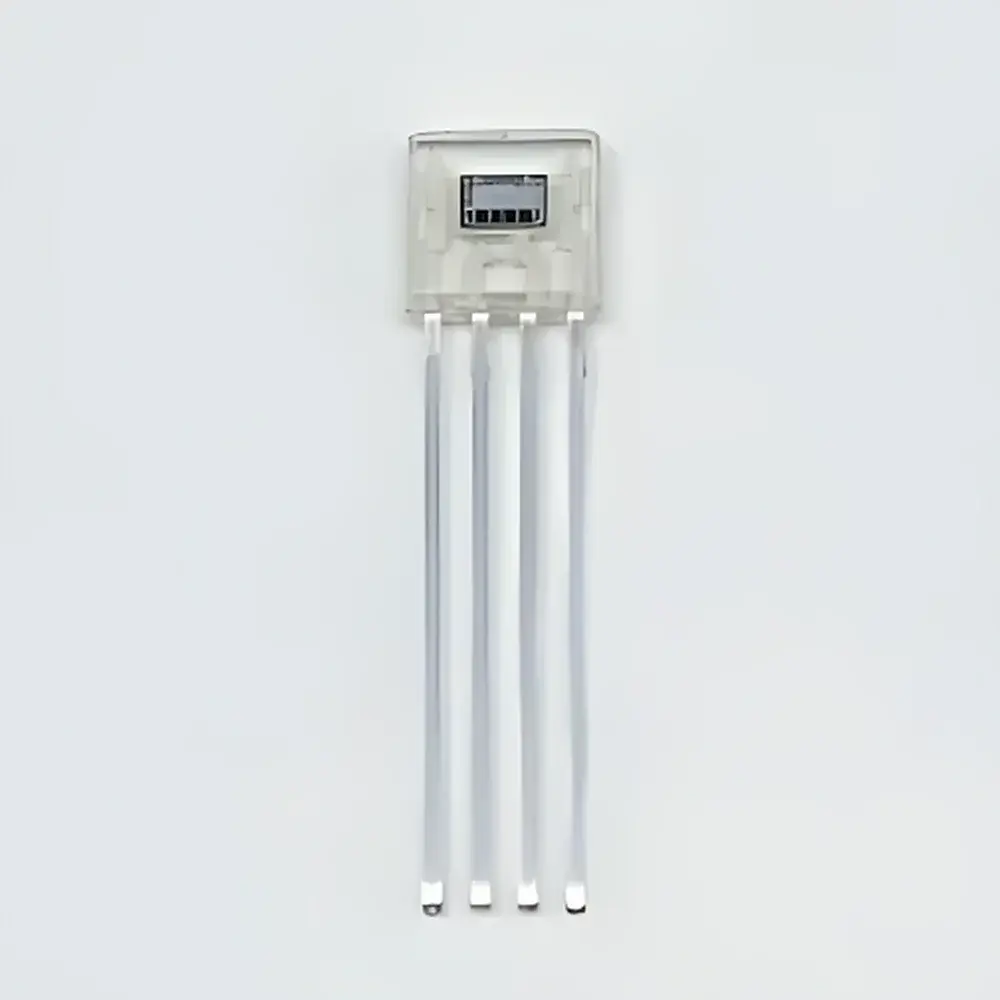
Hamamatsu S4506 Optical Encoder IC
| Brand | Hamamatsu |
|---|---|
| Origin | Japan |
| Manufacturer Type | Original Equipment Manufacturer (OEM) |
| Import Status | Imported |
| Model | S4506 |
| Component Category | Optical Element |
| Output Type | Quadrature 2-phase (A/B), 90° phase shift |
| Package | Plastic DIP |
| Operating Temperature | −30 to +80 °C |
| Storage Temperature | −40 to +85 °C |
| Supply Voltage | 5 V (Vcc) |
| Logic Compatibility | TTL-level output |
| Photodetector Array | Integrated 4-element silicon photodiode array |
| Electrical Interface | Direct TTL connection without external amplification |
Overview
The Hamamatsu S4506 Optical Encoder IC is a monolithic, application-optimized integrated circuit designed for high-reliability optical position and motion sensing in precision laboratory and industrial instrumentation. Engineered around a custom 4-element silicon photodiode array arranged in quadrature geometry, the device converts modulated light signals—typically from rotating or oscillating optical choppers—into deterministic, noise-immune digital quadrature outputs (Channel A and Channel B). Its operation relies on spatially resolved photocurrent detection across four discrete photodiodes, followed by on-chip signal conditioning and digital logic generation. This architecture eliminates the need for external comparators, differential amplifiers, or phase-shifting circuits, enabling compact, low-component-count encoder subsystems with inherent 90° phase quadrature—a prerequisite for direction-sensitive rotation counting and high-resolution angular displacement measurement. The S4506 is not a standalone sensor but a core signal-processing component intended for integration into optical chopper assemblies, rotary encoders, and synchronized beam-gating systems where deterministic TTL-compatible timing and minimal propagation delay are critical.
Key Features
- Monolithically integrated 4-element silicon photodiode array with precise inter-element spacing optimized for optical chopper slits and encoder disk patterns
- Dual-channel quadrature digital output (A and B) with guaranteed 90° phase difference under all specified operating conditions
- Direct TTL logic compatibility: outputs meet standard TTL voltage thresholds (VOH ≥ 2.4 V, VOL ≤ 0.4 V at IOL = 16 mA) without external level-shifting or buffering
- Robust plastic dual-in-line (DIP) package rated for continuous operation from −30 °C to +80 °C, suitable for both ambient lab environments and thermally constrained embedded modules
- Low power consumption: typical supply current of 5 mA at VCC = 5 V, minimizing thermal load in densely packed optical assemblies
- No external biasing or gain-setting components required—fully self-contained signal path from photon detection to digital edge generation
Sample Compatibility & Compliance
The S4506 is engineered for use with standard optical chopper wheels (e.g., 60–360-slot disks) and reflective or transmissive encoder targets operating in the visible to near-infrared spectrum (320–1100 nm peak responsivity). It maintains stable quadrature fidelity across incident irradiance levels ranging from 10 µW/cm² to 1 mW/cm² at 633 nm, accommodating both laser-based and broadband lamp-illuminated configurations. While the device itself carries no formal regulatory certification, its design adheres to baseline electromagnetic compatibility (EMC) practices common to laboratory-grade optoelectronic components (IEC 61000-4 series immunity guidelines). As an OEM component—not a finished instrument—it falls outside scope for FDA 21 CFR Part 11 or ISO/IEC 17025 accreditation; however, when integrated into validated analytical instruments (e.g., FTIR spectrometers, lock-in amplifier synchronization modules), it contributes to system-level compliance with GLP and GMP data integrity requirements through deterministic, repeatable timing behavior.
Software & Data Management
The S4506 operates at the hardware layer and does not incorporate firmware, memory, or communication interfaces. Its outputs are asynchronous, edge-triggered TTL signals intended for direct connection to microcontroller GPIO pins, FPGA input banks, or counter/timer peripherals (e.g., NI PXI counter modules, Arduino interrupt-capable pins). In automated test systems, these signals feed into real-time motion control algorithms or timestamped event logging via DAQ hardware with ≥10 MHz sampling capability. No proprietary drivers or configuration software are associated with the IC; integration relies solely on standard digital I/O protocols and hardware timing constraints. For traceable calibration workflows, users typically characterize the device’s propagation delay (typ. 150 ns max from light onset to A/B edge) and jitter (<5 ns RMS) during system-level validation per ASTM E2750–19 (Standard Practice for Characterizing Optical Encoders).
Applications
- Synchronization of pulsed lasers and gated detectors in time-resolved spectroscopy
- Position feedback in motorized optical filter wheels and monochromator slit drives
- Reference clock generation for lock-in amplifiers and phase-sensitive detection systems
- Direction-aware speed monitoring in centrifuge and stirrer control loops
- Low-cost, high-stability replacement for mechanical limit switches in optical bench automation
- Core detector element in custom-built optical chopper modules compliant with ISO 13406-2 illumination uniformity standards
FAQ
Can the S4506 be used with 3.3 V logic systems?
No—the device requires a nominal 5 V supply and produces TTL-level outputs; interfacing with 3.3 V microcontrollers necessitates level translation.
What is the maximum recommended chopping frequency?
The IC supports reliable quadrature output up to 100 kHz under typical illumination and load conditions; performance beyond this depends on optical modulation depth and downstream signal integrity.
Is the photodiode array sensitive to polarization?
Silicon photodiodes exhibit negligible polarization dependence in the visible-NIR range; however, system-level polarization effects must be evaluated if using polarized light sources.
Does Hamamatsu provide evaluation boards for the S4506?
Hamamatsu does not offer dedicated evaluation kits; users typically implement prototype interfaces using standard PCB breakout carriers compatible with 0.1″ DIP footprints.
How does temperature affect phase accuracy?
Phase quadrature remains stable within ±2° over the full −30 °C to +80 °C operating range, as verified per Hamamatsu’s internal qualification testing (Report No. S4506-TQ-2022).




