
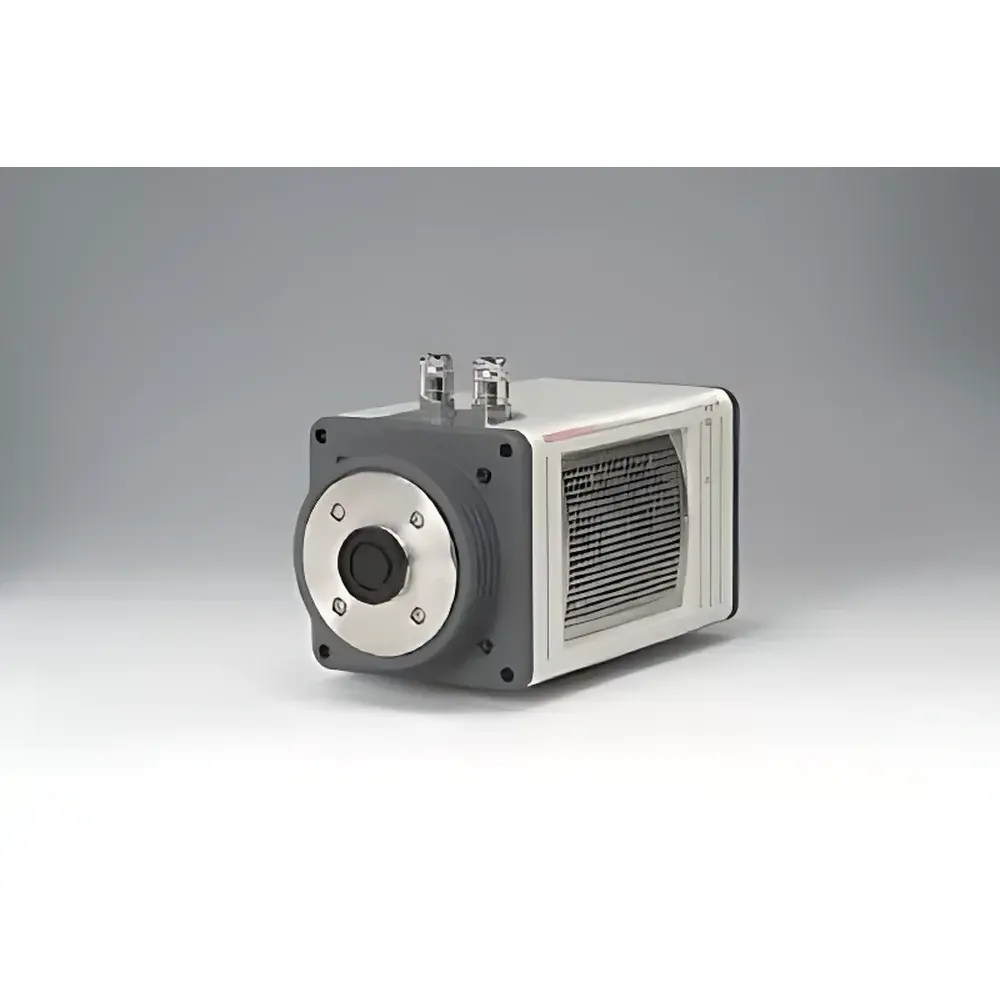
Hamamatsu C9100-13 Electron-Multiplying CCD Camera
| Brand | Hamamatsu |
|---|---|
| Origin | Japan |
| Manufacturer | Hamamatsu Photonics K.K. |
| Type | Imported Scientific EMCCD Camera |
| Model | C9100-13 |
| Sensor Format | 512 × 512 pixels |
| Pixel Size | 16 µm × 16 µm |
| Active Area | 8.19 mm × 8.19 mm |
| Peak Quantum Efficiency | >90% |
| Cooling | -75 °C (air-cooled) / -90 °C (water-cooled, at 10 °C water inlet) |
| Temperature Stability | ±0.03 °C (air-cooled) / ±0.01 °C (water-cooled) |
| Read Noise | 20 e⁻ (conventional mode) / <1 e⁻ (1200× EM gain) |
| Full Well Capacity | 370,000 e⁻ (conventional) / 800,000 e⁻ (EM mode, max) |
| EM Gain Options | 1×, 4×, 1200× |
| Pixel Clock Rates | 11 MHz / 2.75 MHz / 0.69 MHz (EM readout) |
| Frame Rate | 31.9–405 fps |
| A/D Resolution | 16-bit |
| Exposure Range | 10 µs – 7200 s |
| Binning Modes | 2×2, 4×4, 8×8, 16×16 |
| Subarray Readout | Supported |
| Trigger Modes | Edge, Level, Synchronous Readout, Start |
| Lens Mount | C-mount |
| Interface | IEEE 1394b (FireWire 800) |
| Dark Current | 0.01 e⁻/pixel/s (@ -65 °C and @ -80 °C) |
| Analog Gain | 0.5×–5× |
| Vacuum-Sealed Optical Window | Yes |
Overview
The Hamamatsu C9100-13 is a high-performance electron-multiplying charge-coupled device (EMCCD) camera engineered for ultra-low-light scientific imaging applications where single-photon detection sensitivity, temporal resolution, and quantitative fidelity are critical. Based on a back-illuminated, deep-depletion silicon sensor architecture, the C9100-13 achieves peak quantum efficiency exceeding 90% in the visible to near-ultraviolet spectral range (300–700 nm), enabling maximum photon capture without compromising spatial resolution. Its vacuum-sealed optical window ensures stable optical coupling and eliminates condensation or thermal drift—critical for long-duration, temperature-sensitive experiments. The sensor operates at cryogenic temperatures down to -90 °C (water-cooled configuration), suppressing dark current to ≤0.01 e⁻/pixel/s and ensuring exceptional signal-to-noise ratio (SNR) even during extended exposures. Unlike conventional CCDs, the C9100-13 integrates an on-chip electron multiplication register that amplifies photoelectrons prior to readout, effectively overcoming read noise limitations. This architecture delivers sub-electron effective read noise (<1 e⁻) at 1200× EM gain—making it suitable for photon-starved modalities such as total internal reflection fluorescence (TIRF), single-molecule localization microscopy (SMLM), and fast calcium dynamics imaging.
Key Features
- Back-illuminated EMCCD sensor with 512 × 512 pixels and 16 µm pixel pitch for optimal balance of resolution, sensitivity, and field-of-view
- Vacuum-sealed, thermally isolated optical path—eliminates environmental thermal influence on sensor temperature stability
- Multi-stage cooling system supporting both air-cooled (-75 °C) and water-cooled (-90 °C) operation with ±0.01 °C stability under water-cooled conditions
- Three selectable EM gain settings (1×, 4×, 1200×) with calibrated gain mapping for quantitative intensity reconstruction
- Programmable pixel clocking (11 MHz / 2.75 MHz / 0.69 MHz) enabling flexible trade-offs between speed, noise, and dynamic range
- 16-bit analog-to-digital conversion with dual-gain analog amplifier (0.5×–5×) for extended linear response across illumination intensities
- IEEE 1394b (FireWire 800) interface supporting real-time streaming at up to 405 fps in subarray mode
- Comprehensive triggering suite including edge, level, synchronous readout, and start triggers—fully compatible with TTL-synchronized multi-modal acquisition systems
Sample Compatibility & Compliance
The C9100-13 is designed for integration into regulated and research-grade optical platforms, including inverted and upright microscopes, spectrographs, and custom-built biophotonic setups. Its C-mount interface ensures mechanical compatibility with standard microscope adapters and relay optics. The camera complies with IEC 61000-6-3 (EMC emission standards) and IEC 61000-6-2 (immunity requirements), and its firmware architecture supports audit-trail-capable operation when deployed in GLP/GMP environments. While not FDA-cleared as a medical device, its performance characteristics align with ISO 13696 (optical radiation safety) and ASTM E2799 (standard guide for evaluating low-light imaging systems). All calibration data—including EM gain curves, dark frame libraries, and flat-field coefficients—are stored onboard and accessible via Hamamatsu’s HCImage Live software API for traceable, reproducible measurements.
Software & Data Management
Hamamatsu provides HCImage Live—a platform-independent, Windows/Linux-compatible acquisition and analysis suite optimized for EMCCD workflows. The software supports real-time background subtraction, multi-channel time-lapse registration, region-of-interest (ROI) photometry, and export of raw TIFF stacks with embedded metadata (exposure time, gain setting, temperature, trigger source). For integration into automated pipelines, the C9100-13 exposes a comprehensive SDK (C/C++, Python, MATLAB) with full control over all hardware parameters—including programmable subarray definition, binning, and EM gain ramping. Data integrity is preserved through lossless 16-bit storage and optional checksum verification. When configured with timestamped hardware triggers and synchronized external clocks, the system meets documentation requirements for 21 CFR Part 11 compliance in preclinical imaging studies.
Applications
- Live-cell fluorescence imaging requiring high temporal resolution and minimal phototoxicity (e.g., rapid organelle trafficking, vesicle fusion)
- Single-molecule fluorescence imaging (TIRF, PALM/STORM) where photon-limited detection dictates spatial and temporal precision
- Calcium signaling and ion flux dynamics in neuronal or cardiac tissue using ratiometric or intensity-based dyes
- Spinning-disk and instant confocal microscopy demanding high quantum efficiency and low-latency frame delivery
- Bioluminescence reporter assays (e.g., luciferase-based gene expression monitoring) under ultra-low-background conditions
- Low-light spectroscopy and photon correlation measurements in physical chemistry and materials science
- Quantitative colocalization analysis requiring pixel-level SNR consistency across multi-color acquisitions
FAQ
What is the difference between conventional CCD readout and EM gain mode?
EM gain mode applies controlled impact ionization within a specialized multiplication register, amplifying photoelectrons before they reach the output amplifier—thus rendering read noise negligible. Conventional mode retains full well capacity but incurs higher effective read noise (~20 e⁻).
Can the C9100-13 be used in vacuum or controlled-atmosphere chambers?
Yes—the vacuum-sealed optical window and hermetic sensor housing allow direct integration into low-pressure or inert-gas environments without risk of condensation or outgassing interference.
Is EM gain calibration traceable to NIST standards?
Hamamatsu provides factory-measured EM gain vs. voltage curves and recommends periodic verification using uniform LED illumination and Poisson statistics analysis—consistent with ISO/IEC 17025 metrological practices.
Does the camera support hardware synchronization with laser pulse trains?
Yes—via TTL-compatible edge-trigger input with sub-microsecond jitter, enabling precise alignment with pulsed excitation sources (e.g., picosecond lasers in FLIM or pump-probe setups).
How is dark current managed during multi-hour acquisitions?
The combination of deep cooling (-90 °C), temperature stability (±0.01 °C), and on-chip dark frame subtraction ensures drift-free baseline correction—even over 2-hour continuous acquisition windows.




