
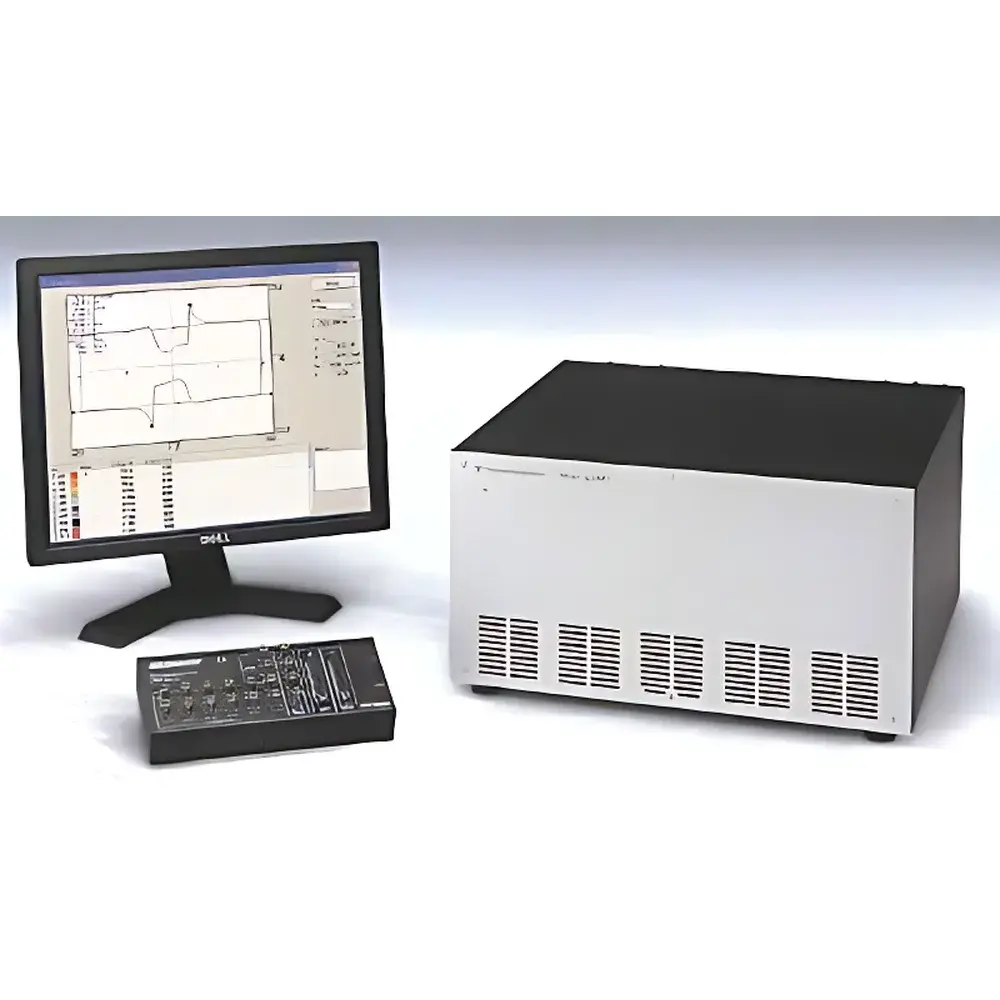
LCM-3 Liquid Crystal Panel Ionic Contamination & Internal DC Voltage Analyzer
| Origin | Japan |
|---|---|
| Manufacturer Type | Authorized Distributor |
| Origin Category | Imported |
| Model | LCM-3 |
| Pricing | Available Upon Request |
Overview
The LCM-3 Liquid Crystal Panel Ionic Contamination & Internal DC Voltage Analyzer is a specialized metrology instrument engineered for quantitative assessment of ionic impurity concentration and internal DC bias voltage within TFT-LCD modules. Developed jointly by the manufacturer and Sharp Corporation, the system employs a non-destructive, contact-based electrochemical measurement principle—combining low-frequency AC impedance spectroscopy with controlled DC polarization to resolve mobile ion mobility and charge accumulation characteristics in liquid crystal cells. Unlike optical or electrical functional testers, the LCM-3 targets root-cause failure mechanisms linked to long-term display reliability: ionic contamination (e.g., Na⁺, K⁺, Cl⁻) originating from sealants, alignment layers, or peripheral adhesives—and time-dependent DC voltage drift induced by asymmetric charge injection during panel driving. It delivers trace-level ionic quantification (in parts-per-trillion equivalent sensitivity) and sub-millivolt DC potential resolution under controlled thermal-humidity conditions, supporting early-stage process validation and field-failure root-cause analysis.
Key Features
- Simultaneous dual-parameter measurement: ionic contamination level (reported as effective ion concentration index) and internal DC voltage (VDC) across full active area
- Non-invasive electrode configuration compatible with standard glass substrates (0.4–1.1 mm thickness), requiring no cell disassembly or LC extraction
- Temperature- and humidity-controlled test chamber (25–85 °C, 30–95% RH) to accelerate ion migration kinetics and replicate real-world aging stressors
- Integrated UV exposure module (365 nm, adjustable intensity) for evaluating photo-induced ion generation from organic materials
- Automated calibration against NIST-traceable reference standards for ion mobility and surface potential
- Rugged industrial-grade enclosure rated IP54, designed for cleanroom-compatible operation (Class 1000 or better)
Sample Compatibility & Compliance
The LCM-3 supports standard TFT-LCD panel formats up to Gen 8.5 (2200 × 2500 mm), including RGB stripe, delta, and pentile subpixel layouts. It accommodates both rigid (glass/glass) and flexible (CPI/PI-on-metal) architectures, provided the top substrate retains sufficient optical transparency and surface conductivity uniformity. Measurement protocols align with JEDEC JESD22-A108 (humidity testing), ISO 11341 (artificial weathering), and IEC 61747-5-1 (LCD environmental stress requirements). Data acquisition and reporting comply with GLP documentation standards; audit trails, user access logs, and electronic signatures are configurable per FDA 21 CFR Part 11 requirements when integrated with validated LIMS environments.
Software & Data Management
The proprietary LCM-Control Suite v4.2 provides real-time visualization of ion diffusion profiles, VDC spatial mapping, and time-resolved drift curves. All raw impedance spectra and polarization transients are stored in HDF5 format with embedded metadata (test condition, operator ID, calibration timestamp, environmental log). The software enables comparative statistical analysis across lots or suppliers via ANOVA and PCA modules. Export options include CSV (for SPC charting), PDF reports compliant with ISO/IEC 17025, and XML files compatible with enterprise MES platforms (Siemens Opcenter, Rockwell FactoryTalk). Remote diagnostics and firmware updates are supported over TLS-secured Ethernet connections.
Applications
- Root-cause analysis of post-shipment Mura, image sticking, and luminance non-uniformity in automotive and medical displays
- Qualification of new sealant formulations, PI alignment layers, and edge-adhesive systems for low-ion-outgassing performance
- Process monitoring of cleaning efficacy after photolithography, etching, and bonding steps in LCD fabrication lines
- Accelerated lifetime testing under combined thermal-humidity-UV stress to predict field failure rates
- Supplier qualification and incoming material inspection for LCD module assembly houses
- Supporting ISO 9001:2015 Clause 8.5.1 (control of production and service provision) and IATF 16949 Section 8.5.1.1 (control plan implementation)
FAQ
What types of ions does the LCM-3 detect?
The instrument does not perform elemental identification; it measures total mobile ionic charge density and mobility behavior. Results correlate empirically with alkali metal (Na⁺, K⁺) and halide (Cl⁻) contaminants commonly found in LCD manufacturing environments.
Can the LCM-3 be used on OLED or microLED panels?
No—it is optimized specifically for nematic liquid crystal dielectric structures. OLED and microLED devices lack the capacitive cell architecture required for the underlying measurement physics.
Is operator training required before deployment?
Yes. A two-day certified application engineer course covers measurement theory, probe calibration, environmental parameter setup, and report interpretation per ISO/IEC 17025 Annex A.2.
Does the system require periodic recalibration?
Annual factory recalibration is recommended. On-site verification using reference test panels (supplied quarterly) ensures measurement stability between service intervals.
How is data integrity ensured during long-duration tests?
All measurements include hardware-level CRC checksums, write-once storage partitioning, and automatic backup to network-attached storage with SHA-256 hash validation.



