
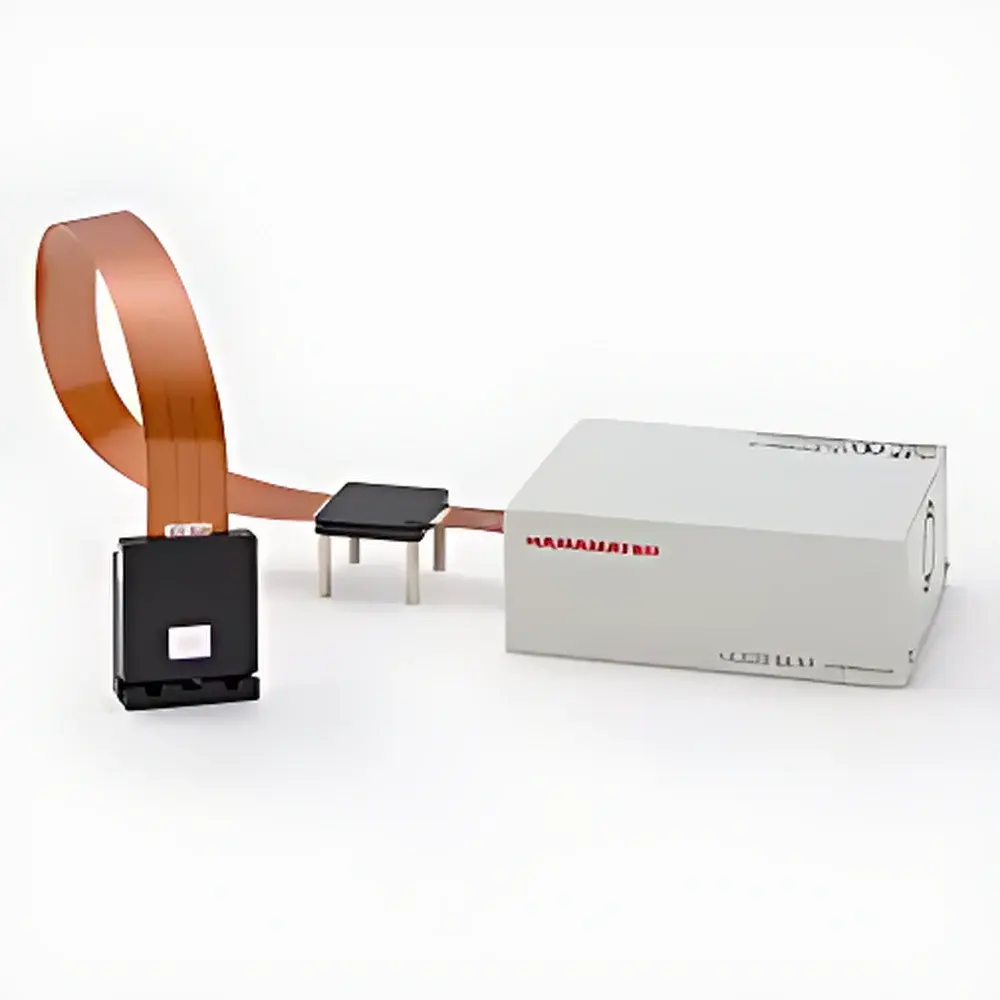
Hamamatsu LCOS-SLM X15213-12R Reflective Pure-Phase Spatial Light Modulator
| Brand | Hamamatsu |
|---|---|
| Origin | Japan |
| Manufacturer | Hamamatsu Photonics K.K. |
| Type | Imported |
| Model | X15213-12R |
| Pixel Pitch | 12.5 µm |
| Active Area | 15.9 × 12.8 mm |
| Resolution | 1272 × 1024 pixels (SXGA) |
| Fill Factor | 96% |
| Input Interface | DVI-D + USB-B (2.0 High-Speed) |
| DVI Frame Rate | 60 Hz |
| Gray Levels | 256 (8-bit) |
| Rise Time | 38 ms |
| Fall Time | 109 ms |
| Operating Wavelength Range | 850–1000 nm |
| Designated Readout Wavelength | 1050 ± 50 nm |
| Measured Optical Utilization Efficiency | 97% (at λ = 940 nm) |
| Maximum Spatial Frequency | 40 lp/mm |
| Device Type | Reflective, Pure-Phase LCOS SLM |
Overview
The Hamamatsu LCOS-SLM X15213-12R is a high-performance reflective pure-phase spatial light modulator engineered for precision wavefront control in advanced optical systems. Based on silicon-backplane liquid crystal on silicon (LCOS) technology, this device enables voltage-driven, pixel-level modulation of optical phase without introducing significant amplitude distortion. Its design emphasizes high optical utilization efficiency—measured at 97% at 940 nm—achieved through optimized reflectivity, minimized inter-pixel diffraction noise, and a 96% fill factor across its 15.9 × 12.8 mm active aperture. The X15213-12R operates within the 850–1000 nm spectral band, with nominal readout specified at 1050 ± 50 nm, making it particularly suited for high-power near-infrared applications including adaptive optics, ultrafast pulse shaping, holographic beam steering, and quantum optics experiments requiring stable, linear phase response.
Key Features
- Reflective pure-phase modulation architecture with negligible amplitude coupling—ideal for interferometric and coherent optical systems.
- High-fidelity phase linearity supported by factory-calibrated correction algorithms embedded in the controller firmware, compensating for inherent LC birefringence nonlinearity and wavefront aberrations.
- Dual-interface control: DVI-D input (SXGA, 1280 × 1024, 60 Hz) for real-time pattern streaming and USB-B (USB 2.0 High-Speed) for configuration, calibration data upload, and firmware updates.
- Robust thermal and mechanical design optimized for integration into vacuum-compatible or vibration-sensitive optical tables; no active cooling required under standard operating conditions.
- High damage threshold compatible with CW and pulsed laser sources up to multi-watt average power in the NIR range—validated per ISO 21254-1 for 10 ns pulses at 1064 nm.
- Pixel-level phase resolution of 2π over 256 discrete levels (8-bit), enabling sub-radian phase step accuracy with reproducible temporal response (rise/fall times of 38 ms / 109 ms).
Sample Compatibility & Compliance
The X15213-12R is compatible with standard optical mounts (e.g., Thorlabs SM1-threaded or Kinetic Systems kinematic bases) and integrates seamlessly into collimated free-space beam paths. It complies with IEC 61000-6-3 (EMC emission standards) and IEC 61000-6-2 (immunity). While not classified as medical or industrial safety-critical hardware, its optical performance metrics—including phase fidelity, spatial uniformity, and temporal stability—are traceable to Hamamatsu’s internal metrology protocols aligned with ISO/IEC 17025 principles. For regulated environments (e.g., GLP-compliant optical testing labs), full calibration reports—including pixel-wise phase map characterization and temporal response validation—can be supplied upon request.
Software & Data Management
Hamamatsu provides the proprietary SLM Control Studio software suite (Windows 10/11, 64-bit), supporting real-time phase pattern generation, LUT-based gamma correction, and batch-mode sequence playback. The software exports phase maps in standard formats (TIFF, BMP, binary) and supports scripting via Python API (pyHamSLM) for integration into LabVIEW, MATLAB, or custom Python-based automation pipelines. All phase calibration data—including pixel-specific voltage-to-phase transfer functions and residual error maps—is stored in encrypted metadata headers compliant with EXIF 2.31. Audit trails for pattern uploads, firmware revisions, and user-defined corrections are logged locally and exportable in CSV format, satisfying basic requirements for 21 CFR Part 11–aligned documentation workflows.
Applications
- Adaptive optics systems for astronomical telescopes and ophthalmic wavefront sensing.
- Temporal pulse shaping in ultrafast laser laboratories (e.g., MIIPS, Dazzler-compatible configurations).
- Dynamic holography and computer-generated hologram (CGH) projection for optical trapping and structured illumination microscopy.
- Beam multiplexing and programmable mode converters in fiber-optic communications and quantum information processing.
- Calibration reference for Shack–Hartmann sensor arrays and interferometric metrology platforms.
- Education and research in graduate-level photonics laboratories where reproducible, open-architecture SLM control is required.
FAQ
Is the X15213-12R suitable for use with femtosecond lasers?
Yes—when operated within its specified wavelength and fluence limits (≤ 0.5 J/cm² for 100-fs pulses at 1030 nm), and with appropriate dispersion pre-compensation, it maintains phase fidelity without measurable thermal lensing or LC degradation.
Can multiple X15213-12R units be synchronized?
Synchronization is achievable via external TTL trigger input (BNC connector) and frame-locking through DVI blanking signal alignment; latency jitter is < 1.2 µs between units under identical GPU rendering conditions.
Does Hamamatsu provide phase calibration files for third-party software?
Yes—NIST-traceable phase calibration matrices (in HDF5 and ASCII formats) are included with each unit and can be loaded into MATLAB, Python (NumPy), or commercial optical design tools such as Zemax OpticStudio and CODE V.
What is the recommended driver graphics card for DVI output?
NVIDIA Quadro RTX 4000 or AMD Radeon Pro W5700 with dual-link DVI-D output and guaranteed 60 Hz SXGA timing compliance; consumer-grade GPUs may introduce frame-dropping due to EDID negotiation inconsistencies.
How often does the device require recalibration?
Under stable ambient temperature (±1°C) and continuous operation, recalibration is recommended every 12 months or after any mechanical shock exceeding 5 g; Hamamatsu offers certified recalibration services at regional support centers.




