
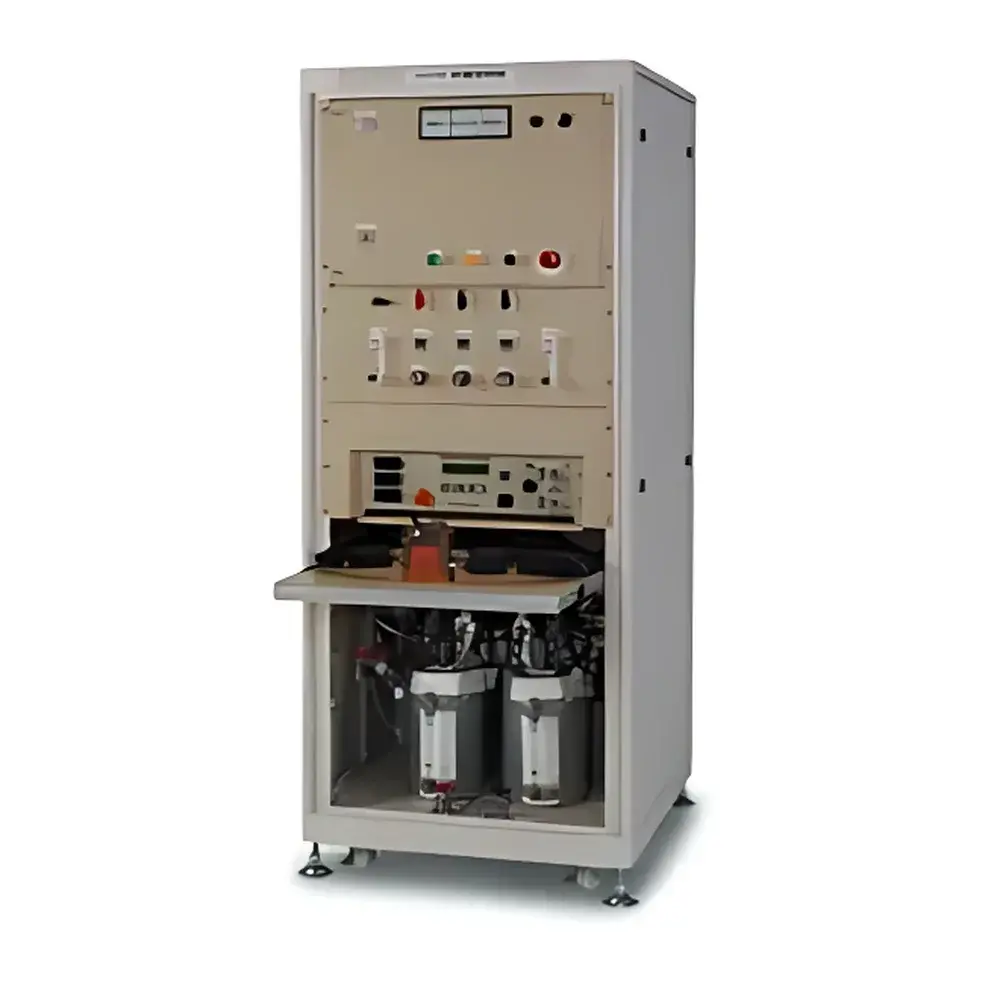
TOYO Corporation AutoPEM Fuel Cell Testing System – Electrochemical Workstation
| Brand | TOYO Corporation (Japan) |
|---|---|
| Origin | Japan |
| Manufacturer Type | Authorized Distributor |
| Product Category | Imported Instrument |
| Model | AutoPEM |
| Instrument Type | Electrochemical Workstation |
| Channel Count | Single-Channel |
| Current Range | Up to 1000 A (multi-range selectable) |
| Current Accuracy | ±0.3% of reading |
| Potential Accuracy | ±0.3% of reading |
| Potentiostatic Range | ±20 V (between fuel and air electrodes) |
| EIS Frequency Range | 1 mHz to 10 kHz |
Overview
The TOYO Corporation AutoPEM Fuel Cell Testing System is a purpose-built, single-channel electrochemical workstation engineered for rigorous evaluation of proton exchange membrane fuel cells (PEMFCs), direct methanol fuel cells (DMFCs), and electrolysis cells under controlled thermal, humidification, and gas-flow conditions. Unlike generic potentiostats, the AutoPEM integrates electrochemical measurement with precision environmental control—most notably high-fidelity dew point regulation—enabling reproducible assessment of membrane hydration dynamics, interfacial charge transfer, and long-term degradation mechanisms. Its architecture follows electrochemical impedance spectroscopy (EIS), cyclic voltammetry (CV), galvanostatic/potentiostatic polarization, and accelerated stress testing (AST) protocols aligned with ASTM D6879, ISO 14687, and DOE Hydrogen and Fuel Cell Technical Targets. Designed and manufactured in Japan, the system meets stringent requirements for laboratory-grade R&D, quality assurance in catalyst/membrane manufacturing, and validation of stack-level performance under variable load and humidity profiles.
Key Features
- Integrated high-accuracy dew point control: Maintains ±1 °C stability across 20–80 °C range at the anode/cathode inlet, achieved via dual-stage thermoelectric cooling/heating and real-time vapor pressure feedback.
- Automated water management: Precision liquid-level control within ±1 cm tolerance during continuous operation, supporting both humidification and condensate removal without manual intervention.
- High-current electrochemical capability: Dual-quadrant operation up to ±1000 A with auto-ranging current sensing; optimized for low-impedance PEMFC stacks and electrolyzer cells.
- Wide potentiostatic compliance: ±20 V differential range between fuel and air electrodes accommodates full-cell polarization curves, including open-circuit voltage (OCV) decay and reverse-current scenarios.
- Full-spectrum EIS support: 1 mHz–10 kHz frequency sweep with phase resolution <0.1° and amplitude accuracy <0.5%, enabling Nyquist and Bode analysis of charge-transfer resistance, membrane resistance, and mass transport limitations.
- Modular expandability: Optional integration with gas chromatography (GC), mass spectrometry (MS), or online conductivity monitoring for coupled product analysis and crossover quantification.
Sample Compatibility & Compliance
The AutoPEM system supports standardized MEA (membrane electrode assembly) formats from 5 cm² to 200 cm² active area, including serpentine, parallel, and interdigitated flow fields. It accommodates both H₂/air and H₂/O₂ operation, as well as reformate gas mixtures with CO tolerance up to 100 ppm. All hardware and firmware comply with IEC 61000-6-3 (EMC), UL 61010-1 (safety), and ISO/IEC 17025 traceable calibration documentation. Software audit trails, user access levels, and electronic signature functionality are configurable to meet GLP, GMP, and FDA 21 CFR Part 11 requirements for regulated laboratories.
Software & Data Management
TFT-based AutoPEM Control Software provides unified supervision of electrochemical, thermal, and humidification parameters through a real-time process flow diagram interface. All sensor inputs—including dew point, cell temperature, backpressure, gas flow rates, and voltage/current—are logged synchronously at up to 100 Hz with timestamped metadata. Data export supports CSV, HDF5, and MPT formats compatible with MATLAB, Python (SciPy), and commercial electrochemical modeling platforms (e.g., COMSOL Multiphysics). Built-in scripting (TCL/Lua) enables automated test sequences, conditional branching, and pass/fail logic for durability cycling per JIS K 8570 or SAE J2718 standards.
Applications
- PEMFC catalyst layer optimization: Kinetic analysis of oxygen reduction reaction (ORR) and hydrogen oxidation reaction (HOR) under variable RH and temperature gradients.
- Membrane hydration studies: Correlation of in-situ EIS spectra with water uptake measured via gravimetric or neutron imaging methods.
- Durability and AST execution: 5,000+ hour lifetime testing with dynamic load cycling, humidity ramping, and start-stop protocols per DOE guidelines.
- Electrolyzer characterization: Anion exchange membrane (AEM) and PEM water electrolysis efficiency mapping under 1–2 A/cm² current densities.
- System-level validation: Integration with balance-of-plant (BoP) components such as humidifiers, recirculators, and DC/DC converters for subsystem co-testing.
FAQ
What is the maximum supported cell area for AutoPEM systems?
Standard configurations accommodate up to 200 cm² active area; custom fixtures are available for larger single-cell or short-stack assemblies.
Does the system support simultaneous dual-gas humidification (anode + cathode)?
Yes—each gas stream features independent dew point control with dedicated saturators and inline sensors.
Can AutoPEM perform transient response analysis (e.g., current step, voltage step)?
Yes, with sub-millisecond timing resolution and synchronized data capture across all analog and digital channels.
Is third-party software integration (e.g., LabVIEW, Python) supported?
Yes, via TCP/IP API and DLL-based SDK with documented command syntax and error-handling protocols.
How is calibration traceability maintained?
All current/voltage sensors are calibrated annually against NIST-traceable references; calibration certificates include uncertainty budgets per ISO/IEC 17025 Annex A.
Related Products





