
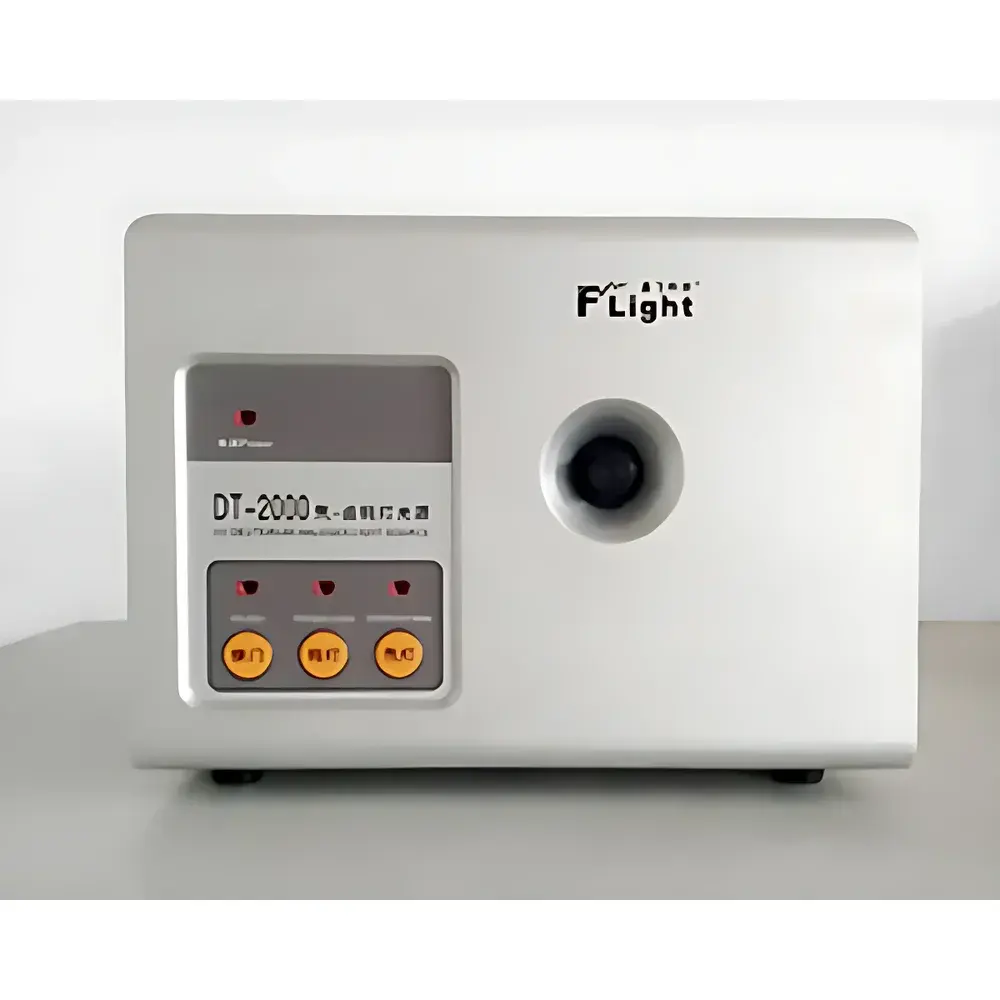
Jingfei FLE1001 Deuterium-Tungsten Combined Light Source
| Brand | Jingfei Technology |
|---|---|
| Origin | Zhejiang, China |
| Manufacturer Type | OEM Manufacturer |
| Product Origin | Domestic (China) |
| Model | FLE1001 |
| Light Source Type | Deuterium–Tungsten Hybrid Source |
| Illumination Mode | External Illumination |
| Wavelength Range | 190–1100 nm |
| Output Power | 10 W (Deuterium), 10 W (Tungsten) |
| Intensity Stability | ±0.3% over 30 min |
| Lamp Lifetime | >1000 h |
| Optical Interface | SMA905 |
| Warm-up Time | 20 min |
Overview
The Jingfei FLE1001 Deuterium–Tungsten Combined Light Source is an engineered broadband illumination system designed for demanding optical laboratory applications requiring continuous spectral coverage from the deep ultraviolet through the near-infrared. It integrates two independently controlled, thermally stabilized discharge lamps—deuterium (D2) and tungsten-halogen—within a single compact, air-cooled housing. The deuterium lamp delivers stable, high-intensity output from 190 nm to ~400 nm, while the tungsten-halogen lamp provides smooth, blackbody-like emission from ~350 nm to 1100 nm. Spectral overlap between the two sources is carefully optimized, and proprietary optical filtering suppresses spectral artifacts—including deuterium line spikes and tungsten filament emission irregularities—resulting in a composite output profile with exceptional continuity and minimal ripple across the full 190–1100 nm range. This architecture eliminates the need for mechanical lamp switching or external spectral stitching, enabling true simultaneous dual-source operation with high photometric reproducibility.
Key Features
- Integrated dual-lamp design with independent on/off control and electronic shuttering for precise temporal gating of each source
- Optimized spectral blending via custom interference filters and beam-combining optics, minimizing discontinuities at the D2/W crossover region (~350–400 nm)
- Thermal and current regulation circuitry ensuring intensity stability of ≤±0.3% over 30 minutes (RMS, measured at 254 nm and 650 nm)
- Modular lamp cartridge design enabling field-replaceable deuterium and tungsten lamps without optical realignment
- SMA905 fiber-coupled output compatible with standard spectrometers, monochromators, and integrating spheres
- 20-minute warm-up time to operational spectral stability, meeting ISO/IEC 17025–compliant instrument readiness requirements
Sample Compatibility & Compliance
The FLE1001 is compatible with standard optical bench configurations, cuvette-based absorption cells (10 mm pathlength), reflectance standards (e.g., Spectralon®), and fiber-optic probe interfaces. Its external illumination geometry supports transmission, reflectance, and fluorescence excitation measurements without internal sample chamber constraints. The unit complies with IEC 61000-6-3 (EMC emission limits) and IEC 61010-1 (safety requirements for electrical equipment for measurement, control, and laboratory use). While not certified to FDA 21 CFR Part 11, its digital control interface supports integration into GLP/GMP environments when paired with validated third-party data acquisition software featuring audit trail and user access control.
Software & Data Management
The FLE1001 operates via front-panel push-button controls and TTL-compatible digital I/O (optional RS-232 or USB-C interface available upon request). No proprietary driver software is required for basic operation; however, OEM integration kits provide Python and LabVIEW-compatible APIs for automated lamp sequencing, shutter timing, and status monitoring. Intensity logging requires external photodiode-based power meters or spectrometer-based calibration routines—no onboard radiometric calibration is embedded. Users are advised to perform annual spectral irradiance verification using NIST-traceable reference detectors (e.g., calibrated silicon photodiodes or thermopiles) per ASTM E275 and ISO 9022-18 guidelines.
Applications
- UV-Vis-NIR spectrophotometer calibration and performance verification (per ASTM E903 and ISO 6780)
- Wavelength accuracy validation of monochromators and array detectors
- Quantitative absorbance linearity testing across extended spectral ranges
- Fluorescence excitation source for wideband screening of quantum dots, organic dyes, and biological fluorophores
- Reflectance and transmittance characterization of optical coatings, thin films, and semiconductor wafers
- Accelerated aging studies requiring controlled UV exposure (254–365 nm) combined with visible thermal load simulation
FAQ
What is the recommended warm-up protocol before spectral measurements?
Allow 20 minutes of continuous operation after cold start; intensity drift stabilizes to within ±0.3% after this period.
Can the deuterium and tungsten lamps be operated simultaneously?
Yes—the FLE1001 supports concurrent emission from both sources, with spectral combination occurring optically prior to the SMA905 output port.
Is the output spectrally calibrated at the factory?
No spectral irradiance calibration certificate is included; users must perform traceable calibration using reference standards appropriate to their application.
What maintenance is required to sustain lamp lifetime beyond 1000 hours?
Operate lamps within rated voltage tolerances, avoid frequent on/off cycling (>5×/day), and ensure ambient temperature remains between 15–30 °C with adequate airflow.
Does the unit support analog intensity modulation?
No—intensity control is binary (on/off); analog dimming is not supported due to lamp physics constraints and stability requirements.





