
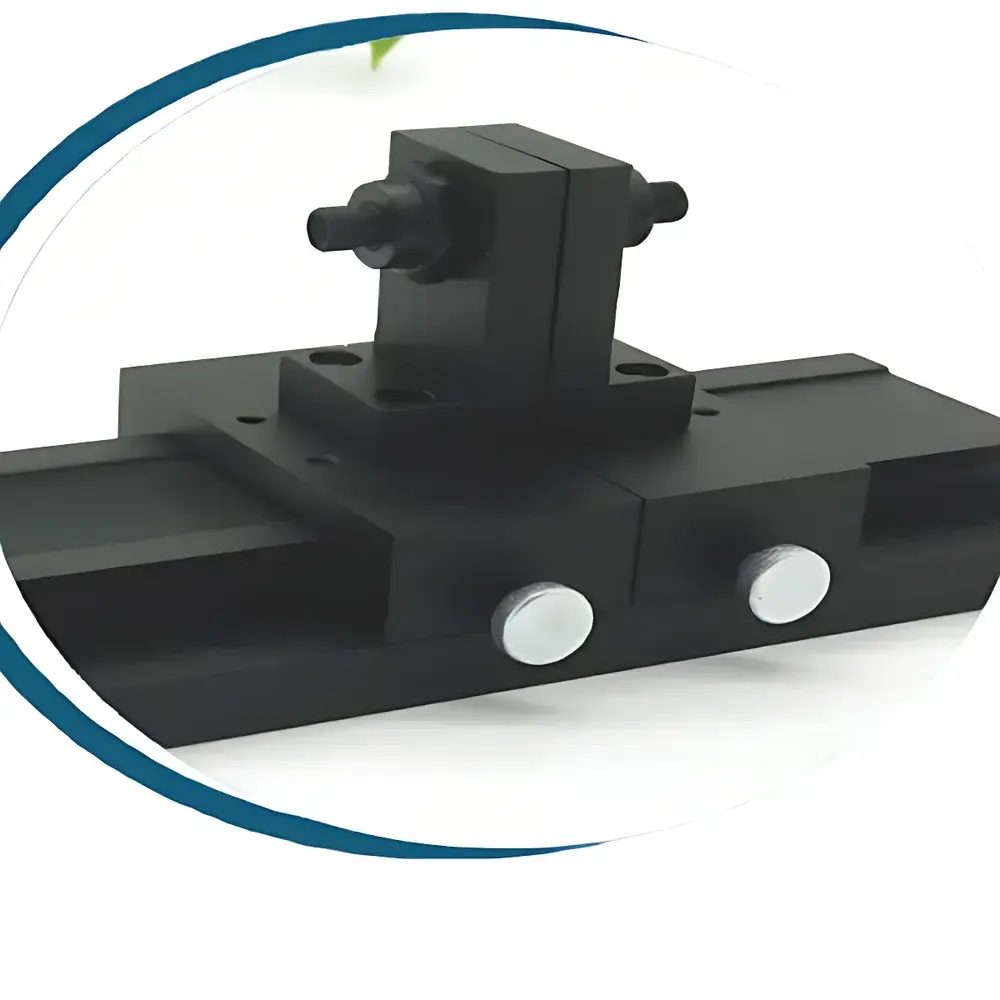
Jingfei FLB1012 Adjustable Transmittance Mount
| Brand | Jingfei Technology |
|---|---|
| Origin | Zhejiang, China |
| Manufacturer Type | OEM/ODM Producer |
| Country of Origin | China |
| Model | FLB1012 |
| Price | Upon Request |
| Weight | 1200 g |
| Material | Black Anodized Aluminum |
| Dimensions | 150 mm (L) × 65 mm (W) × 65 mm (H) |
| Optical Interface | SMA905 |
| Adjustable Aperture Width | Up to 120 mm |
Overview
The Jingfei FLB1012 Adjustable Transmittance Mount is a precision-engineered optical positioning accessory designed for laboratory-grade transmittance measurement setups in UV-Vis and near-UV spectroscopy applications. It functions as a passive, mechanical sample holder that enables reproducible alignment and controlled beam path definition between light source and detector—critical for quantitative transmission analysis across diverse solid and thin-film specimens. Unlike fixed-mount alternatives, the FLB1012 implements a dual-axis micrometer-adjustable aperture mechanism, allowing fine-tuned lateral positioning of the sample plane relative to the incident collimated beam. Its design adheres to fundamental radiometric principles: by constraining the effective illuminated area and minimizing stray light ingress through optimized internal baffling and black anodized surface treatment, it supports high signal-to-noise ratio (SNR) measurements essential for compliance with ASTM E308 and ISO/CIE 11664-3 standards in spectral transmittance characterization.
Key Features
- Dual-directional mechanical adjustability: Independent coarse and fine adjustment knobs enable precise centering and width control of the optical aperture, supporting repeatable sample placement across multiple measurement cycles.
- Integrated dual UV-grade fused silica focusing lenses: Optimized for spectral transmission from 200 nm to 400 nm, these lenses maintain wavefront fidelity and minimize chromatic aberration in ultraviolet photometric configurations.
- Black anodized aluminum construction: Provides electromagnetic shielding, thermal stability (coefficient of linear expansion: ~23.1 µm/m·°C), and non-reflective interior surfaces to suppress internal scattering and ghost reflections.
- SMA905-compatible optical interface: Ensures seamless integration with industry-standard fiber-coupled spectrometers, deuterium/halogen light sources, and integrating sphere systems without adapter dependency.
- Compact modular footprint (150 × 65 × 65 mm): Designed for benchtop compatibility in constrained optical tables and multi-instrument racks, with M4 threaded mounting holes on base for rigid kinematic fixation.
Sample Compatibility & Compliance
The FLB1012 accommodates planar samples ranging from 5 mm × 5 mm microfilms to 120 mm wide macro-specimens—including glass substrates, polymer sheets, optical filters, semiconductor wafers, and coated lenses—without requiring custom jigs. Its open-frame architecture permits unobstructed access for probe insertion, temperature-controlled stage integration, or in situ environmental chamber coupling. The device complies with general laboratory safety requirements per IEC 61010-1 and supports GLP-aligned workflows when used within validated UV-Vis spectrophotometer systems (e.g., Agilent Cary, Shimadzu UV-2700, PerkinElmer Lambda 950). While the mount itself carries no intrinsic calibration certificate, its dimensional repeatability (±0.05 mm aperture width tolerance) and material traceability meet prerequisite conditions for ISO/IEC 17025-accredited transmittance testing laboratories performing method validation under USP <857> or Ph. Eur. 2.2.24.
Software & Data Management
As a hardware-level optical interface component, the FLB1012 does not incorporate embedded firmware or digital connectivity. It operates transparently within existing spectroscopic data acquisition ecosystems—fully compatible with vendor-neutral platforms such as OceanView (Ocean Insight), SpectraSuite (Avantes), and MATLAB-based custom spectral processing toolchains. When deployed in automated test sequences, its mechanical stability ensures consistent spatial registration across time-series acquisitions, enabling reliable baseline correction, drift compensation, and multi-sample comparative analysis. Audit trails generated during instrument qualification (IQ/OQ/PQ) may reference FLB1012’s physical configuration parameters (e.g., aperture width setting, lens orientation) as part of system configuration records compliant with FDA 21 CFR Part 11 Annex 11 requirements.
Applications
- Quantitative transmittance profiling of anti-reflective and UV-blocking coatings on display glass and ophthalmic lenses.
- In-process quality control of optical density uniformity in lithographic photomasks and semiconductor reticles.
- Reference-grade transmission calibration using NIST-traceable neutral density filters in metrology labs.
- Environmental aging studies tracking spectral degradation of polymer encapsulants under accelerated UV exposure (ASTM G154).
- Multi-angle transmittance mapping of textured or diffusive materials using motorized rotation stages interfaced via standard kinematic mounts.
FAQ
Is the FLB1012 compatible with both UV and visible wavelength ranges?
Yes—the dual fused silica lenses transmit efficiently from 200 nm to >1000 nm; however, optimal UV performance (200–400 nm) is achieved when paired with low-OH quartz fibers and UV-optimized spectrometers.
Can the aperture be locked after adjustment to prevent drift during vibration-prone measurements?
Yes—each adjustment axis features a locking screw mechanism that secures position without hysteresis or backlash, verified at ±0.02 mm repeatability over 500 operational cycles.
Does Jingfei provide calibration documentation or dimensional certification for the FLB1012?
Dimensional verification reports (including CMM-measured aperture width tolerance and lens centering error) are available upon request for regulated environments; full optical calibration requires integration into a certified spectrophotometer system.
What is the maximum sample thickness supported without obstructing the optical path?
Up to 25 mm—achieved via adjustable lens-to-aperture spacing; thicker samples may require optional extended-length lens tubes (accessory part #FLB-EXT-LT).
Is thermal expansion compensated in the mechanical design?
No active compensation is implemented, but the matched coefficient of thermal expansion between anodized aluminum housing and fused silica lenses minimizes relative misalignment below ±0.15 arcmin over 15–35 °C ambient range.




