
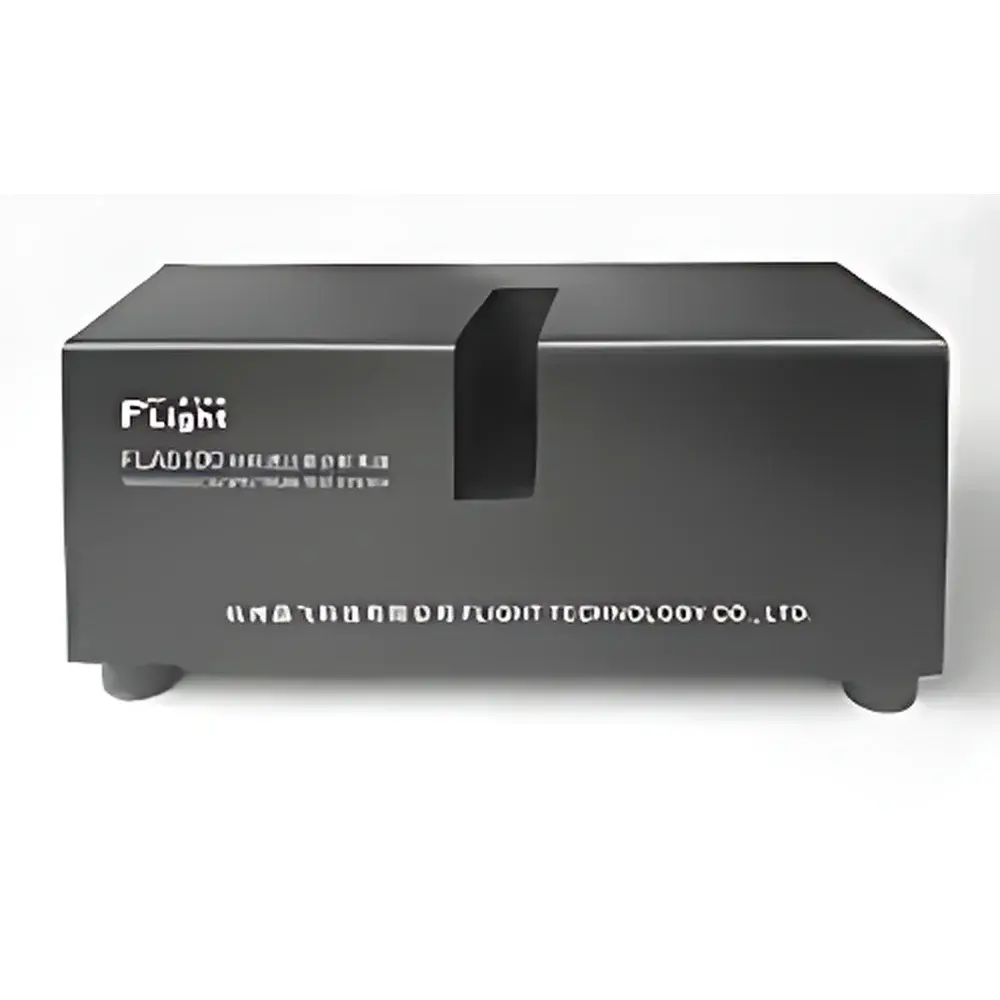
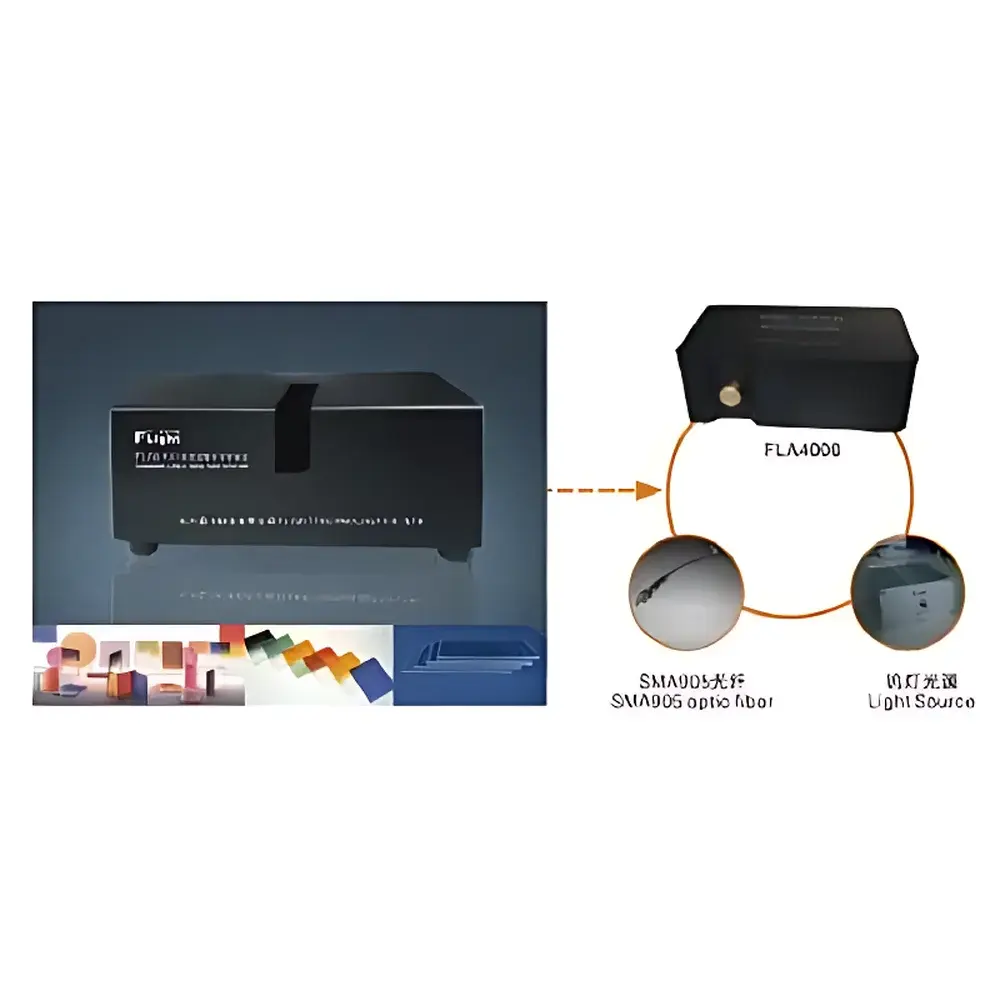
Jingfei Technology FLA5100 Optical Transmittance Analysis System
| Brand | Jingfei Technology |
|---|---|
| Origin | Zhejiang, China |
| Manufacturer Type | Original Equipment Manufacturer (OEM) |
| Product Origin | Domestic (China) |
| Model | FLA5100 |
| Pricing | Available Upon Request |
Overview
The Jingfei Technology FLA5100 Optical Transmittance Analysis System is a modular, benchtop-grade spectroscopic measurement platform engineered for quantitative spectral transmittance and absorbance characterization of optically transparent and semi-transparent materials. Built around the FLA-series miniature fiber optic spectrometer core—featuring a high-sensitivity CMOS linear array detector and optimized optical path design—the system operates on the principle of comparative intensity measurement: incident light from a stabilized broadband source passes through a reference channel (air or calibrated standard), then through the sample under test, with both spectra acquired sequentially or simultaneously via dual-channel configuration. The ratio of sample-intensity to reference-intensity yields wavelength-resolved transmittance (T(λ)), from which absorbance A(λ) is derived using the Beer–Lambert relationship (A(λ) = −log₁₀[T(λ)]). Designed for routine QC/QA in optics manufacturing, polymer R&D, and thin-film coating validation, the FLA5100 delivers reproducible results across the 200–1100 nm spectral range with typical optical resolution ≤1.5 nm (FWHM) and radiometric stability <0.5% over 4 hours.
Key Features
- Modular architecture integrating FLA-series miniature fiber optic spectrometer (200–1100 nm range), tunable or fixed-wavelength broadband light source (deuterium-halogen or LED-based options), precision collimating optics, and sample holder stage with adjustable alignment
- Real-time spectral acquisition at up to 1000 spectra per second, enabling dynamic transmittance monitoring during thermal or mechanical stress testing
- Embedded calibration routines supporting NIST-traceable irradiance and wavelength calibration; factory-installed spectral response correction for flat-field and stray-light compensation
- Ruggedized aluminum chassis with EMI-shielded enclosure and thermally stabilized detector housing to minimize dark current drift
- USB 3.0 and Ethernet interfaces for integration into automated production lines or centralized lab networks; support for external trigger synchronization (TTL input/output)
Sample Compatibility & Compliance
The FLA5100 accommodates planar, rigid, or flexible samples up to 100 mm × 100 mm and 20 mm thickness—including interference filters, AR/HR coatings on glass substrates, polycarbonate and PMMA sheets, PET and PC films, laminated safety glass, and UV-curable optical adhesives. Sample mounting utilizes non-contact vacuum chucks or low-pressure clamping fixtures to prevent surface deformation or micro-scratching. All optical components comply with ISO 9022-3 (environmental testing of optical instruments) and IEC 61340-5-1 (ESD protection). Measurement protocols align with ASTM E308 (computing CIE tristimulus values from spectral data), ISO 9050 (optical properties of glazing), and ISO 13468-2 (determination of transmittance of transparent plastics). System software supports audit trails, user access levels, and electronic signatures compliant with FDA 21 CFR Part 11 requirements when deployed in regulated GMP/GLP environments.
Software & Data Management
The included SpectraView Pro software (v4.2+) provides full instrument control, spectral acquisition, real-time transmittance/absorbance calculation, and batch report generation. It features built-in spectral database management for reference standards (e.g., NIST SRM 2036, Schott OG515 filter), customizable pass/fail thresholds per wavelength band, and export to CSV, XML, or PDF formats with embedded metadata (timestamp, operator ID, calibration ID, environmental conditions). Raw spectral data are stored in HDF5 format to ensure long-term integrity and compatibility with MATLAB, Python (NumPy/H5Py), and LabVIEW. Optional modules include GLP-compliant electronic lab notebook (ELN) integration, multi-instrument fleet monitoring dashboard, and API-driven scripting interface (RESTful + Python SDK) for LIMS or MES connectivity.
Applications
- Quality assurance of optical filters in laser systems, fluorescence microscopy, and machine vision illumination
- Development and process validation of anti-reflective, heat-absorbing, and selective-transmission coatings on architectural and automotive glass
- Characterization of UV stability and yellowing index in transparent polymers (e.g., polycarbonate aging studies per ISO 4892-2)
- In-line monitoring of film thickness uniformity in roll-to-roll coating processes via interference fringe analysis
- Validation of spectral transmission windows for optical sensors, photovoltaic encapsulants, and medical device housings
FAQ
What spectral range does the FLA5100 support, and can it be customized for UV-VIS-NIR extension?
The standard configuration covers 200–1100 nm. Optional grating and detector variants extend coverage to 190–1700 nm; customization requires pre-shipment optical recalibration and firmware update.
Is the system suitable for measuring highly scattering or diffusive samples?
No—it is optimized for direct transmittance of low-scatter media. For turbid or matte samples, integrating sphere accessories (FLA-IS-200) must be added to enable total transmittance measurement per ASTM D1003.
Does the FLA5100 meet ISO/IEC 17025 requirements for accredited laboratories?
Yes, when operated with documented calibration procedures, traceable standards, and validated SOPs, the system satisfies metrological requirements for ISO/IEC 17025 clause 6.4 (equipment) and 6.5 (traceability).
Can the system operate unattended for extended duration (e.g., 72-hour stability testing)?
Yes—thermal stabilization and active dark-current compensation enable continuous operation with <0.3% signal drift over 72 hours under controlled ambient conditions (23 ± 1 °C, <50% RH).
Related Products





