
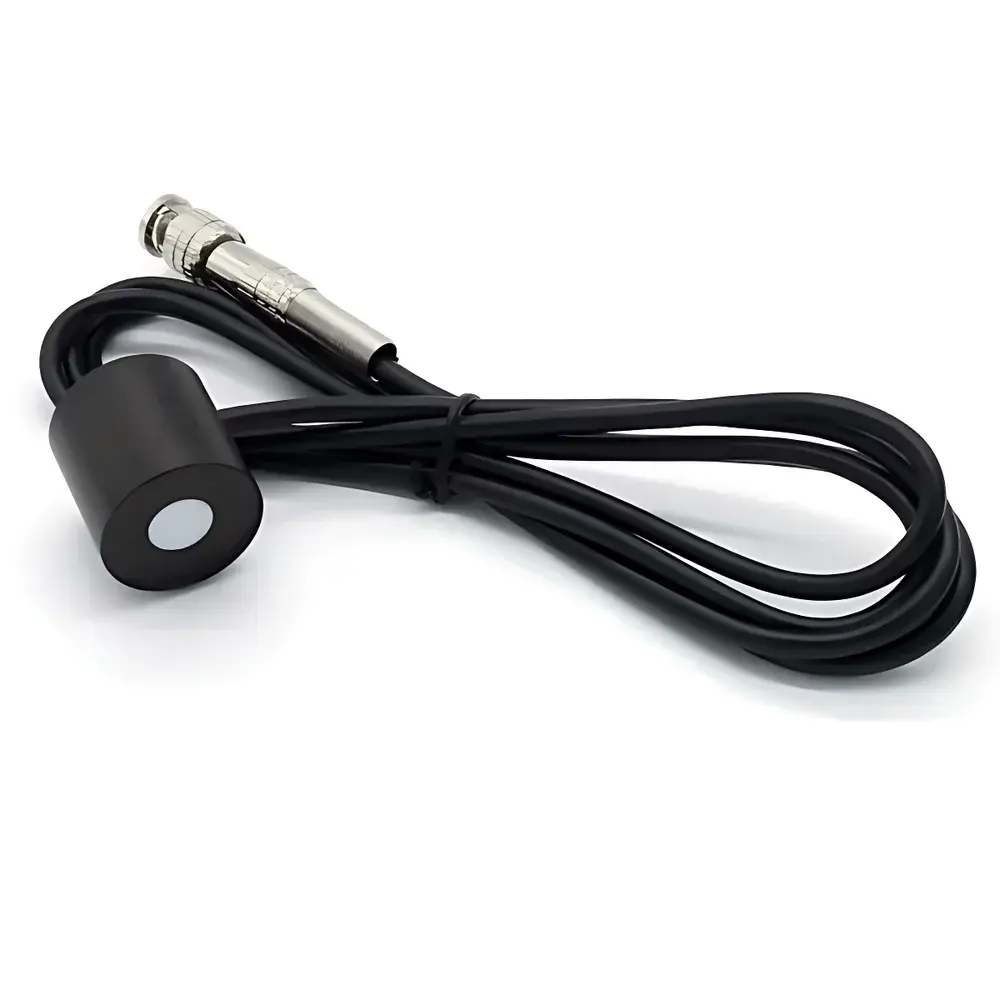
Jingfei FLT1002 Luminance Detector
| Brand | Jingfei Technology |
|---|---|
| Origin | Zhejiang, China |
| Manufacturer Type | OEM/ODM Producer |
| Country of Origin | China |
| Model | FLT1002 |
| Interface Options | Q9, 4-pin Aviation Connector, BNC, SMA |
| Spectral Range | 200–1100 nm (customizable) |
| Illuminance Measurement Range | 0.1–200,000 lx (dependent on integrating sphere configuration) |
| Relative Illuminance Error | < ±3% |
| Dimensions | 30 × 30 mm (customizable) |
Overview
The Jingfei FLT1002 Luminance Detector is a precision photometric sensor engineered for high-fidelity light measurement in spectroscopic and photometric applications. It incorporates a silicon photodiode coupled with an optical filter assembly precisely matched to the CIE 1931 photopic luminosity function V(λ), enabling accurate spectral weighting that replicates human visual response across the visible spectrum (380–780 nm) and extending into near-UV (200 nm) and near-IR (1100 nm) regions. Unlike uncorrected radiometric sensors, the FLT1002 delivers photometrically valid output—specifically illuminance (lx) or luminance (cd/m²)—without requiring post-acquisition spectral correction. Its core architecture supports integration into modular optical test benches, spectroradiometer systems, LED characterization platforms, and quality control workflows where traceable, repeatable photometric data is required under ISO/CIE-compliant conditions.
Key Features
- Photopic V(λ)-matched spectral responsivity certified per CIE S 023/E:2019 and aligned with ISO/CIE 11664-3:2012 for photometric quantity derivation.
- Wide dynamic range: 0.1–200,000 lx, scalable via interchangeable aperture adapters and calibrated integrating spheres (e.g., 2″, 4″, or 8″ spheres with BaSO₄ or PTFE coatings).
- Low uncertainty performance: relative illuminance error ≤ ±3% (k = 2) across full range, verified against NIM-traceable standard lamps under controlled ambient temperature (23 ± 1 °C) and stable DC bias conditions.
- Multi-interface compatibility: factory-configurable output connectors including Q9 (for legacy analog DAQ systems), 4-pin aviation (for industrial embedded controllers), BNC (for oscilloscope-based transient analysis), and SMA (for fiber-coupled spectrograph synchronization).
- Compact footprint (30 × 30 mm PCB-mount form factor) with optional hermetic sealing and thermal stabilization for operation in variable environmental conditions (10–40 °C, <70% RH non-condensing).
Sample Compatibility & Compliance
The FLT1002 is designed for direct coupling with broadband light sources (LEDs, OLEDs, halogen lamps, fluorescent tubes) and collimated or diffused beams in laboratory and production-line settings. It complies with key photometric standards including CIE Publication 127:2007 (measurement of LED intensity), IEC 62471 (photobiological safety), and EN 13032-1:2012 (lighting equipment photometry). When integrated into validated instrument platforms, it supports GLP/GMP-aligned workflows—data integrity is preserved through analog voltage output (0–5 V or 0–10 V, selectable) with linearity ≥99.8% (R² > 0.9999 over 4-decade range). Calibration certificates include uncertainty budgets per ISO/IEC 17025:2017 requirements and are issued with NIST-traceable reference standards.
Software & Data Management
The detector operates as a standalone analog transducer and does not require proprietary firmware or drivers. Output signals are compatible with industry-standard data acquisition hardware (e.g., National Instruments PXI, Keysight DAQmx, or Dewesoft X) and open-architecture software environments (LabVIEW, MATLAB, Python with PyDAQmx or NIDAQmx drivers). For automated photometric testing, users may implement calibration lookup tables (LUTs) or polynomial correction functions derived from factory-provided spectral responsivity data (provided in CSV and .spc formats). Audit trails, calibration history, and measurement metadata can be logged in accordance with FDA 21 CFR Part 11 requirements when deployed within validated LIMS or MES systems.
Applications
- Luminous flux and efficacy measurement of solid-state lighting (SSL) devices using integrating sphere photometry.
- Real-time illuminance monitoring in display backlight uniformity testing (LCD, microLED, OLED panels).
- Calibration transfer between reference photometers and field-deployable light meters.
- Spectral power distribution (SPD) reconstruction support when used in conjunction with monochromators or array spectrometers.
- Photometric validation of automotive headlamps, signaling lamps, and interior ambient lighting per ECE R149 and SAE J1383.
FAQ
Is the FLT1002 calibrated before shipment?
Yes—each unit undergoes individual spectral responsivity characterization and illuminance calibration against a NIM-certified standard lamp at three reference wavelengths (450 nm, 555 nm, and 650 nm), with full calibration report provided.
Can the spectral range be extended beyond 1100 nm?
Standard configuration covers 200–1100 nm; custom versions with InGaAs photodiodes are available for extended NIR (up to 1700 nm), subject to minimum order quantity and recalibration protocol.
Does the detector support digital communication protocols (e.g., USB, RS-485)?
No—the FLT1002 is strictly analog-output only to ensure signal integrity, minimize electromagnetic interference, and maintain compatibility with high-speed transient photometry setups.
What is the recommended warm-up time for stable readings?
A 15-minute thermal stabilization period is advised prior to critical measurements to achieve optimal baseline drift performance (<0.1% per hour).
Is mechanical mounting hardware included?
Standard units ship with M3 threaded holes and alignment fiducials; custom brackets, kinematic mounts, or fiber-optic couplers are available upon request.





