
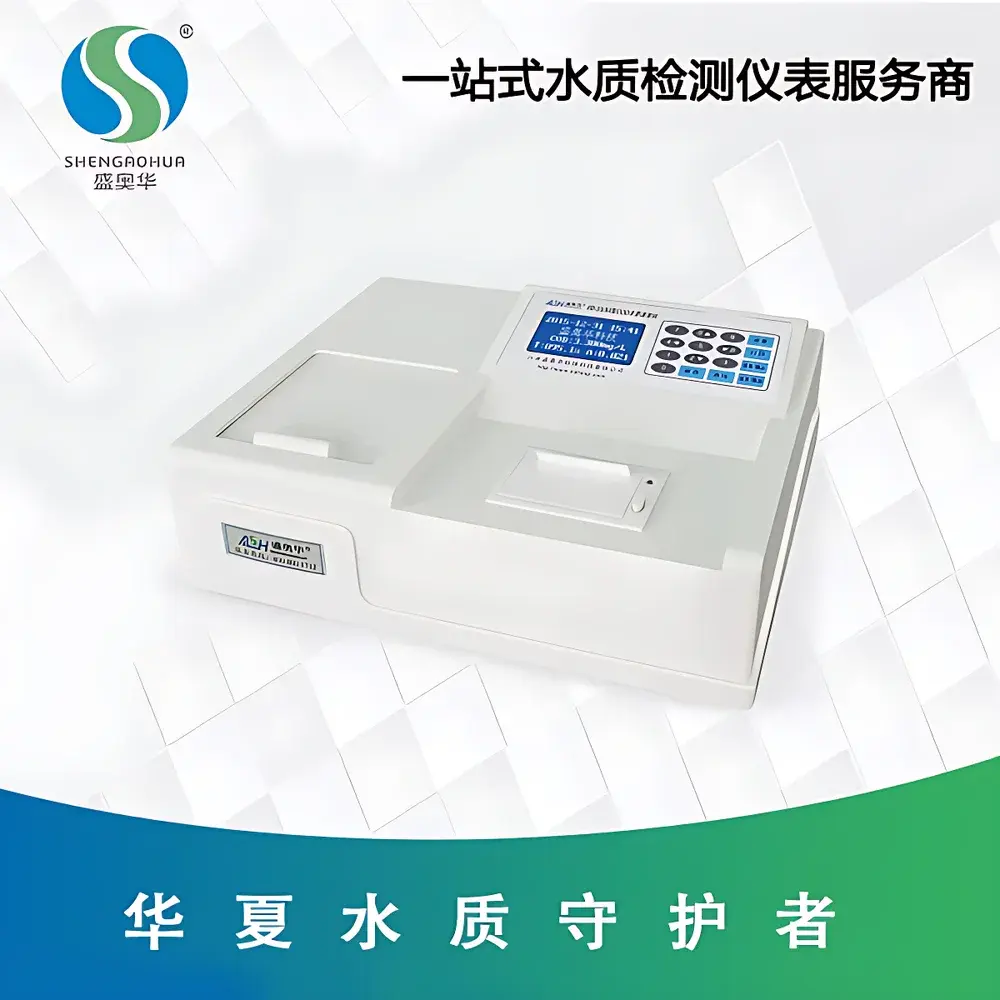
ShengAohua 6B-200(M) Permanganate Index Analyzer
| Brand | ShengAohua |
|---|---|
| Origin | Jiangsu, China |
| Manufacturer Type | Direct Manufacturer |
| Instrument Type | Benchtop Laboratory Analyzer |
| Model | 6B-200(M) |
| Detection Principle | Colorimetric Method (KMnO₄ Oxidation + Spectrophotometric Quantification at 520 nm) |
| Measurement Range | 0.05–10 mg/L (multi-range auto-segmentation) |
| Repeatability | ±3% RSD |
| Accuracy | ±10% of full scale |
| LOD | 0.05 mg/L |
| Resolution | 0.01 mg/L |
| Single-Test Duration | 20 min |
| Wavelength | 520 nm ±1 nm |
| Temperature Control Range (Digestion Unit) | Ambient to 200 °C |
| Chloride Interference Tolerance | [Cl⁻] < 300 mg/L |
| Data Storage Capacity | 5,000,000 records |
| Preloaded Calibration Curves | >100 user-accessible and editable curves |
| Batch Capacity | 12 samples per digestion cycle |
| Light Source | Cold LED with narrow-band interference filter (100,000 h lifetime) |
| Dimensions | 360 × 280 × 112 mm |
| Interface | Backlit LCD with Chinese menu navigation |
| Data Export | USB 2.0 port for real-time and historical data transfer to PC |
Overview
The ShengAohua 6B-200(M) Permanganate Index Analyzer is a dedicated benchtop instrument engineered for the quantitative determination of the permanganate index (CODMn) in natural waters, drinking water sources, wastewater effluents, and process streams. It operates on the standardized colorimetric principle defined in ISO 8467:1993 and GB/T 5750.7–2006: aqueous samples are subjected to controlled thermal oxidation with potassium permanganate under acidic conditions; the residual unreacted KMnO₄ is quantified spectrophotometrically at 520 nm using a stable cold LED light source and precision narrow-band optical filtering. This method provides a robust, cost-effective proxy for oxygen-demanding organic and inorganic reductants—particularly relevant for low-COD surface waters where dichromate-based COD analysis may overestimate oxidizable load. The integrated system comprises the 6B-200(M) photometric analyzer and the companion 6B-12(V9) intelligent digestion unit, enabling fully guided, temperature- and time-regulated sample pretreatment.
Key Features
- Automated multi-range measurement from 0.05 to 10 mg/L MnO4− equivalent, with automatic range switching and internal calibration validation
- Dual-module architecture: independent control of digestion (6B-12(V9)) and photometric readout (6B-200(M)), ensuring thermal stability and optical integrity during analysis
- High-stability cold LED light source (520 nm ±1 nm) with 100,000-hour operational lifetime and minimal thermal drift
- Push-pull concealed cuvette compartment minimizing ambient light intrusion and operator exposure to hot digestion vessels
- Onboard memory storing up to 5 million test records with timestamp, operator ID, curve ID, and raw absorbance values
- Preloaded library of >100 editable calibration curves; supports manual curve generation via certified reference standards traceable to NIM (China National Institute of Metrology)
- USB 2.0 interface compliant with Windows-based LIMS and laboratory data management software for audit-ready export of raw and processed datasets
Sample Compatibility & Compliance
The 6B-200(M) is validated for use with freshwater, groundwater, treated effluent, and low-salinity industrial process water. Its chloride tolerance ([Cl⁻] < 300 mg/L) permits direct analysis of many municipal and surface water samples without pre-treatment. The instrument conforms to the procedural requirements of ISO 8467, GB/T 5750.7–2006, and APHA Standard Methods 5210 B. While not inherently 21 CFR Part 11-compliant, its data export architecture supports integration into validated GxP environments when paired with appropriate electronic record controls and audit trail software. All firmware and calibration routines are designed to support GLP-aligned documentation practices, including full traceability of curve derivation, digest temperature logs, and measurement history.
Software & Data Management
The embedded firmware features a Chinese-language graphical interface with context-sensitive prompts, step-by-step digestion guidance, and real-time status feedback. All calibration curves—including slope, intercept, correlation coefficient (r²), and verification point residuals—are stored with metadata (date, technician, standard lot number). Data export via USB generates CSV-formatted files containing sample ID, measurement date/time, measured concentration, selected curve ID, raw absorbance, and digestion parameters. No proprietary drivers or cloud dependencies are required—files are natively readable in Excel, LabArchives, or custom LIMS platforms. Firmware updates are delivered via USB stick and include version-controlled changelogs and calibration verification protocols.
Applications
This analyzer serves laboratories requiring routine, high-throughput assessment of oxidative stability in aquatic systems. Key application domains include: environmental monitoring stations evaluating river and reservoir health; municipal water treatment plants verifying pre- and post-filtration organic load; food & beverage facilities (dairy, brewing, winemaking) monitoring rinse water and cooling loop integrity; pulp & paper mills assessing bleach plant effluent biodegradability; and academic research labs conducting limnological surveys or method validation studies. Its 20-minute total assay time and 12-sample batch digestion capability support daily throughput of 40–60 determinations under standard operating conditions.
FAQ
What regulatory standards does the 6B-200(M) comply with?
It implements the methodology specified in ISO 8467:1993 and GB/T 5750.7–2006 for permanganate index determination.
Can the instrument be used for saline or seawater samples?
No—it is not suitable for samples with chloride concentrations exceeding 300 mg/L without prior dilution or chloride masking, as Cl⁻ interferes with the KMnO₄ redox reaction.
Is external calibration verification required before each analysis run?
While daily verification with a mid-range certified standard is recommended for QA/QC, the instrument’s built-in zero and span checks allow for operator-defined verification frequency aligned with internal SOPs.
Does the system support remote diagnostics or network connectivity?
No—the 6B-200(M) is a standalone instrument with USB-only data transfer; Ethernet or Wi-Fi functionality is not included.
What maintenance is required for long-term optical stability?
Annual verification of wavelength accuracy (using NIST-traceable filters) and LED output intensity is advised; the cuvette path is self-aligning and requires no mechanical adjustment.
Related Products







