
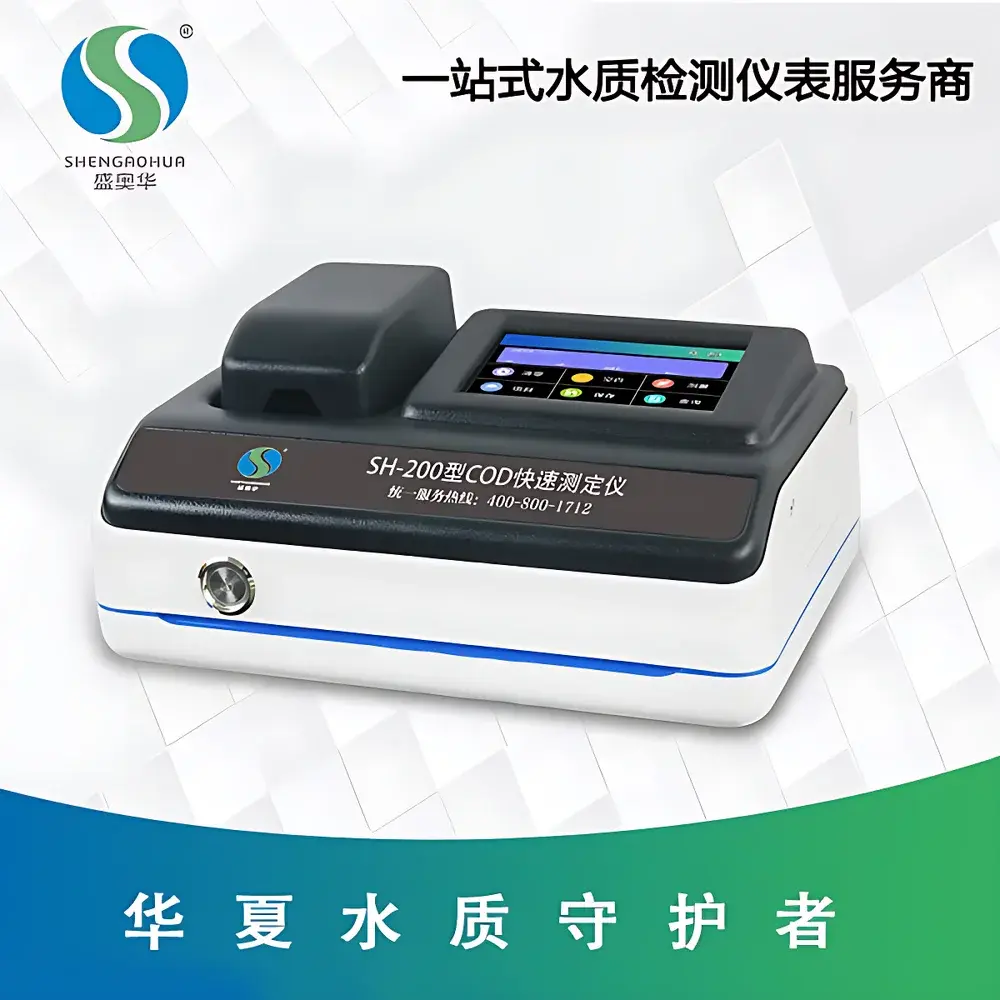
Shengaohua SH-200 Chemical Oxygen Demand (COD) Analyzer
| Brand | Shengaohua |
|---|---|
| Origin | Jiangsu, China |
| Manufacturer Type | Direct Manufacturer |
| Product Category | Domestic |
| Model | SH-200 |
| Instrument Type | Laboratory-Grade |
| Measurement Principle | Rapid Digestion Method |
| Wavelength | 610 ± 1 nm |
| Measurement Range | 5–6000 mg/L |
| Accuracy | ≤ ±5% |
| Repeatability | ≤ ±5% |
| Limit of Detection | 5 mg/L |
| Analysis Time | 20 minutes per batch |
| Sample Throughput | 16 samples per run |
| Display | 5-inch IPS capacitive touchscreen |
| Wavelength Accuracy | ±1 nm |
| Data Storage Capacity | >100,000 measurement records (expandable via TF card up to 5 million entries) |
| Power Supply | AC 220 V, 50 Hz |
| Dimensions | 270 × 190 × 130 mm |
| Net Weight | 1.5 kg |
| Light Source | Long-life cold LED (≥100,000 h lifetime) |
| Optical Design | Rear-mounted monochromator with narrow-band interference filter |
| Optional Output | Wireless thermal printer interface |
Overview
The Shengaohua SH-200 Chemical Oxygen Demand (COD) Analyzer is a compact, laboratory-grade spectrophotometric instrument engineered for rapid, reliable quantification of chemical oxygen demand in aqueous samples. It operates on the principle of rapid acid digestion followed by colorimetric detection at 610 ± 1 nm — a wavelength optimized for the absorbance peak of the Cr(III) complex formed after dichromate reduction under standardized heating conditions (in accordance with ISO 6060 and APHA Standard Methods 5220 D). Designed for routine compliance monitoring and process control, the SH-200 delivers results in under 20 minutes per 16-sample batch, eliminating the need for time-consuming titration or external digestion ovens. Its integrated digestion-ready design ensures consistent thermal profiles across all reaction tubes, minimizing inter-sample variability while maintaining full alignment with regulatory expectations for wastewater, surface water, and industrial effluent testing.
Key Features
- 5-inch high-resolution IPS capacitive touchscreen with intuitive Chinese-language GUI and responsive navigation
- Compact footprint (270 × 190 × 130 mm) and lightweight construction (1.5 kg), enabling seamless deployment in constrained lab spaces or mobile field laboratories
- Rear-mounted optical path architecture with narrow-band interference filters and cold LED light source (rated ≥100,000 hours), ensuring long-term photometric stability and minimal ambient light interference
- Automated wavelength selection and internal calibration routines reduce operator dependency and support method reproducibility
- Built-in library of 100 pre-programmed calibration curves compliant with common COD test protocols; supports user-defined curve generation using standard reference solutions
- Onboard data management system stores ≥100,000 measurement records locally; expandable to 5 million entries via removable TF card (FAT32 formatted)
- Optional wireless thermal printer interface enables immediate hardcopy output of results with timestamp, sample ID, and operator tag — traceable for GLP/GMP documentation
Sample Compatibility & Compliance
The SH-200 accommodates standard 16 mm diameter digestion vials (16 mm × 100 mm), compatible with both open-reflux and sealed-tube rapid digestion kits meeting ISO 6060 Annex A requirements. It accepts raw, filtered, or clarified liquid samples from municipal wastewater, industrial discharges, aquaculture systems, food processing effluents, and pretreated influent streams. While not certified to EPA Method 410.4 or ASTM D1252, its operational parameters align with the performance criteria specified in ISO 6060:1989 (E) for Class B instruments, including accuracy (≤±5%), repeatability (≤±5%), and LOD (5 mg/L). The device supports audit-ready data logging with time/date stamping, user ID fields, and editable sample identifiers — essential for laboratories operating under ISO/IEC 17025 or CNAS accreditation frameworks.
Software & Data Management
The embedded firmware implements hierarchical access control (operator/admin levels), automatic data tagging, and export-ready CSV file generation via USB port. All stored records include measurement timestamp, selected curve ID, raw absorbance value, calculated concentration, and operator-assigned sample code. The system enforces immutable data integrity: once saved, entries cannot be edited or deleted without administrative override and electronic log entry. Optional PC software (Windows-compatible) provides advanced statistical reporting, trend analysis across batches, and export to LIMS-compatible formats (e.g., ASTM E1384-compliant XML). Data files are timestamped and checksum-verified to satisfy basic FDA 21 CFR Part 11 requirements for electronic records where signature controls are implemented externally.
Applications
- Wastewater treatment plant process monitoring (influent, effluent, sludge supernatant)
- Environmental compliance testing for discharge permits (e.g., China’s GB 8978-1996, EU Urban Wastewater Directive)
- Industrial QA/QC in electroplating, dyeing, pharmaceutical synthesis, and beverage manufacturing
- Research applications in biodegradability assessment and kinetic modeling of organic load removal
- Emergency response screening during spill events or accidental discharges
- Educational use in environmental engineering and analytical chemistry laboratories
FAQ
Does the SH-200 require external digestion equipment?
No — the instrument itself does not include a built-in digester; it is designed to accept pre-digested samples prepared using standard 16-mm glass vials and an external heating block or oven calibrated to 150 °C for 2 hours (or 165 °C for 10–15 min for rapid methods).
Can the SH-200 measure other parameters besides COD?
Not natively — it is optimized exclusively for COD determination at 610 nm. However, its open architecture allows firmware-level customization for additional wavelengths and analytes upon OEM collaboration.
Is the instrument suitable for drinking water analysis?
It is not recommended for low-COD potable water (typical range < 2 mg/L), as its LOD is 5 mg/L; it is intended for wastewater, industrial effluents, and polluted surface waters.
How is calibration verified?
Users perform daily verification using NIST-traceable potassium hydrogen phthalate (KHP) standards at 100 mg/L and 500 mg/L; the system logs verification status and alerts if deviation exceeds ±5%.







