
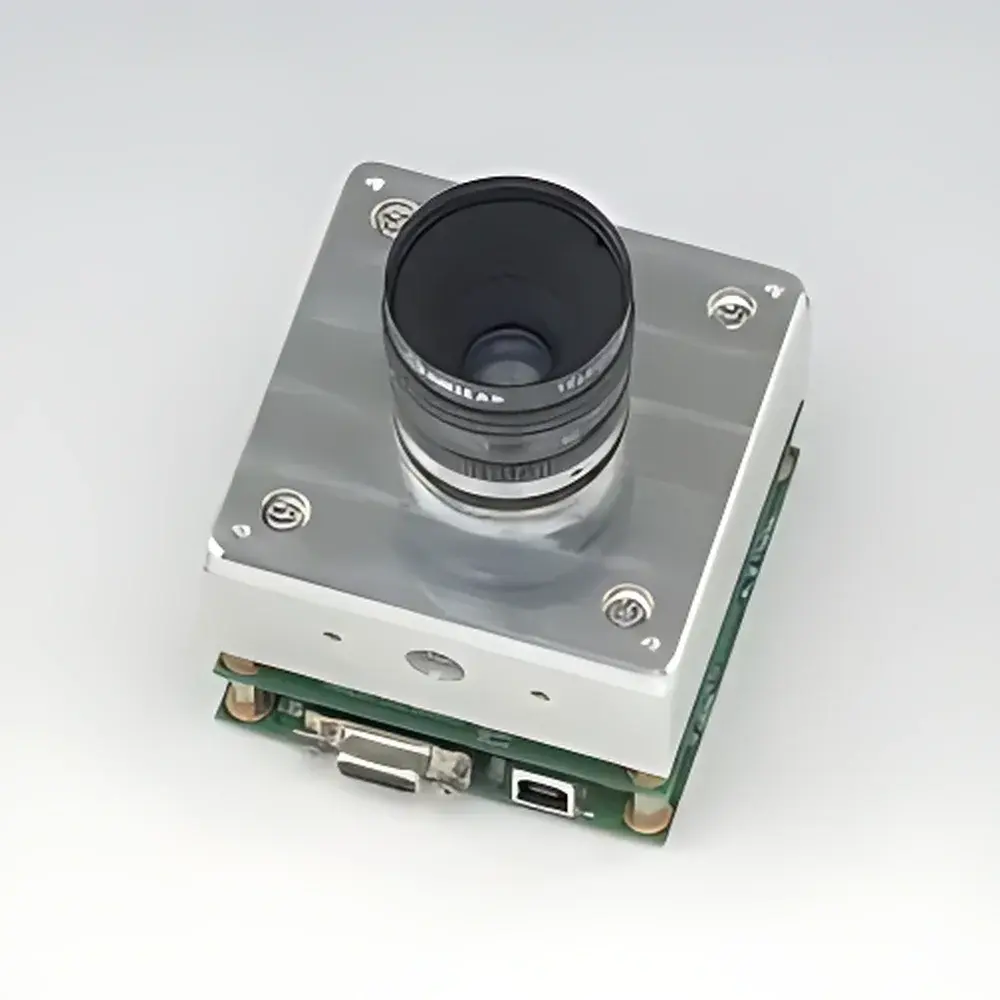
Hamamatsu C10990-942 OEM Board-Level Cooled Digital CCD Camera
| Brand | Hamamatsu |
|---|---|
| Origin | Japan |
| Manufacturer Type | Original Equipment Manufacturer (OEM) |
| Product Category | Imported |
| Model | C10990-942 |
| Pricing | Upon Request |
Overview
The Hamamatsu C10990-942 is a board-level, thermoelectrically cooled digital CCD camera engineered for integration into high-performance optical imaging systems requiring low-noise, quantitative light detection. Built around a 1300K-pixel, 2/3-inch progressive-scan interline-transfer CCD sensor, it delivers high quantum efficiency across the visible to near-infrared spectrum (typically 400–1000 nm), with optimized response in key fluorescence bands including GFP (509 nm), Cy3 (570 nm), and Cy5 (670 nm). Its monolithic board design integrates analog signal conditioning, timing control, A/D conversion, and USB 2.0 interface circuitry—eliminating external controller dependencies and reducing system footprint. The 1-stage Peltier cooler stabilizes the sensor at +10 °C (ambient +20 °C), suppressing dark current by >99% relative to uncooled operation and enabling reliable long-exposure acquisition up to 20 seconds without significant thermal noise accumulation. This architecture meets the stringent spatial stability, temporal reproducibility, and electromagnetic compatibility (EMC) requirements typical of OEM instrumentation deployed in regulated environments such as clinical pathology analyzers, automated microscopy platforms, and industrial inspection tools.
Key Features
- 1344 × 1024 active pixels with 6.45 µm square pixel pitch and 8.67 mm × 6.60 mm photosensitive area
- Low readout noise: 13 e⁻ rms at 12.5 MHz pixel clock, measured at 20 °C ambient
- 12-bit digitization with 1380:1 dynamic range (typical)
- Full-well capacity: 18,000 e⁻ (standard), up to 23,000 e⁻ with on-chip charge binning
- Programmable exposure time from 5 ms to 20 s, supporting both single-frame and burst-mode acquisition
- On-board 2×2 and 4×4 pixel binning (spatial averaging) for enhanced SNR in low-light applications
- Region-of-interest (ROI) readout capability to accelerate frame rates and reduce data volume
- Active anti-blooming with high overflow protection to prevent charge spillage during saturation
- USB 2.0 high-speed interface (480 Mbps equivalent bandwidth) with isochronous transfer mode for deterministic latency
- C-mount lens interface compatible with standard achromatic and apochromatic objectives
- DC +12 V power input; total current draw ≤ 600 mA (including TEC load); voltage ripple tolerance ±50 mV
Sample Compatibility & Compliance
The C10990-942 supports direct coupling to fluorescence microscopes, X-ray scintillation detectors (e.g., CsI:Tl or Gd₂O₂S), and semiconductor wafer inspection optics via C-mount adapters. Its spectral response and low dark current make it suitable for ISO/IEC 17025-accredited fluorescence intensity quantification workflows. While not pre-certified as a medical device, its stable gain calibration, non-volatile offset correction, and hardware-level trigger synchronization enable compliance with GLP and GMP documentation requirements when integrated into validated analytical systems. The camera operates within IEC 61326-1 Class A emission limits and conforms to RoHS 2011/65/EU and REACH (EC 1907/2006) material restrictions.
Software & Data Management
Hamamatsu provides the HCImage Live SDK (Windows/Linux), offering native support for C/C++, Python, MATLAB, and LabVIEW. The SDK includes memory-mapped frame buffers, hardware-triggered acquisition queues, and timestamp-accurate metadata embedding (exposure time, temperature, binning mode, ROI coordinates). All image data are output in lossless 12-bit packed format (Big Endian), compatible with TIFF-based archival standards used in digital pathology (DICOM Supplement 145) and scientific publishing. Audit trail functionality—including user-defined acquisition parameters, firmware version logging, and sensor temperature history—is available through optional HCImage Acquisition Manager software, supporting FDA 21 CFR Part 11 compliance when deployed with electronic signature modules.
Applications
- Quantitative fluorescence microscopy: GFP, RFP, and multiplexed immunofluorescence assays
- FISH (fluorescence in situ hybridization) karyotyping and chromosomal aberration analysis
- Live-cell time-lapse imaging with sub-second temporal resolution
- DIC/phase contrast combined with epifluorescence for label-free + labeled correlative imaging
- Metallurgical and semiconductor failure analysis using reflected-light and IR-enhanced contrast
- X-ray phosphor screen readout in non-destructive testing (NDT) and radiography systems
- Automated cytology screening platforms compliant with CLIA and CAP guidelines
- High-content screening (HCS) instrumentation requiring stable photometric linearity over extended duty cycles
FAQ
Does the C10990-942 support external triggering and synchronization with other instruments?
Yes—it accepts TTL-compatible start/stop and frame-sync triggers via dedicated SMA connectors, enabling precise coordination with lasers, shutters, or motion stages.
Can the camera operate continuously at maximum cooling performance?
The Peltier element is rated for continuous operation at ΔT = −10 °C (sensor at +10 °C, ambient at +20 °C); sustained use above +35 °C ambient requires supplemental airflow per Hamamatsu Technical Note TN-CCD-004.
Is dark frame subtraction supported in real time?
Hardware-based offset correction is applied automatically; full dark frame acquisition and subtraction are implemented in HCImage Live SDK via user-configurable background reference frames.
What is the maximum sustained frame rate with 4×4 binning?
Up to 18 fps at full resolution with 4×4 binning enabled, limited only by USB 2.0 bandwidth and host buffer management.
Are mechanical or electrical interfaces documented for OEM mechanical integration?
Yes—Hamamatsu provides comprehensive mechanical drawings (STEP/IGES), pinout schematics, and thermal dissipation profiles in the C10990-942 Integration Guide (Document No. K0001234-01).




