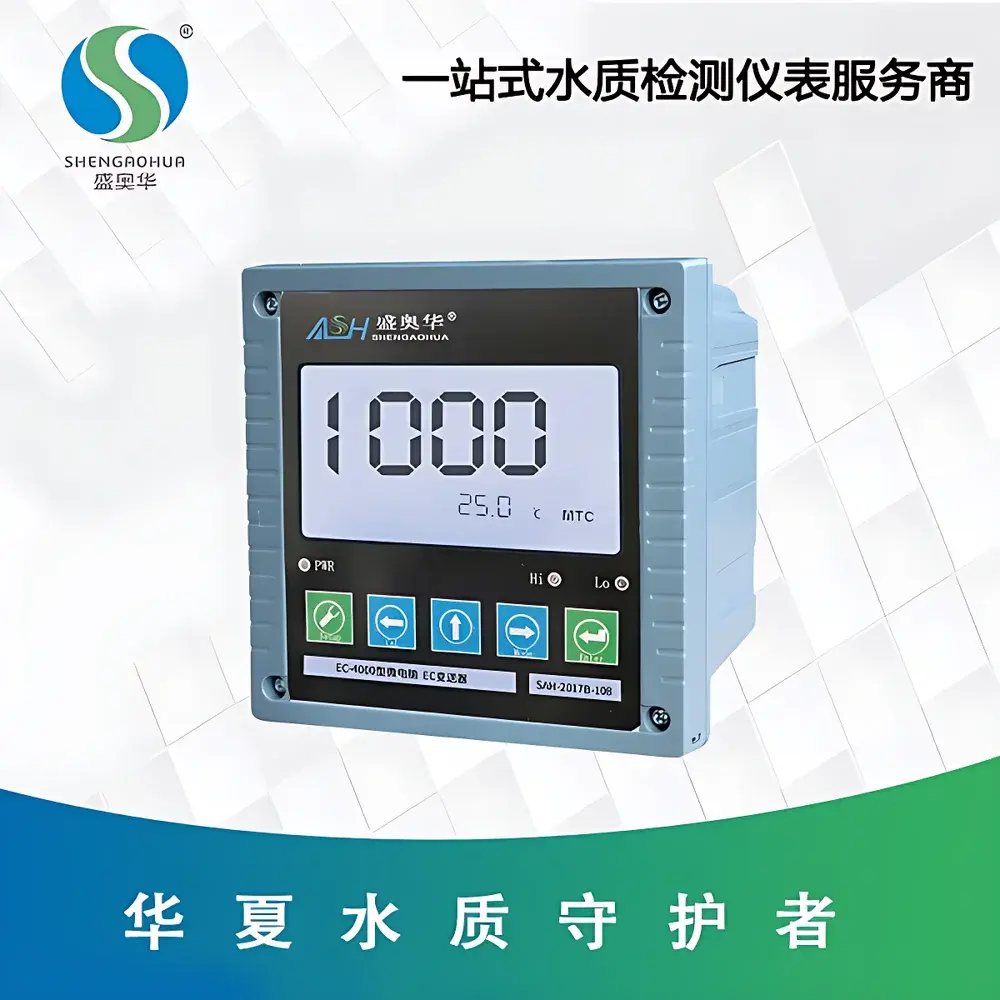
Shengaohua EC-4000 Online Conductivity Analyzer
| Brand | Shengaohua |
|---|---|
| Origin | Jiangsu, China |
| Manufacturer Type | Direct Manufacturer |
| Country of Origin | China |
| Model | EC-4000 |
| Conductivity Range | 0–200,000 µS/cm |
| Temperature Range | 0–60 °C |
| Basic Accuracy | ±3% FS |
| Resolution | 0.001 µS/cm |
| Output Signals | Relay (Low/High/Clean), 0–20 mA / 4–20 mA analog |
| Electrode Cable Length | 3 m (customizable) |
| Operating Environment | 0–60 °C (non-freezing), 0–2 bar |
| Power Supply | AC 220 V / 50 Hz |
| Dimensions | 144 × 144 × 115 mm |
| Weight | 1.5 kg |
Overview
The Shengaohua EC-4000 Online Conductivity Analyzer is a robust, industrial-grade process instrument engineered for continuous, real-time measurement of aqueous solution conductivity in demanding production and monitoring environments. It employs the four-electrode graphite sensor principle—distinct from traditional two-electrode designs—to eliminate polarization effects and electrode fouling artifacts, thereby ensuring stable long-term performance in high-conductivity, variable-salinity, or scaling-prone applications such as boiler feedwater monitoring, reverse osmosis (RO) system control, wastewater effluent compliance tracking, and chemical dosing feedback loops. The analyzer integrates a temperature-compensated measurement circuit with automatic temperature compensation (ATC) based on built-in Pt1000 sensing, enabling accurate conductivity reporting across the full 0–60 °C operational range. Its compact 144 mm square DIN-rail mountable housing conforms to IP65 front-panel ingress protection, supporting deployment in humid, dusty, or splash-prone industrial enclosures without additional housing.
Key Features
- Four-electrode graphite conductivity cell design for enhanced stability, reduced polarization drift, and extended service life in aggressive or particulate-laden media
- Wide dynamic measurement range: 0–200,000 µS/cm with 0.001 µS/cm resolution—suitable for ultrapure water verification through to brine concentration control
- Integrated Pt1000 temperature sensor with automatic linear/non-linear compensation per IEC 60751 standards
- Dual-mode analog output (selectable 0–20 mA or 4–20 mA) with galvanically isolated current loop for noise immunity in electrically noisy plant environments
- Three programmable relay outputs: configurable for low-limit alarm, high-limit alarm, and automatic electrode cleaning cycle initiation
- DIN-rail mounting chassis with front-access terminal blocks and intuitive LED status indicators for power, signal health, and relay activation
- AC 220 V / 50 Hz power input with internal surge suppression and wide-input voltage tolerance (±10%) for grid instability resilience
Sample Compatibility & Compliance
The EC-4000 is validated for use with clean to moderately turbid aqueous streams—including municipal water, cooling tower makeup, desalination permeate, pharmaceutical PW/WFI distribution loops, and food-grade CIP rinse solutions. It is not intended for non-aqueous solvents, highly viscous fluids (>100 cP), or slurries containing abrasive solids >100 µm. The graphite electrodes comply with ISO 7888:2019 (Electrical conductivity of water) for sensor material inertness and electrochemical stability. While not certified to ATEX or IECEx, its enclosure meets EN 60529 IP65 requirements for front-panel protection. For regulated industries, the device supports audit-ready operation when paired with external data loggers compliant with FDA 21 CFR Part 11 (electronic records/signatures) and GLP/GMP traceability protocols.
Software & Data Management
The EC-4000 operates as a standalone field instrument with no embedded firmware-based configuration software. All parameter setup—including conductivity range scaling, temperature compensation curve selection (NaCl or KCl reference), relay setpoints, hysteresis values, and analog output mapping—is performed locally via a 4-button keypad and dual-line LCD display. Configuration changes are stored in non-volatile EEPROM with battery-backed retention (>10 years). For centralized SCADA integration, the 4–20 mA output is compatible with standard PLC analog input modules (e.g., Siemens S7-1200, Allen-Bradley CompactLogix), while relay contacts interface directly with safety-rated control relays or DCS digital input cards. Optional third-party Modbus RTU communication modules (sold separately) enable RS-485 connectivity for HMI visualization and historical trending in systems such as Ignition SCADA or Siemens WinCC.
Applications
- Real-time conductivity monitoring in steam boiler feedwater systems to prevent scale formation and corrosion
- RO/NF membrane performance validation and concentrate bleed control in water reuse facilities
- Concentration control of acid/base solutions in electroplating and pickling lines
- Final rinse water quality assurance in semiconductor wet benches and medical device cleaning validation
- Effluent discharge compliance monitoring per local environmental regulations (e.g., EPA 120.1, GB 8978-1996)
- Monitoring conductivity drift during CIP cycle validation in dairy and beverage processing plants
FAQ
What calibration standards are recommended for the EC-4000?
Standard KCl solutions traceable to NIST SRM 3602a (e.g., 1413 µS/cm, 12.88 mS/cm) are recommended for two-point calibration. Calibration frequency depends on application severity—typically weekly for critical processes, monthly for stable utility water streams.
Can the EC-4000 be used in pressurized piping systems?
Yes—the sensor body is rated for continuous operation at up to 2 bar (29 psi) static pressure. For higher-pressure applications, a threaded inline adapter with pressure relief port must be installed upstream.
Is temperature compensation mandatory?
Yes. Conductivity is inherently temperature-dependent; all measurements are automatically compensated using the integrated Pt1000 sensor. Disabling ATC is not supported in firmware.
Does the unit support automatic temperature coefficient (α) adjustment?
Yes—users may select fixed α = 2.0 %/°C (for NaCl-like media) or enter custom α values between 1.0–3.0 %/°C to match specific electrolyte behavior.
How is electrode fouling detected or mitigated?
The EC-4000 does not include automated fouling diagnostics, but the four-electrode design inherently reduces coating sensitivity. Scheduled cleaning via the dedicated “Clean” relay output—triggered manually or by timer-based PLC logic—is strongly advised for applications with organic or mineral deposit risk.