
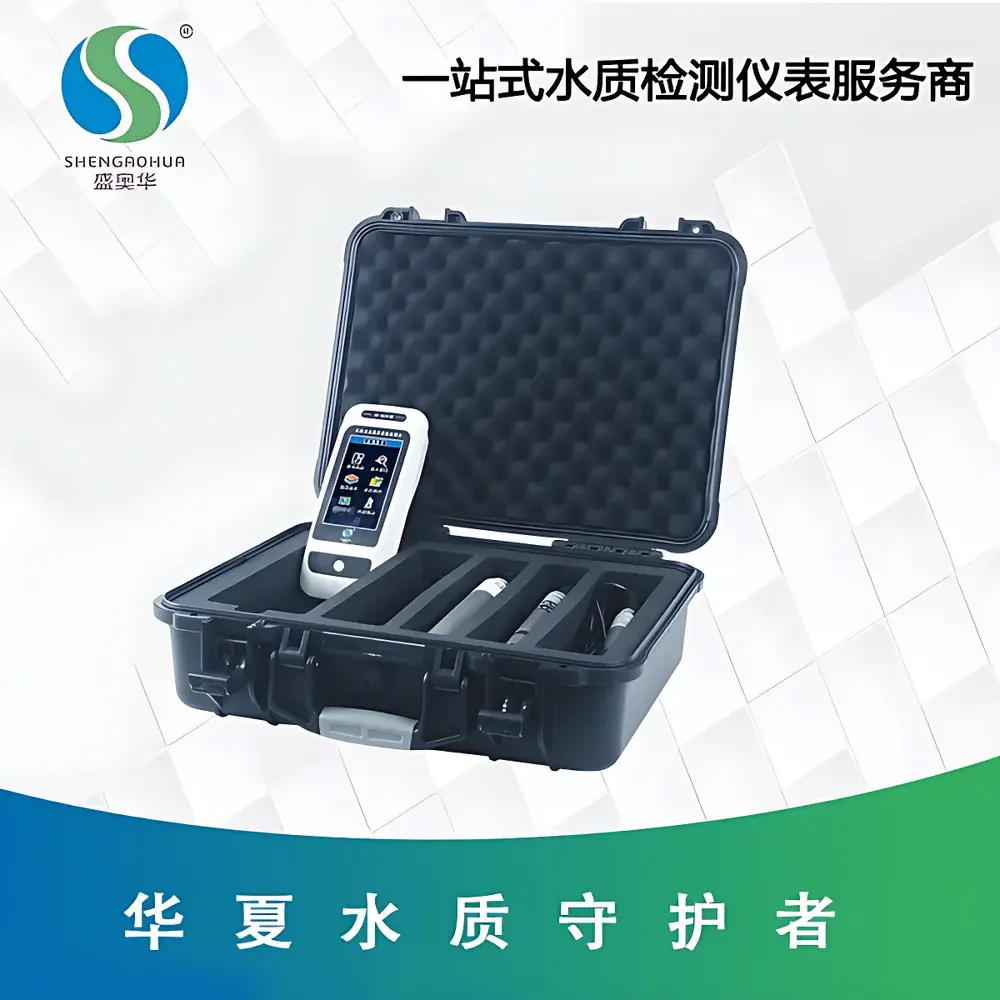
Shengaohua SH-9006 Handheld Multiparameter Water Quality Analyzer
| Brand | Shengaohua |
|---|---|
| Origin | Jiangsu, China |
| Manufacturer Type | Direct Manufacturer |
| Origin Category | Domestic |
| Model | SH-9006 |
| Instrument Type | Portable |
| Temperature Range | 0–60 °C |
| pH Range | 0–14 pH |
| Dissolved Oxygen (DO) Range | 0–20 mg/L (fluorescence method) |
| Conductivity Range | 0–200 mS/cm (auto-ranging) |
| Turbidity Range | 0–4000 NTU |
| COD Range | 0–300 mg/L (UV absorption) |
| Ammonia-N Range | 0–30 mg/L (ion-selective electrode) |
| Chlorophyll-a Range | 0–50 / 500 µg/L (fluorescence) |
| Phycocyanin (Cyanobacteria) Range | 0–200.0 / 2000.0 K cells/mL (fluorescence) |
| ORP Range | −2000 to +2000 mV |
| Display | 5″ IPS capacitive touchscreen |
| Operating Environment | −10 to 60 °C, 10–90% RH (host) |
| Battery | 7800 mAh Li-ion, 5 V/2 A charging |
| Dimensions (host) | 230 × 103 × 56 mm |
| Weight (host) | 0.5 kg |
| Carrying Case | IP65 rated, IK08 impact-resistant, UL94-V0 flame-retardant, 460 × 360 × 170 mm, 2.5 kg |
| Data Storage | ≥100,000 records on microSD card |
| Electrode Cable | Standard 3 m, optional 5 m |
| Communication | Digital interface with auto-electrode recognition, USB-C for charging/data export/firmware update |
| Power Options | Internal battery or AC/DC adapter |
| Measurement Modes | Continuous and instantaneous |
| Sleep Mode | Configurable timeout with one-touch wake-up |
| Optional | Wireless thermal printer support |
Overview
The Shengaohua SH-9006 Handheld Multiparameter Water Quality Analyzer is an engineered field instrument designed for rapid, on-site assessment of critical water quality parameters in diverse aquatic environments. Built upon a modular sensor architecture, it integrates electrochemical, optical, and physical measurement principles—including fluorescence-based dissolved oxygen detection, glass electrode potentiometry for pH, four-electrode conductivity measurement, nephelometric turbidity analysis, UV absorbance for chemical oxygen demand (COD), ion-selective electrode (ISE) methodology for ammonia-nitrogen, and dual-range fluorometric quantification of chlorophyll-a and phycocyanin. Its compact, ruggedized chassis supports real-time, multi-parameter acquisition without laboratory dependency—enabling regulatory compliance verification, routine surveillance, and emergency response across surface water, groundwater, aquaculture systems, municipal distribution networks, industrial discharge points, and reservoir monitoring stations.
Key Features
- Industrial-grade 5″ IPS capacitive touchscreen with ambient-light-adaptive brightness, displaying real-time parameter values, timestamps, battery status, and system diagnostics.
- Modular plug-and-play sensor interface with automatic electrode identification and digital signal conditioning—eliminating manual calibration configuration and minimizing cross-talk interference.
- Dual-mode operation: continuous logging at user-defined intervals (1 s–24 h) or single-point instantaneous measurement with immediate stabilization confirmation.
- Robust mechanical design featuring aircraft-grade metal latching connectors for rapid, tool-free sensor exchange; compliant with IP65 ingress protection and IK08 impact resistance per IEC 62262.
- High-capacity 7800 mAh lithium-ion battery supporting >16 hours of continuous operation under typical load; rechargeable via USB-C with simultaneous data transfer capability.
- Onboard microSD slot enabling secure storage of ≥100,000 timestamped records with full metadata (GPS optional via external module), including raw sensor outputs and derived indices.
- Configurable auto-sleep with adjustable timeout and tactile one-button wake-up—optimized for extended deployment in remote locations with intermittent usage patterns.
- Integrated USB-C port serving triple function: power input (5 V/2 A), firmware over-the-air (OTA) updates, and direct file export to PC or cloud gateway without proprietary drivers.
Sample Compatibility & Compliance
The SH-9006 is validated for use with natural and anthropogenically influenced waters, including freshwater lakes, rivers, estuaries, groundwater wells, recirculating aquaculture tanks, stormwater runoff, and treated effluent streams. Sensor modules meet ASTM D888 (DO), ASTM D1253 (residual chlorine proxy for turbidity correlation), ISO 7888 (conductivity), ISO 10523 (pH), and USP (turbidity) measurement principles where applicable. While not certified to GLP or GMP standards out-of-box, its audit-ready data structure—including immutable timestamps, operator ID fields, and calibration history logs—supports alignment with EPA Method 160.1 (field screening), ISO/IEC 17025 documentation requirements, and internal QA/QC protocols. All electronics comply with CE EMC Directive 2014/30/EU and RoHS 2011/65/EU restrictions.
Software & Data Management
Data generated by the SH-9006 adheres to vendor-agnostic CSV and XML export formats compatible with LIMS integration, GIS mapping platforms (e.g., QGIS, ArcGIS), and statistical analysis tools (R, Python pandas). Firmware supports configurable data tagging (site ID, operator code, project name) and encrypted microSD write protection. Remote diagnostics and version-controlled firmware updates are delivered via signed binary packages through the Shengaohua Desktop Utility—a Windows/macOS application supporting batch calibration certificate import, spectral baseline correction (for UV-COD), and QC flagging (e.g., temperature-compensated conductivity drift alerts). Audit trails include full change logs for calibration coefficients, sensor replacement events, and user-access timestamps—facilitating 21 CFR Part 11–aligned record retention when deployed with supplementary identity management.
Applications
- Regulatory field verification for national surface water quality standards (e.g., China’s GB 3838-2002, EU WFD Annex V).
- Real-time algal bloom early warning using synchronized chlorophyll-a and phycocyanin fluorescence ratios.
- Wastewater treatment plant influent/effluent profiling, including redox potential (ORP) trending for nitrification/denitrification control.
- Aquaculture health monitoring—correlating DO saturation, pH stability, and ammonia-N thresholds against species-specific tolerance curves.
- Source water vulnerability assessment in karst aquifers or fractured bedrock systems via conductivity–temperature–turbidity anomaly detection.
- Post-disaster water safety triage following flood or infrastructure failure, prioritizing parameters with WHO provisional guideline values (e.g., turbidity <5 NTU, pH 6.5–8.5).
FAQ
Does the SH-9006 support GPS geotagging?
Internal GPS is not integrated; however, the device accepts NMEA 0183 serial input from external GNSS receivers via USB-C TTL adapter for coordinate stamping during data capture.
Can calibration be performed in the field without lab-grade standards?
Yes—two-point pH and single-point DO calibrations use pre-programmed buffer and zero-oxygen solutions; conductivity employs KCl traceable standards. Calibration coefficients are digitally signed and stored with expiration dates.
Is wireless printing supported natively?
Thermal printer connectivity requires optional Bluetooth or Wi-Fi dongle; driverless ESC/POS protocol compatibility is confirmed with Zebra ZQ510 and Star SM-L200 models.
What is the recommended maintenance interval for optical sensors?
Turbidity, chlorophyll, and phycocyanin optical windows require cleaning every 72 hours in high-fouling environments; manufacturer-supplied isopropyl alcohol wipes and lint-free swabs are specified in the service manual.
How does the instrument handle temperature compensation across parameters?
Each sensor applies embedded thermistor-derived compensation algorithms per ISO 7888 (conductivity), ASTM D1253 (turbidity), and APHA 4500-O (DO), with user-selectable reference temperatures (20 °C or 25 °C).







