
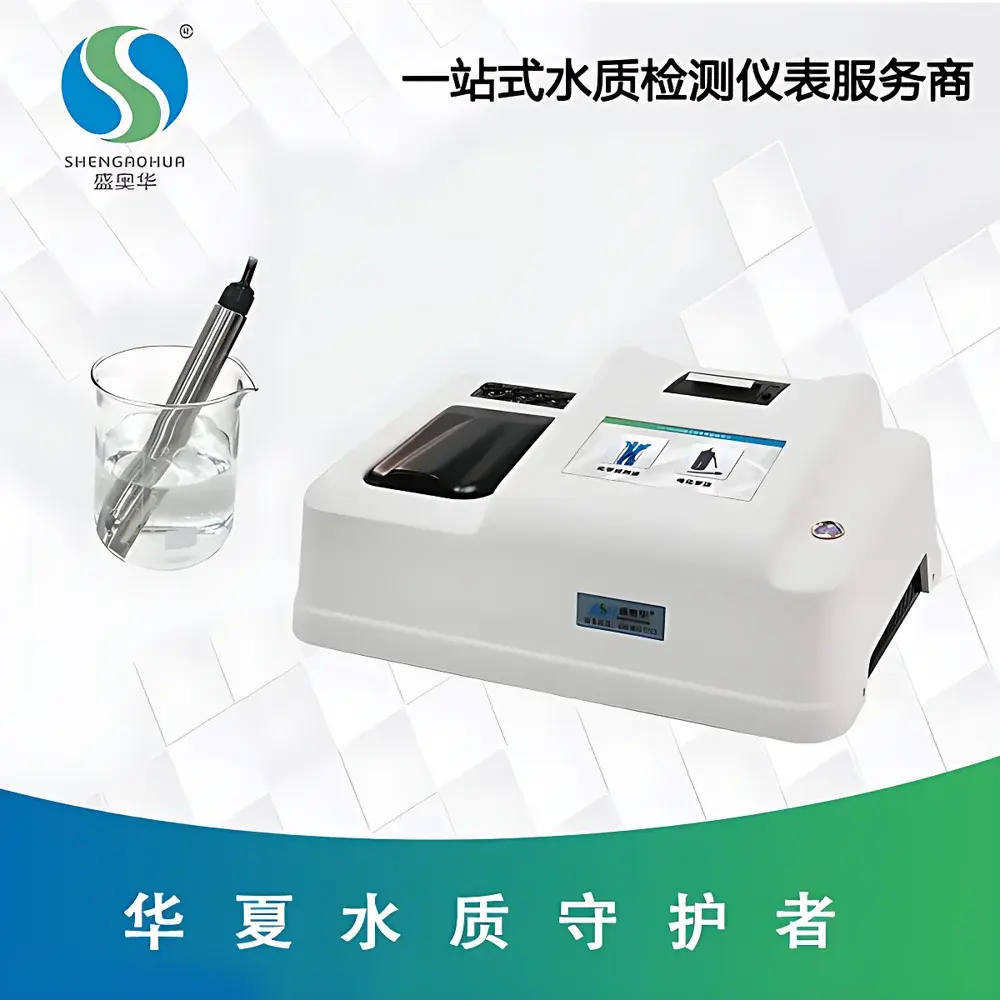
Shengaohua SH-1900A Multi-Parameter Water Quality Analyzer for COD, Ammonia Nitrogen, Total Phosphorus and Total Nitrogen
| Brand | Shengaohua |
|---|---|
| Origin | Jiangsu, China |
| Manufacturer Type | OEM Manufacturer |
| Product Category | Domestic Instrument |
| Model | SH-1900A |
| Instrument Type | Laboratory Water Quality Analyzer |
| Measured Parameters | COD, Ammonia Nitrogen, Total Phosphorus, Total Nitrogen, Heavy Metals (Fe, Cu, Ni, Zn, Cr⁶⁺, Total Cr, Ag), Permanganate Index, Formaldehyde, Sulfide, Sulfate, Nitrite Nitrogen, Residual Chlorine, Total Chlorine, Aniline, Fluoride, Nitrobenzene (user-selectable 7 parameters), plus pH, Dissolved Oxygen (DO), ORP, Conductivity, Chlorophyll-a, Phycocyanin |
| Display | 7-inch Full-Touch Color LCD |
| Optical System | Post-mounted Spectrophotometric Design with Narrow-band Interference Filters |
| Wavelength Range | 400–750 nm |
| Photometric Stability | ≤0.001 A/10 min |
| Light Source Lifetime | 100,000 hours |
| COD Range | 5–50 mg/L and 30–6000 mg/L (dual-range) |
| Ammonia Nitrogen | 0.01–100 mg/L |
| Total Phosphorus | 0.001–8 mg/L |
| pH | 0–14 |
| DO | 0–20 mg/L |
| Accuracy | ≤±8% (COD/NH₃-N/TP/TN), ±0.02 pH, ±0.3 mg/L DO |
| Repeatability | ≤±5% |
| Calibration Curves | 100 total (15 standard + 85 expandable) |
| Data Storage | 5 million records |
| Batch Capacity | 6–56 samples per run |
| Digestion Temp | 165°C / 123°C ±0.5°C |
| Digestion Time | 10 / 30 min |
| Temperature Control Range | Ambient to 200°C |
| Chloride Interference Tolerance | ≤1200 mg/L (standard), ≤4000 mg/L (high-clarity mode) |
| Dimensions | 400 × 300 × 180 mm |
| Weight | 5 kg |
| Power Supply | AC 220 V ±10%, 50 Hz |
Overview
The Shengaohua SH-1900A Multi-Parameter Water Quality Analyzer is a fully integrated laboratory-grade spectrophotometric platform engineered for simultaneous, high-throughput quantification of key water quality indicators—including chemical oxygen demand (COD), ammonia nitrogen (NH₃-N), total phosphorus (TP), total nitrogen (TN), heavy metals, and physicochemical parameters such as pH, dissolved oxygen (DO), oxidation-reduction potential (ORP), conductivity, chlorophyll-a, and phycocyanin. It operates on the principle of narrow-band interference photometry within the visible spectrum (400–750 nm), utilizing post-mounted optical architecture to eliminate ambient light interference and ensure long-term photometric stability (≤0.001 A/10 min). The instrument integrates a microprocessor-controlled digestion module with adaptive power regulation and intelligent PID temperature management—enabling precise, reproducible thermal treatment at user-defined setpoints (ambient to 200°C) and standardized digestion protocols (e.g., 165°C/10 min for COD, 123°C/30 min for TN). Its dual-range measurement capability, combined with 100 programmable calibration curves—including 15 preloaded ISO/GB-compliant standards and 85 field-expandable curves—supports method flexibility across diverse matrices: municipal wastewater, industrial effluents (e.g., pharmaceutical, petrochemical, textile, electroplating), surface water, and groundwater.
Key Features
- Modular optical design with cold LED light source (100,000-hour lifetime) and narrow-band interference filters for consistent spectral resolution and minimal drift.
- 7-inch full-touch color LCD interface with intuitive Chinese-language menu navigation and context-aware workflow prompts.
- Dual-sample format compatibility: accepts both standard 10-mm cuvettes and 16-mm glass test tubes—enabling seamless transition between routine screening and regulatory compliance testing.
- Intelligent digestion system with auto-adjusting heating power, real-time temperature feedback, overheat delay protection, and programmable time/temperature profiles (stored and recalled).
- Built-in thermal printer supporting immediate hardcopy output of current results, historical data queries, and calibration logs—fully traceable for GLP/GMP documentation requirements.
- USB host interface for direct connection to Windows-based PCs; compatible with Shengaohua’s proprietary data management software for automated report generation, trend charting, and export to CSV/PDF formats.
- Robust mechanical architecture (5 kg net weight, compact 400 × 300 × 180 mm footprint) optimized for benchtop deployment in QC labs, environmental monitoring centers, and academic teaching facilities.
Sample Compatibility & Compliance
The SH-1900A is validated for use with raw, filtered, digested, and preserved aqueous samples from municipal, industrial, and natural sources. Its chloride tolerance—up to 4000 mg/L in high-interference mode—meets the robustness requirements of complex wastewater matrices per GB/T 11914-1989 (COD), HJ 535-2009 (NH₃-N), GB/T 11893-1989 (TP), and HJ 636-2012 (TN). While not certified to ISO/IEC 17025 under third-party accreditation, its performance specifications align with foundational metrological criteria outlined in ISO 7027 (turbidity), ISO 5814 (DO), and ASTM D1253 (residual chlorine). Curve validation workflows support user-generated method verification per EPA Method 410.4 (COD), Standard Methods 4500-NH₃ F (ammonia), and APHA 4500-P E (phosphate), facilitating internal audit readiness and regulatory submission preparation.
Software & Data Management
The analyzer embeds firmware with non-volatile memory capable of storing up to 5 million discrete measurement records—including sample ID, timestamp, operator code, method ID, raw absorbance, calculated concentration, curve reference, and digestion parameters. All data entries are immutable and timestamped, satisfying basic audit-trail requirements under GLP and internal QA protocols. USB-linked PC software provides role-based access control (administrator/operator modes), electronic signature support, and configurable report templates compliant with ISO/IEC 17025 Clause 7.8. Data export includes metadata-rich CSV files suitable for LIMS integration and graphical visualization tools for longitudinal performance monitoring (e.g., control charting of blank stability or spike recovery trends).
Applications
This platform serves as a primary analytical tool in environmental laboratories conducting routine compliance monitoring (e.g., discharge permit reporting per China’s “Integrated Wastewater Discharge Standard” GB 8978-1996), process optimization in wastewater treatment plants (WWTPs), and effluent characterization for industrial pretreatment programs. It is routinely deployed in university environmental science curricula for hands-on method development and validation exercises, and by third-party testing institutions performing contract analysis for food & beverage, pharmaceutical, and semiconductor manufacturing clients. Specific application domains include bioreactor influent/effluent profiling, landfill leachate assessment, river basin health surveys, and metal finishing rinse water analysis—where rapid turnaround, multi-parameter parallelism, and matrix adaptability are operationally critical.
FAQ
What digestion methods are preprogrammed in the SH-1900A?
The instrument includes factory-loaded protocols for COD (165°C/10 min), total nitrogen (123°C/30 min), and total phosphorus (120°C/30 min), all aligned with national standard methodologies.
Can users import custom calibration curves from external sources?
Yes—curves may be uploaded via USB using the provided .csv template; each curve is assigned a unique ID and version stamp for traceability.
Is the instrument compatible with LIMS systems?
While no native HL7 or ASTM E1384 interface is embedded, ASCII-formatted export files support manual or scripted ingestion into most LIMS platforms.
Does the SH-1900A meet FDA 21 CFR Part 11 requirements?
No—it lacks electronic signature enforcement, audit-log encryption, and role-based authentication required for regulated pharmaceutical or clinical applications.
How is photometric accuracy verified during routine operation?
Users perform daily zero-point verification with deionized water blanks and periodic absorbance checks using NIST-traceable neutral density filters (optional accessory).
Related Products







