
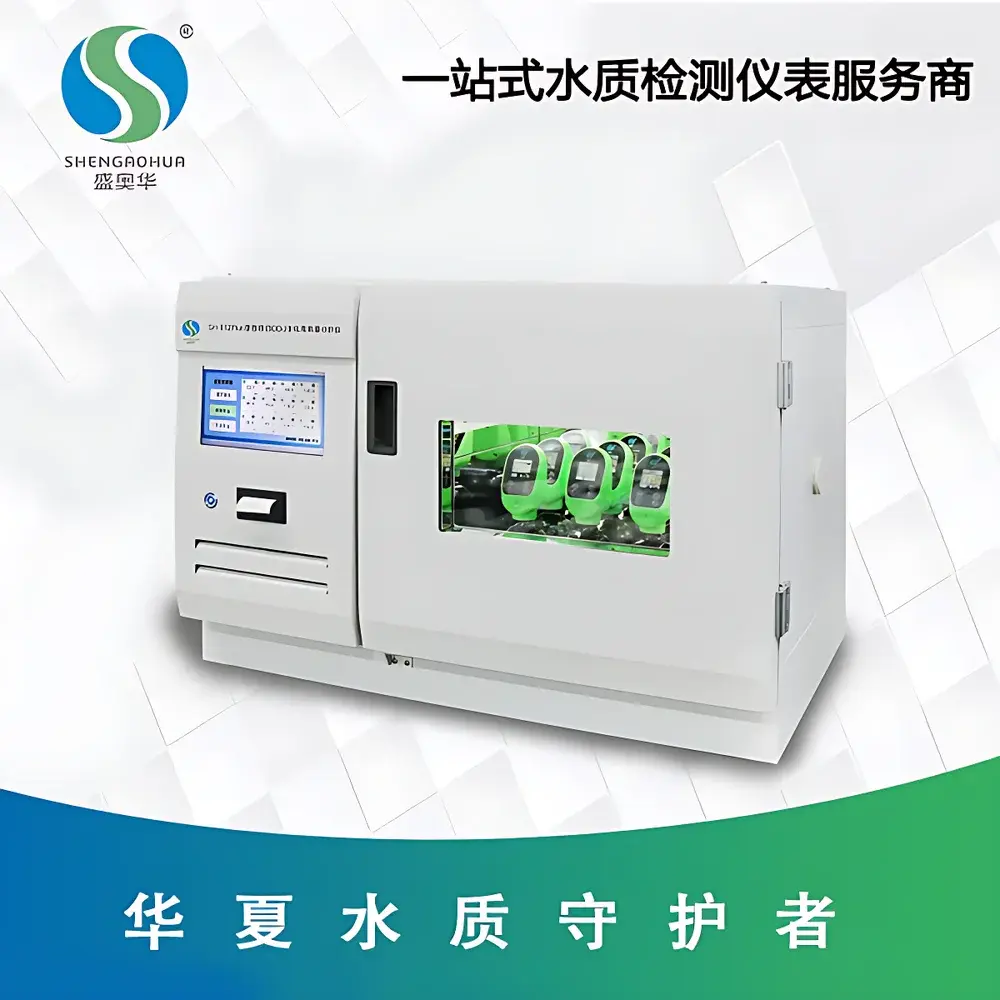
Shengaohua SH-812Plus Intelligent BOD₅ Analyzer (Pressure-Difference Method)
| Brand | Shengaohua |
|---|---|
| Origin | Jiangsu, China |
| Manufacturer Type | Direct Manufacturer |
| Country of Origin | China |
| Model | SH-812Plus |
| Instrument Type | Laboratory BOD Analyzer |
| Measurement Principle | Mercury-Free Pressure-Difference Method |
| Measurement Range | 2–4000 mg/L |
| Detection Limit | 2 mg/L |
| Accuracy | ±8% |
| Incubation Duration | 5 days (standard BOD₅) |
| Incubation Temperature | 20 °C ±1 °C |
| Repeatability | ±8% |
| Sample Capacity | 9 or 12 bottles per batch |
| Bottle Volume | 580 mL |
| Temperature Control Precision | ≤1 °C |
| Stirring | Electromagnetic, 4 adjustable modes |
| Data Storage Capacity | >1,000,000 records |
| Display | 10.1″ capacitive touchscreen + 1.5″ auxiliary color LCD |
| Operating System | Android-based embedded OS |
| Connectivity | USB 2.0, Bluetooth 5.0, Wi-Fi 802.11 b/g/n |
| Power Supply | Internal rechargeable Li-ion battery with AC adapter |
| Auto-Sleep | Configurable (1–99 min) |
| Data Logging Interval | 1 h |
| Temperature Range (Chamber) | 0–50 °C |
| Temp. Resolution | 1 °C |
| Chamber Volume | 60 L |
| Dimensions (W×D×H) | 910 × 668 × 657 mm |
| Net Weight | 45 kg |
Overview
The Shengaohua SH-812Plus Intelligent BOD₅ Analyzer is a fully integrated, laboratory-grade instrument engineered for standardized five-day biochemical oxygen demand (BOD₅) determination in water and wastewater samples. It operates on the mercury-free pressure-difference principle—measuring the partial pressure change of dissolved oxygen consumed by aerobic microorganisms during controlled incubation at 20 °C. Unlike traditional dilution or manometric methods requiring manual titration or mercury-based manometers, the SH-812Plus employs high-stability electrochemical pressure transducers and sealed, non-invasive reaction chambers to quantify oxygen depletion without reagent addition or hazardous materials. This design aligns with global environmental safety directives—including the Minamata Convention—and eliminates risks associated with mercury handling, disposal, and regulatory reporting. The system integrates incubation, real-time monitoring, data acquisition, and reporting into a single compact unit, reducing inter-laboratory variability and supporting compliance with ISO 5815-1:2019, ASTM D5210–22, and EPA Method 405.1.
Key Features
- Mercury-free pressure-difference measurement architecture compliant with modern environmental health and safety standards.
- Dual-display interface: 10.1″ high-resolution capacitive touchscreen for interactive control and visualization, plus a dedicated 1.5″ color LCD for ambient status monitoring (temperature, time, bottle ID).
- Modular incubation chamber accommodating either 9 or 12 standardized 580 mL BOD bottles per run—each independently addressable for asynchronous start/stop, parameter adjustment, and real-time DO consumption profiling.
- Precision temperature regulation (20 °C ±1 °C) via PID-controlled Peltier-heating and forced-air circulation; chamber uniformity validated across full 60 L volume.
- Electromagnetic stirring with four programmable modes (pulse, continuous, intermittent, off) to ensure homogeneous microbial suspension and consistent oxygen transfer kinetics.
- Embedded Android OS enabling local application execution, firmware updates via USB/Type-C, onboard video-guided operation, and secure over-the-air configuration backup.
- Internal rechargeable lithium-ion battery supporting ≥72 h continuous operation; hot-swappable charging during incubation without interrupting measurement cycles.
- Automated data logging at user-defined intervals (default: 1 h), with timestamped, bottle-specific records stored in non-volatile memory (>1 million entries capacity).
Sample Compatibility & Compliance
The SH-812Plus accepts standard 580 mL glass BOD bottles conforming to APHA 2540 D and ISO 5815 requirements. It supports raw wastewater, treated effluent, surface water, drinking water pre-treatment samples, and industrial process streams—with optional sample dilution performed externally per standard protocols. Each analysis channel maintains independent calibration traceability; up to 10 user-defined calibration curves may be stored and recalled. The instrument meets functional requirements for GLP-compliant laboratories: audit-trail-enabled event logging (start/stop, parameter changes, error alerts), password-protected administrator mode, and immutable record generation. Data export formats include CSV and PDF reports compatible with LIMS integration. While not FDA 21 CFR Part 11 certified out-of-box, its architecture supports electronic signature implementation through third-party validation packages.
Software & Data Management
The embedded Android platform hosts a purpose-built BOD analysis application featuring intuitive workflow navigation, multi-language UI (English, Chinese, Spanish), and contextual help overlays. All measurements are automatically assigned unique identifiers (batch ID, bottle ID, operator ID, timestamp). Raw pressure differentials, calculated BOD values (mg/L), temperature logs, and stirring status are synchronized to internal storage and optionally transmitted via Bluetooth or Wi-Fi to networked PCs or cloud repositories. USB host port enables direct export to external drives; Type-C port supports firmware upgrades and remote diagnostics. Built-in video tutorials (accessible offline) guide users through calibration, bottle loading, incubation setup, and report generation—reducing training overhead and operator dependency.
Applications
- Regulatory compliance testing for municipal wastewater treatment plants (WWTPs) under national discharge permits.
- Environmental monitoring agencies performing routine surface water quality assessment (e.g., rivers, lakes, reservoirs).
- Industrial pretreatment verification for food processing, pharmaceutical, textile, and chemical manufacturing facilities.
- Academic and research laboratories conducting biodegradability studies, toxicity screening (e.g., inhibition tests), and microbial kinetics modeling.
- Third-party testing labs requiring auditable, high-throughput BOD₅ analysis with minimal manual intervention and cross-contamination risk.
FAQ
What is the minimum detectable BOD concentration?
The detection limit is 2 mg/L, verified per ISO 5815-1:2019 Annex C using low-concentration glucose-glutamic acid (GGA) reference solutions.
Can the incubation period be adjusted beyond 5 days?
Yes—the system supports configurable incubation durations from 1 to 30 days, enabling extended BODn (e.g., BOD20) or respirometric kinetic studies.
Is external dilution required for samples exceeding 4000 mg/L?
Yes; the analyzer’s linear range is 2–4000 mg/L. Samples above this threshold must be diluted prior to analysis following APHA Standard Methods guidelines.
How is temperature uniformity validated across the incubation chamber?
Factory calibration includes 9-point thermal mapping at 20 °C, with deviation ≤±0.8 °C across all bottle positions—certified in the出厂 calibration report.
Does the system support multi-user access with role-based permissions?
Yes; the Android OS implements three-tier access control: Operator (run-only), Supervisor (calibration + method edit), and Administrator (system settings, audit log review, firmware update).







