
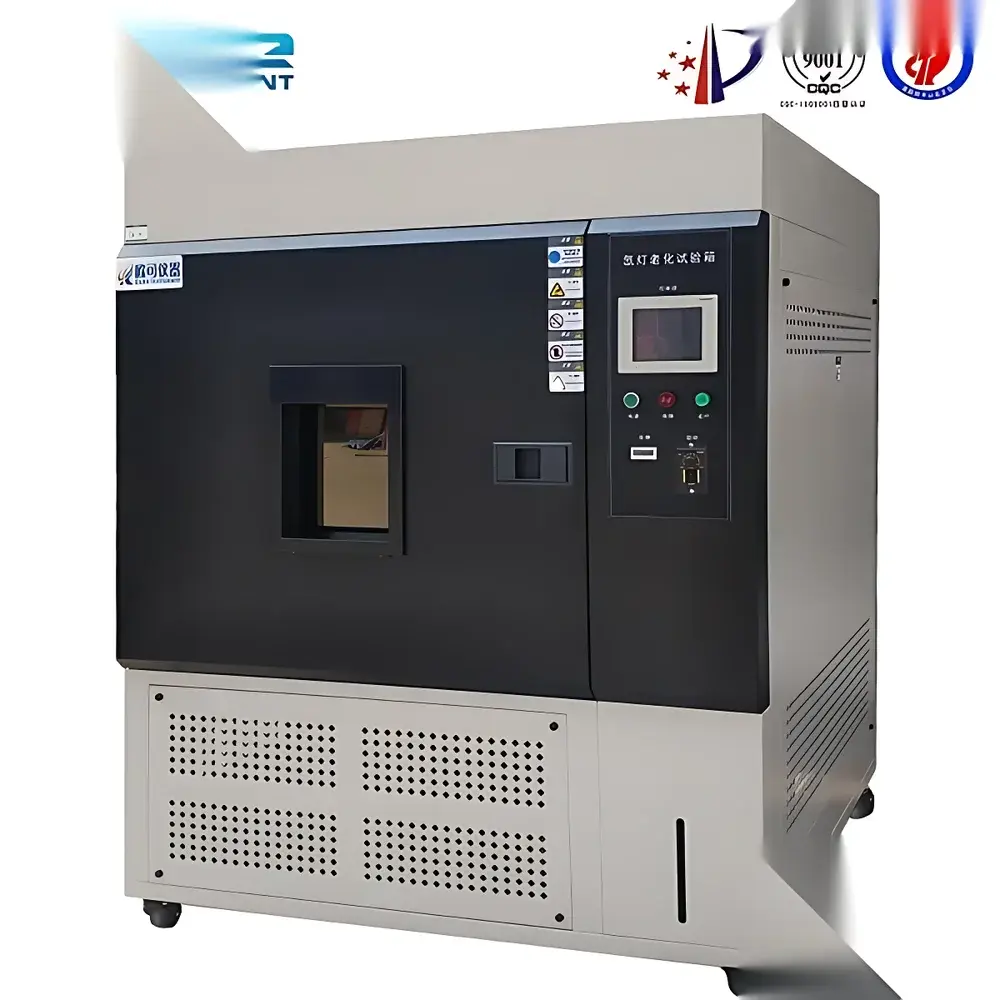
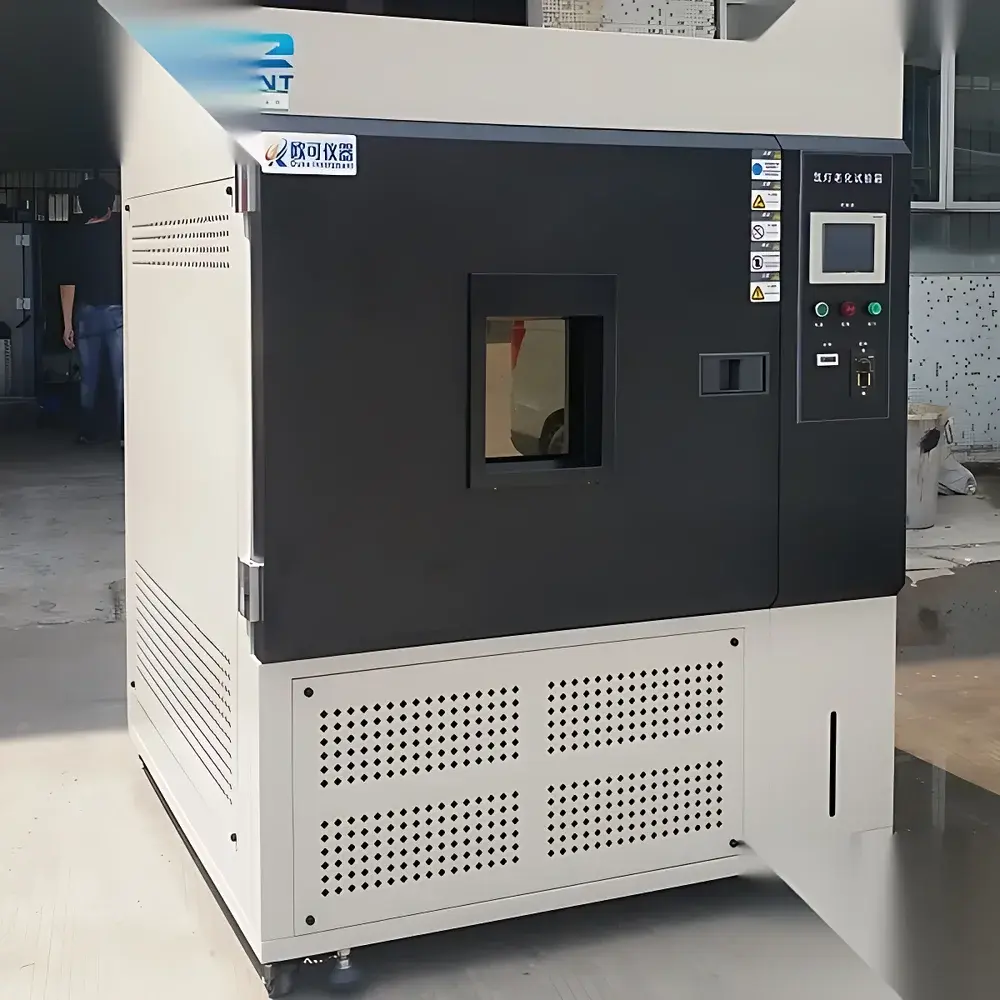
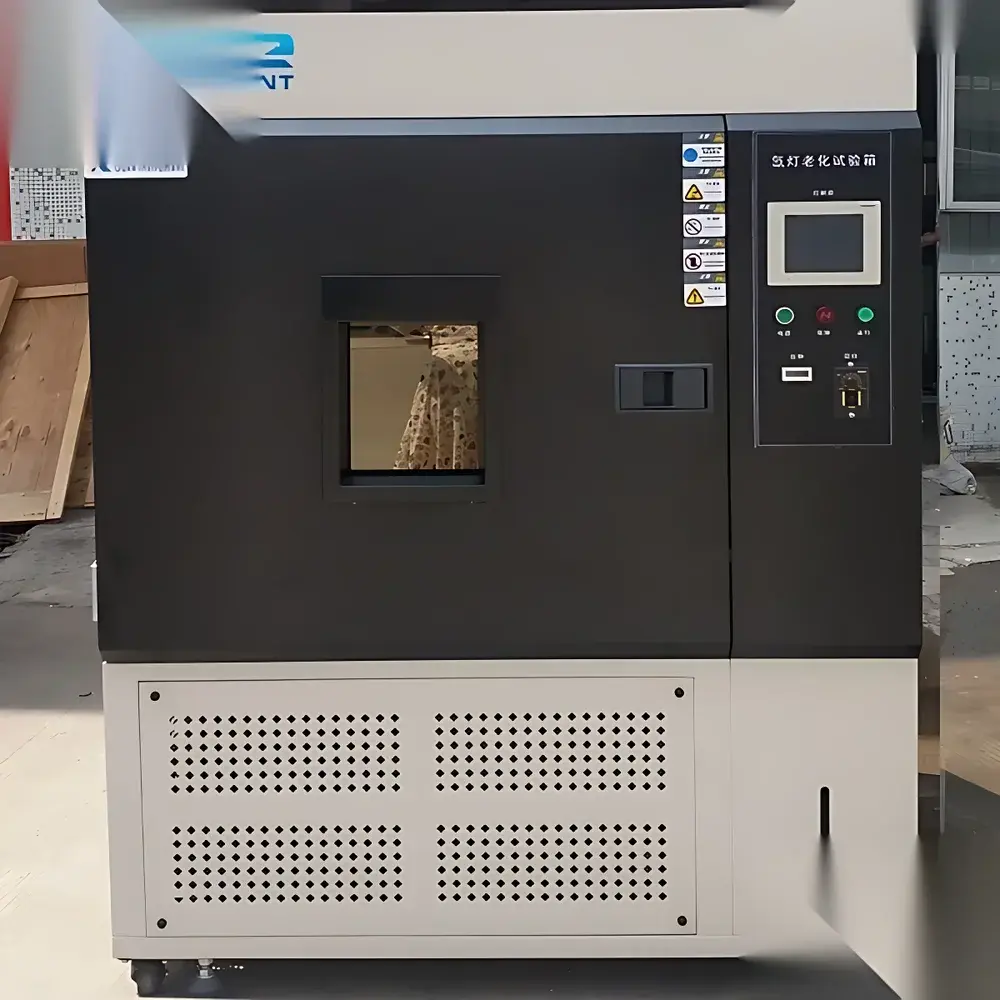
Xenon Arc Weathering Chamber
| Key | Chamber Interior Dimensions: 500 × 700 × 600 mm |
|---|---|
| Temperature Range | RT to +80 °C (adjustable) |
| Humidity Range | 45–90 % RH (adjustable) |
| Black Panel Temperature | 63 °C or 100 °C ±2 °C |
| Temperature Uniformity | ±2.0 °C |
| Temperature Fluctuation | ±0.5 °C |
| Humidity Deviation | ≤±2 % RH |
| Xenon Lamp Type | Air-Cooled, 1.8 kW |
| Spectral Range | 290–800 nm |
| Irradiance (290–800 nm) | 550 W/m² |
| Sample Rack Distance from Lamp | 230–280 mm |
| Rainfall Duration | 0–9999 min (continuous) |
| Rainfall Cycle | 0–240 min (cyclic/intermittent) |
| Nozzle Orifice Diameter | Ø0.8 mm |
| Heating Power | 3 kW |
| Humidification Power | 1.5 kW |
| Total Rated Power | 9 kW |
| Sample Tray | 1-layer, height-adjustable |
| Filter Glass | 1 piece |
| Compliance | Designed per ISO 4892-2, ASTM G155, SAE J2527, and GB/T 16422.2 |
Overview
The Xenon Arc Weathering Chamber is an engineered environmental simulation system designed to replicate the full solar spectrum—including UV, visible, and near-infrared radiation—using a stabilized air-cooled xenon arc lamp. Unlike UV fluorescent or metal halide sources, xenon lamps provide spectral energy distribution closely matching natural sunlight (290–800 nm), making this chamber suitable for evaluating photodegradation, color fading, gloss loss, cracking, chalking, and other weather-induced material failures under controlled, repeatable conditions. The chamber integrates precise temperature and humidity control with programmable irradiance regulation, rainfall simulation, and black panel temperature monitoring—enabling correlation between laboratory-accelerated testing and real-world outdoor exposure. Its architecture supports long-term stability required for compliance-driven test protocols across automotive, aerospace, coatings, plastics, textiles, and building materials industries.
Key Features
- High-fidelity xenon arc source delivering continuous spectral output from 290 nm to 800 nm, calibrated to meet ISO 4892-2 spectral requirements;
- Microprocessor-based controller with PID algorithms for independent regulation of chamber air temperature (RT to +80 °C), relative humidity (45–90 % RH), and black panel temperature (63 °C or 100 °C ±2 °C);
- Dual-stage temperature control: air-heating elements (3 kW) and water-based humidification system (1.5 kW) ensure low thermal inertia and high reproducibility;
- Programmable rainfall subsystem featuring adjustable duration (0–9999 min) and cycle intervals (0–240 min), with precision nozzles (Ø0.8 mm) enabling uniform water distribution over specimens;
- Adjustable sample rack positioned 230–280 mm from lamp axis to accommodate varying specimen geometries while maintaining consistent irradiance exposure;
- Integrated optical filter glass to condition spectral output and simulate specific atmospheric transmission profiles (e.g., daylight through window glass);
- Robust stainless-steel interior construction with insulated double-wall housing and forced-air circulation for uniform environmental distribution;
- Real-time monitoring of irradiance (550 W/m² across 290–800 nm band) via calibrated broadband sensor with auto-compensation for lamp aging.
Sample Compatibility & Compliance
This chamber accommodates flat-panel, molded, or flexible specimens up to 500 × 700 × 600 mm in internal volume. Specimens are mounted on a single-height-adjustable tray, allowing optimization of exposure geometry relative to lamp position and airflow patterns. The system meets essential performance criteria outlined in ISO 4892-2 (Plastics — Methods of exposure to laboratory light sources — Part 2: Xenon-arc lamps), ASTM G155 (Standard Practice for Operating Xenon Arc Light Apparatus for Exposure of Non-Metallic Materials), SAE J2527 (Surface Vehicle Recommended Practice for Accelerated Exposure of Automotive Exterior Materials Using a Controlled Irradiance Xenon-Arc Apparatus), and GB/T 16422.2 (Chinese national standard equivalent). It supports GLP-compliant operation when paired with validated calibration records, audit-trail-enabled software, and documented maintenance logs.
Software & Data Management
The chamber operates via an embedded industrial-grade controller with touchscreen interface, supporting multi-step test programs with up to 99 segments per cycle. All operational parameters—including irradiance setpoint, temperature/humidity ramps, rainfall timing, and black panel feedback—are logged at user-defined intervals (minimum 1-minute resolution) and exportable via USB or RS-485 to external LIMS or QA databases. Optional Ethernet connectivity enables remote monitoring and integration into centralized lab management platforms. Data integrity safeguards include password-protected parameter modification, electronic signature prompts for critical changes, and non-volatile memory retention during power interruption—supporting alignment with FDA 21 CFR Part 11 requirements where configured with appropriate validation documentation.
Applications
- Evaluation of polymer photostability and UV resistance for automotive interior trim, exterior body panels, and under-hood components;
- Accelerated aging of architectural coatings, sealants, and façade systems per AAMA 2604/2605 and ASTM D4329;
- Colorfastness and dimensional stability testing of textile fibers, geotextiles, and outdoor fabrics;
- Validation of packaging material barrier performance against light-induced oxidation of pharmaceuticals and food products;
- Correlation studies linking laboratory xenon exposure cycles to field service life predictions using Arrhenius-type modeling and spectral weighting functions (e.g., CIE S 016/E:2015);
- Pre-qualification of new pigment formulations, stabilizer packages, or resin blends prior to outdoor exposure campaigns.
FAQ
What standards does this xenon chamber comply with?
It is engineered to meet ISO 4892-2, ASTM G155, SAE J2527, and GB/T 16422.2. Full compliance verification requires periodic radiometric calibration and filter replacement per manufacturer specifications.
Can the chamber operate without rainfall simulation?
Yes—rainfall is fully programmable and may be disabled for dry-cycle tests or substituted with condensation-only modes depending on test protocol requirements.
How often must the xenon lamp be replaced?
Typical lamp service life is 1,500–2,000 hours under continuous operation at rated irradiance; replacement interval depends on cumulative radiant exposure and spectral drift measured via reference sensor.
Is black panel temperature monitoring mandatory?
Yes—black panel sensors provide direct measurement of specimen surface heating effects, which is critical for correlating accelerated test data with real-world thermal loading conditions as specified in ISO 4892-2 Annex B.
Does the system support automated data export for regulatory submissions?
With optional communication modules and validated software configuration, it supports CSV/Excel export, timestamped audit trails, and electronic signatures aligned with FDA 21 CFR Part 11 and EU Annex 11 expectations.



