
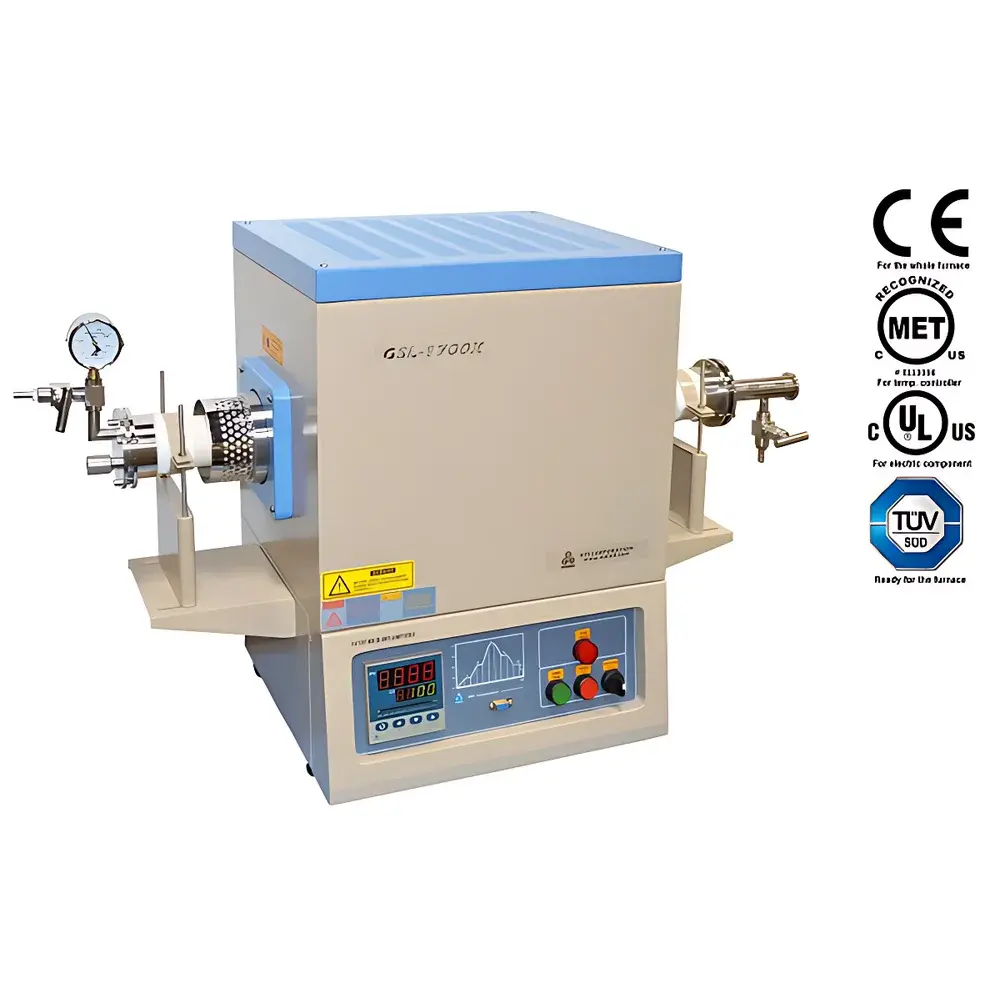
KEJING GSL-1700X-S60 High-Temperature Horizontal Tube Furnace (1700 °C, CE-Certified)
| Brand | KEJING |
|---|---|
| Model | GSL-1700X-S60 |
| Max Temperature | 1700 °C |
| Heating Element | MoSi₂ (Silicon Molybdenum) Rods, Grade 1800 |
| Heating Zone Length | 300 mm |
| Uniform Temperature Zone | 80 mm |
| Tube Dimensions | 60 mm OD × 54 mm ID × 790 mm L |
| Tube Material | High-Purity Al₂O₃ (≥99.9% Al₂O₃) |
| Cooling Method | Dual-Layer Air-Cooled Shell |
| Surface Temperature | <60 °C at Ambient |
| Control System | 30-Stage Programmable PID Controller with RS232 Interface |
| Power Supply | 220 V AC, Single Phase, 50/60 Hz, 30 A Circuit Breaker Required |
| Max Power Consumption | 2.5 kW |
| Vacuum Compatibility | 10⁻³ Torr (with Dual-Stage Rotary Pump), 10⁻⁵ Torr (with Turbomolecular Pump) |
| Certification | CE, UL/MET/CSA Compliant Components (>24 V), TÜV/CAS Certification Available on Request |
| Warranty | 12 Months (excl. consumables: furnace tube, MoSi₂ rods, silicone O-rings) |
Overview
The KEJING GSL-1700X-S60 is a horizontally oriented, high-temperature tube furnace engineered for precision thermal processing under controlled atmospheres—vacuum, inert gas (e.g., Ar, N₂), or reducing environments. It operates on the principle of resistive heating via high-stability silicon molybdenum (MoSi₂) heating elements, enabling stable and repeatable operation up to 1700 °C. The furnace employs a dual-layer stainless steel shell with forced-air cooling to maintain external surface temperature below 60 °C during continuous operation—a critical safety and energy-efficiency feature in shared laboratory spaces. Its internal chamber is lined with high-purity alumina fiber insulation and coated with a proprietary high-emissivity aluminum oxide ceramic layer (imported from the U.S.), enhancing radiative heat transfer efficiency and minimizing thermal lag. Designed for reproducible materials synthesis, sintering, annealing, and crystal growth, the GSL-1700X-S60 meets the dimensional and thermal uniformity requirements specified in ASTM C1112 (Standard Guide for High-Temperature Thermal Processing Equipment) and aligns with ISO/IEC 17025-compliant calibration practices when paired with traceable thermocouples.
Key Features
- Dual-shell air-cooled architecture ensures operator safety and reduces ambient heat load—external casing remains <60 °C even at 1700 °C internal setpoint.
- 30-segment programmable PID temperature controller with ramp-soak profiles, ±1 °C accuracy over the full operating range (room temperature to 1700 °C).
- High-purity alumina (≥99.9%) tube (60 mm OD × 54 mm ID × 790 mm L) with integrated end plugs to preserve axial temperature uniformity and minimize convective losses.
- Standard vacuum-rated stainless steel flanges with high-temp silicone O-rings; optional KF25 quick-connect ports and SS 1/4″ VCR-style compression fittings for leak-tight gas/vacuum line integration.
- RS232 interface enables remote monitoring and program upload via optional PC software (sold separately); supports data logging and audit-trail generation for GLP/GMP-aligned workflows.
- Compliance-ready design: All low-voltage components certified to UL 61010-1 / CSA C22.2 No. 61010-1 / EN 61010-1; CE-marked per Machinery Directive 2006/42/EC and EMC Directive 2014/30/EU.
Sample Compatibility & Compliance
The GSL-1700X-S60 accommodates crucibles, boats, and substrates made from quartz, graphite, boron nitride, or high-purity alumina—compatible with powder metallurgy, thin-film deposition precursors, battery cathode materials (e.g., LiCoO₂, NMC), and ceramic matrix composites. Its vacuum-tight configuration supports processes requiring oxygen partial pressures <10⁻³ Torr (standard rotary pump) or <10⁻⁵ Torr (with turbomolecular pumping system). The furnace satisfies material compatibility requirements outlined in USP (Thermal Analysis) and ISO 11358-1 (Polymer Thermogravimetry), provided appropriate thermocouple placement and calibration protocols are followed. Optional digital vacuum gauges (3.8×10⁻⁵–1125 Torr range, gas-independent calibration) meet ASTM E581 specifications for residual gas analysis in inert-atmosphere furnaces.
Software & Data Management
The optional RS232-enabled control software provides real-time temperature graphing, multi-curve overlay, and export of time-stamped .csv datasets. Each temperature program includes user-defined metadata fields (operator ID, sample ID, atmosphere type), supporting 21 CFR Part 11 compliance when deployed with electronic signature validation and audit-log archiving. Firmware supports firmware version tracking and secure parameter locking—preventing unauthorized modification of critical settings during QA/QC runs. Calibration certificates for integrated Type S thermocouples (supplied with NIST-traceable documentation) can be imported into the software for automatic correction curve application.
Applications
- Sintering of advanced ceramics (Al₂O₃, ZrO₂, SiC) and refractory metals (Mo, W, Ta).
- Controlled-atmosphere annealing of semiconductor wafers and transparent conductive oxides (ITO, AZO).
- Synthesis of solid-state battery electrolytes (e.g., LLZO, LATP) under argon glovebox-integrated operation.
- Thermal decomposition studies of MOFs and coordination polymers under programmed vacuum ramps.
- Graphitization of carbon precursors and high-temperature reduction of metal oxides (e.g., NiO → Ni, Co₃O₄ → Co).
- Calibration reference furnace for secondary standard thermocouples (per ISO/IEC 17025 Clause 6.4.10).
FAQ
What vacuum level can the GSL-1700X-S60 achieve without optional pumps?
With the included dual-stage rotary vane pump, base pressure reaches ≤10⁻³ Torr. For ultra-high vacuum applications (e.g., thin-film precursor evaporation), a turbomolecular pump system is recommended.
Is the furnace compatible with hydrogen gas atmospheres?
Yes—when equipped with H₂-compatible stainless steel flanges, metal gaskets (optional), and proper ventilation protocols per NFPA 55 and CGA G-5.1 guidelines. Hydrogen flow rates must remain below laminar combustion thresholds.
Can the furnace be integrated into an automated process line?
The RS232 interface supports Modbus RTU protocol emulation via third-party drivers; discrete I/O signals (start/stop, fault status) are available via optional relay module.
What maintenance intervals are recommended for consumables?
MoSi₂ rods typically last >2000 hours at ≤1600 °C; alumina tubes show measurable degradation after ~500 cycles above 1500 °C. Silicone O-rings require replacement every 6–12 months depending on thermal cycling frequency.
Does KEJING provide installation support for international customers?
Yes—remote commissioning assistance is included. On-site service and TÜV-certified factory acceptance testing (FAT) are available upon request, subject to regional regulatory alignment (e.g., German TRBS 2152, UK PUWER 1998).



