
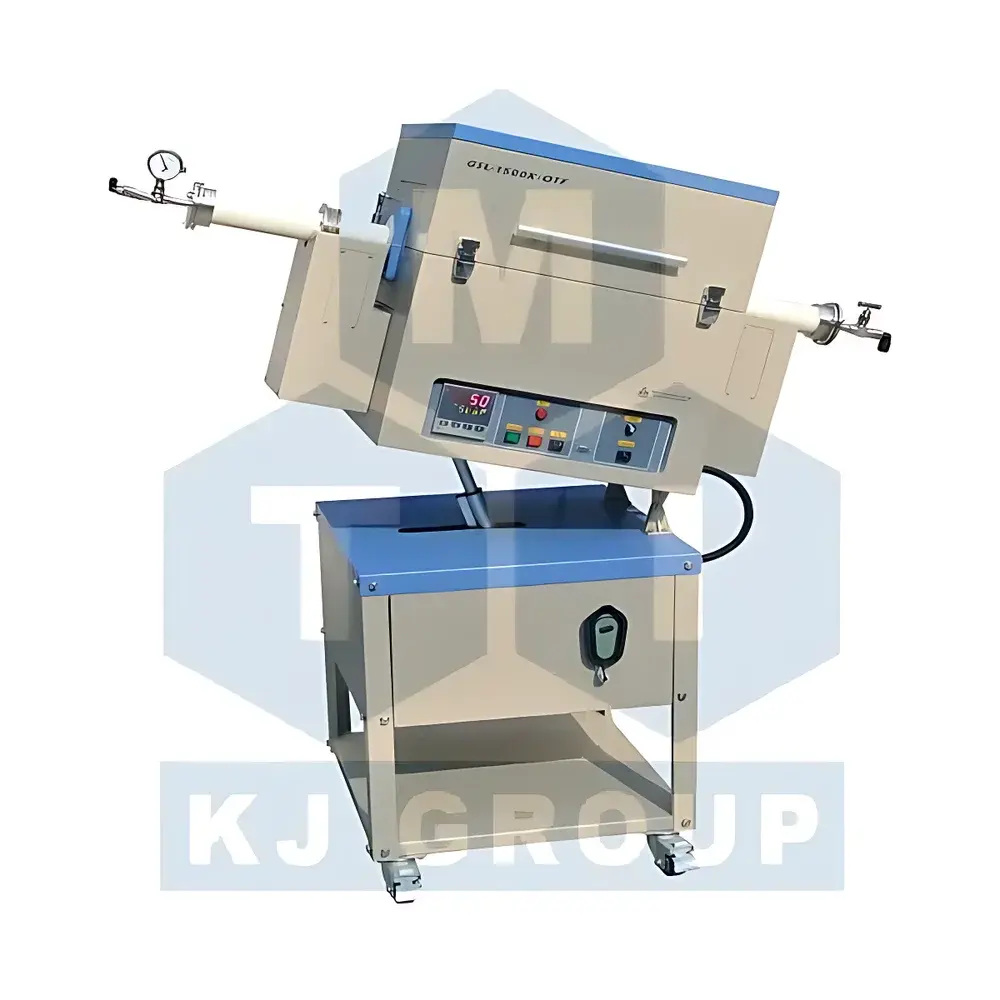
合肥科晶 GSL-1500X-OTF-R Single-Zone Rotating Tube Furnace
| Brand | Hefei Kejing |
|---|---|
| Origin | Anhui, China |
| Model | GSL-1500X-OTF-R |
| Max Temperature | 1500°C |
| Temperature Uniformity | ±5°C over 150 mm (isothermal zone) |
| Control Accuracy | ±1°C |
| Max Power | 2.5 kW |
| Heating Rate to Max Temp | 10°C/min |
| Tube Rotation Speed | 0–7 RPM (adjustable) |
| Tube Dimensions (standard) | 60 mm OD × 54 mm ID × 1200 mm L (Al₂O₃ ceramic) |
| Furnace Chamber | Dual-layer steel shell with forced-air cooling |
| Heating Element | SiC rods |
| Insulation | High-purity alumina fiber + imported high-temp alumina coating |
| Vacuum Level | 4.5×10⁻² torr (with mechanical pump) |
| Leak Rate | <0.1 mtorr/s |
| Tilt Angle | 0–30° |
| Voltage | 208–240 VAC, single-phase |
| Weight | 100 kg |
| Certifications | CE |
| Warranty | 1 year (excl. consumables: tube, heating elements, seals) |
Overview
The Hefei Kejing GSL-1500X-OTF-R is a precision-engineered single-zone rotating tube furnace designed for high-temperature thermal processing under controlled atmosphere or vacuum conditions. It operates on the principle of resistive heating via silicon carbide (SiC) heating elements, integrated within a dual-layer stainless-steel chamber featuring forced-air cooling and high-efficiency thermal insulation. The furnace achieves a maximum operating temperature of 1500°C, with a certified continuous service limit of 1400°C—ensuring long-term stability during extended sintering, annealing, or calcination cycles. Its defining feature is motor-driven rotational capability (0–7 RPM), enabling uniform exposure of solid samples—including powders, pellets, and granular precursors—to thermal gradients and reactive gas flows. This rotation mitigates sedimentation, promotes homogeneous heat transfer, and enhances compositional homogeneity in multi-component inorganic systems such as battery cathode materials, catalyst precursors, and ceramic oxides.
Key Features
- Single-zone heating architecture with 300 mm active heating length and a 150 mm isothermal zone (±5°C), validated per ASTM E220 calibration standards;
- High-purity alumina (99.8% Al₂O₃) ceramic tube (60 mm OD × 54 mm ID × 1200 mm L) as standard; optional 80 mm OD variant available for higher batch capacity;
- PID-based temperature controller with 30-segment programmable ramp-soak profiles, supporting precise thermal history replication for GLP-compliant process development;
- Integrated tilt mechanism (0–30° adjustable) facilitating gravity-assisted sample loading/unloading and improving gas flow distribution across the tube cross-section;
- Dual-layer furnace housing with interstitial air-cooling channels, minimizing external surface temperature rise (<60°C at ambient) and enhancing operator safety;
- Vacuum-compatible flange system: Swagelok® 1/4″ (6.35 mm) compression fitting on inlet, 12 mm barbed outlet for exhaust or gas scrubbing integration;
- Compliance with CE marking requirements for electromagnetic compatibility (EMC Directive 2014/30/EU) and low-voltage safety (LVD Directive 2014/35/EU).
Sample Compatibility & Compliance
The GSL-1500X-OTF-R accommodates a broad range of inorganic solids—including transition-metal oxides, rare-earth phosphates, mixed-metal carbonates, and nitride precursors—under inert (Ar, N₂), reducing (H₂/N₂), or vacuum environments. Its design conforms to common laboratory safety and quality frameworks: the furnace body meets ISO 13857 clearance requirements for guarded access, while its thermal control architecture supports audit-ready data logging when paired with optional RS485/Modbus communication modules (sold separately). Though not inherently 21 CFR Part 11 compliant, the system’s programmable controller allows traceable parameter locking and user-access logging when integrated into validated GMP workflows using third-party SCADA platforms.
Software & Data Management
The standard temperature controller includes front-panel programming and real-time curve display. Optional communication modules (RS485 interface, +¥1000) enable bidirectional data exchange with PC-based software—supporting export of time-temperature-pressure logs in CSV format, remote setpoint adjustment, and synchronized multi-furnace scheduling. All thermal profiles are stored with timestamped user IDs and version-controlled revision history, aligning with basic ALCOA+ data integrity principles (Attributable, Legible, Contemporaneous, Original, Accurate). No cloud connectivity or proprietary firmware is embedded; all configuration remains locally managed to preserve IT security boundaries typical in academic and industrial R&D labs.
Applications
- Synthesis and phase-pure crystallization of layered oxide cathodes (e.g., NMC811, LiCoO₂) via solid-state reaction under flowing O₂;
- Controlled carbothermal reduction of metal oxides (e.g., Fe₂O₃ → Fe, SnO₂ → Sn) with uniform carbon dispersion enabled by rotation;
- Atmosphere-dependent densification studies of YSZ (yttria-stabilized zirconia) electrolytes for SOFC applications;
- In-situ thermal gravimetric analysis (TGA) pre-screening prior to dedicated TGA-DSC instrumentation;
- Thermal aging protocols for catalyst supports (e.g., γ-Al₂O₃, SiO₂-TiO₂ composites) under cyclic redox conditions.
FAQ
What is the recommended maintenance interval for the SiC heating elements?
Under continuous operation at ≤1300°C, SiC rods typically retain >95% resistance stability for 1,500–2,000 hours. Visual inspection every 200 h is advised; replacement is required when resistance deviation exceeds ±10% from nominal value.
Can this furnace be used for hydrogen atmosphere processing?
Yes—provided appropriate leak-checking procedures are performed, and the system is purged with inert gas prior to H₂ introduction. Maximum safe H₂ concentration is limited to 5% in N₂ per NFPA 55 guidelines; full H₂ operation requires additional explosion-proof certification not included with base unit.
Is the alumina tube included in the standard configuration?
Yes—the 60 mm OD × 54 mm ID × 1200 mm L high-purity alumina tube is supplied as standard equipment. Quartz tubes are not recommended above 1100°C and are excluded from warranty coverage if used beyond thermal limits.
Does the rotation mechanism support load balancing for asymmetric samples?
The gearmotor-driven rotation system maintains consistent torque output up to 2 kg payload. For irregularly shaped or dense samples, mechanical counterbalancing via symmetric tube loading is strongly advised to minimize bearing wear and vibration-induced thermal drift.



