Hefei Kejing CaCO₃ Calcite Crystal Substrates
| Brand | Hefei Kejing |
|---|---|
| Origin | Anhui, China |
| Manufacturer Type | Authorized Distributor |
| Product Type | Domestic |
| Model | CaCO₃ Calcite Crystal Substrate |
| Price | Upon Request |
| Crystal Structure | Trigonal, a = 4.989 Å, c = 17.062 Å |
| Melting Point | 1339 °C |
| Density | 2.71 g/cm³ |
| Transmission Range | 350–2300 nm |
| Hardness | 3 Mohs |
| Thermal Expansion Coefficients | αₐ = 24.39 × 10⁻⁶/K, α꜀ = 5.68 × 10⁻⁶/K |
| Optical Class | Uniaxial Negative (n₀ = nₐ = n_b, nₑ = n꜀) |
| Refractive Indices | n₀ = 1.6557, nₑ = 1.4852 @ 633 nm |
| Birefringence (Δn) | −0.1705 @ 633 nm |
| Acute Angle of Optical Axis (r) | 6.20° @ 633 nm |
| Surface Quality | 20/10 |
| Dimensional Tolerance | ±0.1 mm |
| Beam Deviation | < 3 arcmin |
| Orientation Accuracy | ±0.5° |
| Flatness | λ/4 @ 632.8 nm |
| Transmitted Wavefront Distortion | < λ/2 @ 632.8 nm |
| AR Coating | R < 0.5% per surface |
| Surface Roughness (Ra) | < 0.5 nm |
| Packaging | Class 1000 Cleanroom + Class 100 Clean Bag or Individual Protective Box |
Overview
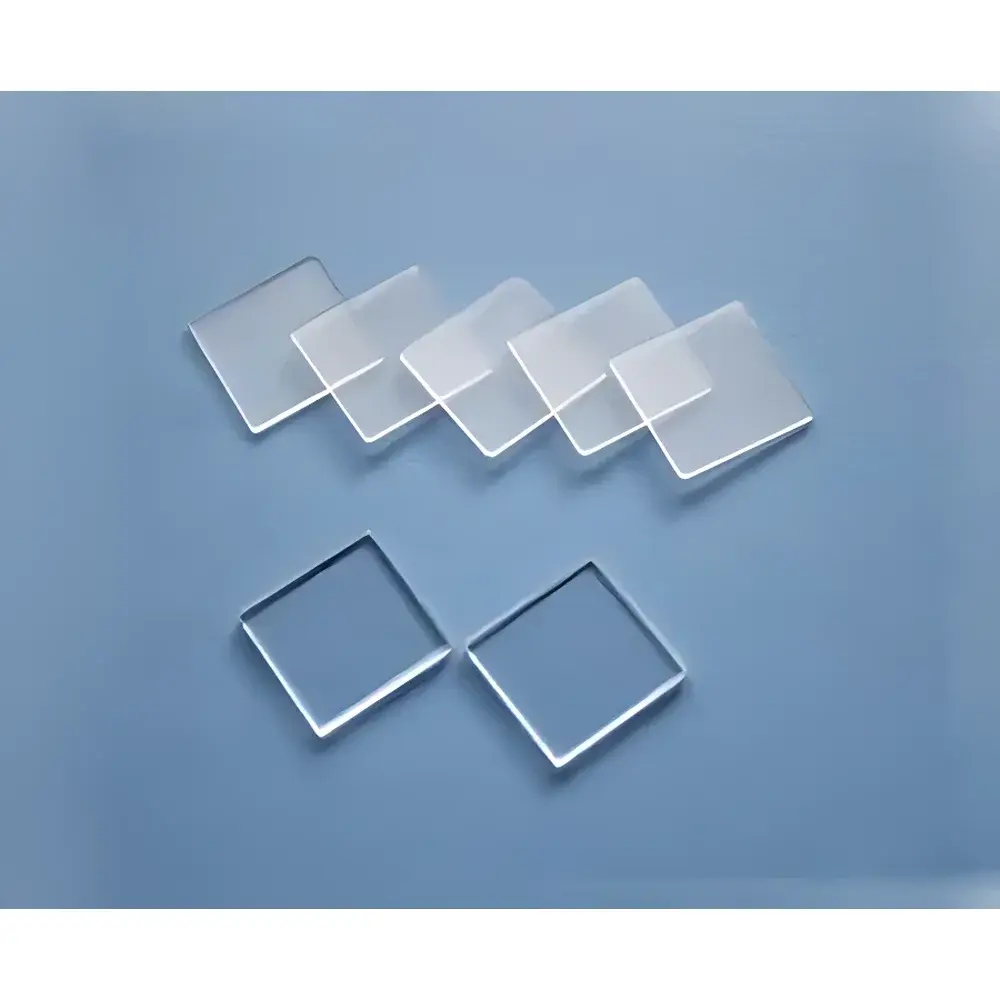
Hefei Kejing CaCO₃ Calcite Crystal Substrates are high-purity, naturally sourced calcite (CaCO₃) optical substrates engineered for precision polarization optics and broadband birefringent applications. As a negative uniaxial crystal with large natural birefringence (Δn ≈ −0.17), calcite exhibits distinct ordinary (n₀) and extraordinary (nₑ) refractive indices across the visible and near-infrared spectrum (350–2300 nm). Its trigonal crystal structure (space group R3̄c) enables robust angular dispersion control and high extinction ratio in polarizing beam splitters, waveplates, and optical isolators. Unlike synthetic alternatives, naturally grown calcite offers superior homogeneity and low intrinsic scattering—critical for interferometric stability and high-fidelity polarization state manipulation. These substrates are not consumables but foundational optical elements intended for integration into OEM systems, research-grade spectrometers, and metrology platforms requiring deterministic phase retardation and minimal depolarization.
Key Features
- Naturally grown calcite crystals selected for low defect density, uniform birefringence, and minimal strain-induced birefringence gradients
- Precision-cut with optical axis orientation accuracy within ±0.5°, verified via conoscopic interference and X-ray Laue diffraction
- Surface finish meets ISO 10110-7 standards: 20/10 scratch-dig, λ/4 flatness @ 632.8 nm, and transmitted wavefront distortion < λ/2
- Low surface roughness (Ra < 0.5 nm) ensures minimal scatter loss in high-numerical-aperture optical trains
- Optional broadband anti-reflection (BBAR) coating applied via ion-assisted e-beam evaporation, achieving average reflectance < 0.5% across 400–2000 nm
- Rigorous metrological traceability: each batch includes certificate of conformance with measured n₀/nₑ at 633 nm and 1300 nm, orientation angle, and transmission spectra
Sample Compatibility & Compliance
These substrates are compatible with standard optical mounting fixtures (e.g., kinematic mounts, prism housings) and withstand vacuum environments up to 10⁻⁶ Torr without outgassing or coating delamination. They comply with ISO 14644-1 Class 5 cleanroom handling protocols during final packaging. While calcite is chemically stable in ambient dry air, prolonged exposure to acidic vapors or high-humidity environments (>60% RH) may induce surface etching; therefore, storage in desiccated, nitrogen-purged enclosures is recommended for long-term stability. No RoHS or REACH exemptions apply—the material contains no restricted substances. For regulated instrumentation (e.g., medical laser delivery systems or aerospace EO/IR sensors), full material declarations and batch-specific test reports are available upon request to support GLP/GMP documentation requirements.
Software & Data Management
No embedded firmware or proprietary software is associated with these passive optical components. However, Kejing provides downloadable technical documentation including Sellmeier coefficient datasets (n₀² and nₑ² as functions of wavelength), orientation tolerance maps, and spectral transmission curves in CSV and MATLAB .mat formats. These files integrate directly into optical design software (e.g., Zemax OpticStudio, CODE V, FRED) for accurate ray tracing and polarization modeling. Traceable calibration data—including measured birefringence vs. temperature (−20°C to +60°C) and humidity-dependent transmission shifts—is archived for five years and accessible under NDA for qualified customers engaged in system-level qualification.
Applications
- High-extinction-ratio Glan-type polarizers and Wollaston beam splitters for ellipsometry and quantum optics
- Zero-order and multiple-order waveplates operating from 405 nm to 2000 nm
- Reference standards for birefringence calibration in automated polarimetric imaging systems
- Substrates for thin-film deposition of dielectric or metallic polarization-selective coatings
- Optical delay lines and path-length-matched interferometer arms requiring phase-stable birefringent compensation
- Teaching and research kits in advanced optics laboratories covering Jones calculus, Mueller matrix analysis, and crystal optics theory
FAQ
What is the maximum usable aperture for a 2″ × 2″ × 1.2 mm substrate?
The clear aperture is defined as ≥90% of the nominal dimension; for the 2″ variant, this corresponds to ≥48.3 mm diameter centered on the geometric axis.
Can these substrates be coated with custom wavelength-specific AR or HR layers?
Yes—Kejing collaborates with certified thin-film vendors to apply custom coatings (e.g., 1064 nm HR, 1550 nm AR) using IAD or magnetron sputtering; lead time extends by 10–14 working days.
Is thermal drift of the optical axis characterized over temperature?
Yes—orientation shift is ≤0.008°/°C between 20–50°C, validated via thermal-cycle interferometry per ISO 10110-5 Annex B.
Do you provide certificates of conformance with NIST-traceable refractive index measurements?
Each shipment includes a test report with n₀/nₑ measured at two wavelengths using a calibrated prism coupler; NIST-traceable calibration is available as an add-on service.
Are larger dimensions (e.g., 3″ × 3″) available?
Standard offerings cap at 2″ × 2″; larger sizes require custom crystal growth and are subject to feasibility review based on natural crystal availability and yield constraints.