
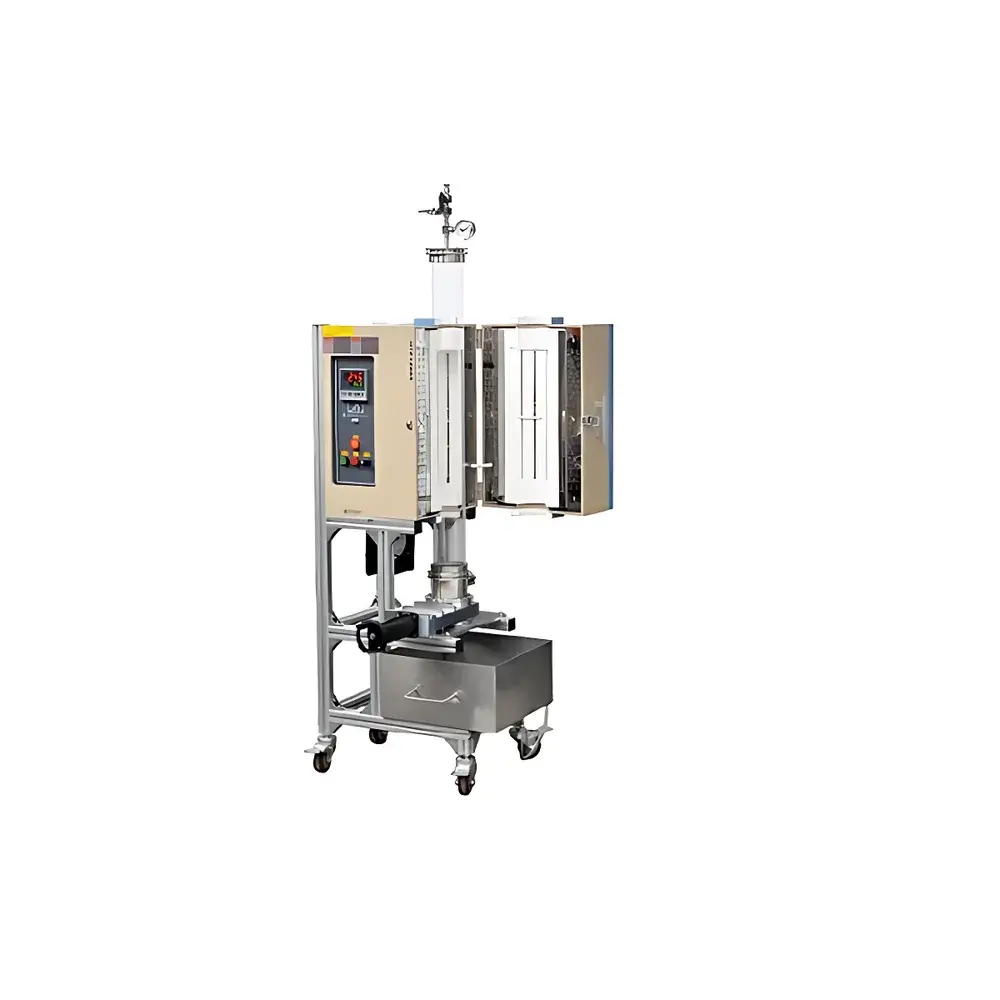
OTF-1200X-4-VTQ Vertical Vacuum Tube Quenching Furnace by合肥科晶 (Hefei Kejing)
| Key | Max Temp: 1200°C (<1 hr) |
|---|---|
| Temp Control Accuracy | ±1°C |
| Heating Rate | ≤20°C/min (recommended ≤10°C/min) |
| Heating Zone Length | 40 mm |
| Uniform Temp Zone | 150 mm (±1°C) |
| Tube Dimensions | OD 100 mm × ID 94 mm × L 1450 mm |
| Power | 3 kW |
| Voltage | AC 208–240 V, 1-phase, 50/60 Hz |
| Vacuum Level | ≤0.05 Torr (pump-dependent) |
| Net Weight | ~85 kg |
| External Dimensions | 660 L × 400 W × 1450 H mm |
| Heating Element | Mo-doped Fe-Cr-Al alloy with ZrO₂ coating |
| Cooling Medium Compatibility | Liquid nitrogen, ice water, or quenching oil |
| Compliance | CE, UL/MET/CSA (for components >24 V), optional TÜV or CSA single-unit certification |
Overview
The OTF-1200X-4-VTQ is a vertically oriented, vacuum-capable tube furnace engineered for controlled rapid thermal quenching of solid-state materials under inert or reduced-pressure atmospheres. Unlike conventional horizontal tube furnaces, its vertical architecture integrates a pneumatically actuated gate valve and a dedicated liquid quench chamber—enabling reproducible, contamination-free drop-quenching of samples directly from high-temperature zones into cryogenic or thermally conductive media (e.g., ice-water baths, silicone oil, or liquid nitrogen). The system operates on the principle of transient thermal gradient imposition: a sample suspended at the center of the uniform temperature zone (150 mm, ±1°C) is heated to up to 1200°C, then rapidly lowered through a sealed quartz tube (OD 100 mm, ID 94 mm, L 1450 mm) into a pre-conditioned quench vessel. This process facilitates precise kinetic arrest of metastable phases, enabling systematic investigation of solid-state phase transformations, martensitic transitions, glass formation, and microstructural evolution in alloys, ceramics, and functional oxides.
Key Features
- Vertical dual-zone design with integrated gate valve (CF-100 compatible) and detachable 400 × 400 × 200 mm stainless steel quench container
- Mo-doped Fe-Cr-Al heating elements coated with ZrO₂ ceramic for extended service life and resistance to thermal cycling degradation
- 30-segment programmable temperature controller with PID auto-tuning, ramp/soak profiling, and independent control of heating and cooling rates
- Double-walled air-cooled outer shell maintaining surface temperature <65°C during continuous operation at 1100°C
- K-type thermocouple feedback with RS485 interface; optional PC-based data logging software supports real-time curve export and audit-trail-compliant record storage
- Comprehensive safety architecture: over-temperature cutoff, thermocouple break detection, audible/visual alarm, and fail-safe power interruption
Sample Compatibility & Compliance
The furnace accommodates crucibles, rods, pellets, and thin-film substrates up to Ø25 mm × 50 mm in height. Quartz tube compatibility ensures chemical inertness for oxide, nitride, and fluoride-based samples; optional alumina or molybdenum tubes are available for reducing or high-vacuum applications. All electrical subsystems (>24 V) comply with UL 61010-1, MET, and CSA C22.2 No. 61010-1 standards. The system carries CE marking per EU Machinery Directive 2006/42/EC and Electromagnetic Compatibility Directive 2014/30/EU. Upon client request—and subject to third-party test fees—the unit can be certified to TÜV Rheinland’s EN 61000-6-2/-4 or CSA C22.2 No. 61010-1 for use in GLP-regulated laboratories or ISO 17025-accredited testing facilities.
Software & Data Management
The embedded controller supports full 30-step thermal programs with user-defined ramp rates (0.1–20°C/min), dwell times (1 s–99 h 59 min), and cooling profiles. Optional RS485-to-USB interface modules enable bidirectional communication with Windows-based control software, permitting remote parameter adjustment, live temperature graphing, and CSV-formatted export of time-temperature datasets. All thermal events—including setpoint changes, alarm triggers, and power interruptions—are timestamped and stored locally for ≥30 days. When configured with audit trail firmware (optional upgrade), the system meets FDA 21 CFR Part 11 requirements for electronic records and signatures in regulated environments.
Applications
- Phase transformation kinetics studies (e.g., austenite → martensite, perovskite → brownmillerite)
- Thermal shock resistance evaluation of ceramic coatings and refractory composites
- Quench-induced amorphization of intermetallics and chalcogenide glasses
- Controlled synthesis of metastable nanocrystalline phases via rapid solidification
- Heat treatment protocol development for additive manufacturing feedstock powders
- Calibration reference generation for differential scanning calorimetry (DSC) and thermogravimetric analysis (TGA)
FAQ
What vacuum level can the system achieve?
With a standard two-stage rotary vane pump, the base pressure reaches ≤0.05 Torr. For lower pressures (≤1×10⁻³ Torr), a turbomolecular pump package is available as an add-on option.
Can the furnace operate under inert gas flow instead of vacuum?
Yes—the flanged quartz tube assembly supports continuous purge with Ar, N₂, or forming gas (5% H₂/95% N₂) at adjustable flow rates (0–2 L/min) using mass flow controllers.
Is the quench container compatible with liquid nitrogen?
Yes, but direct LN₂ immersion requires optional cryo-rated O-rings (Viton not recommended; Kalrez® or metal-CF seals advised) and pre-chilling of the chamber to avoid thermal shock cracking.
How is temperature uniformity validated across the 150 mm hot zone?
Uniformity is verified per ASTM E220 using three calibrated K-type thermocouples positioned at center, +75 mm, and –75 mm along the tube axis under steady-state conditions at 1100°C.
What maintenance intervals are recommended for critical consumables?
Quartz tube inspection every 200 thermal cycles; Al₂O₃ furnace plugs every 500 cycles; O-rings replaced annually or after any vacuum leak detection; heating elements typically last >3000 hours at ≤1100°C continuous operation.



